
Top EV Jobs in India’s Expanding EV and Clean-Tech Sector
Published: Oct 7, 2026
Key Points
- India's rapidly growing sustainable energy sector is creating thousands of high-paying EV jobs across engineering, manufacturing, and supply chain functions in 2026.
- High-growth segments like battery manufacturing and EV charging infrastructure are projecting compound annual growth rates exceeding 60% through 2026.
- Core engineering roles—such as Battery Engineers and Powertrain Specialists—command top compensation packages ranging up to ₹60 LPA for senior specialists.
- Top employers actively recruiting talent include established automotive OEMs, pure-play EV startups, and renewable energy conglomerates.
- Bridging the industry talent gap requires professionals to combine deep technical specialization with strategic market knowledge and cross-functional adaptability.
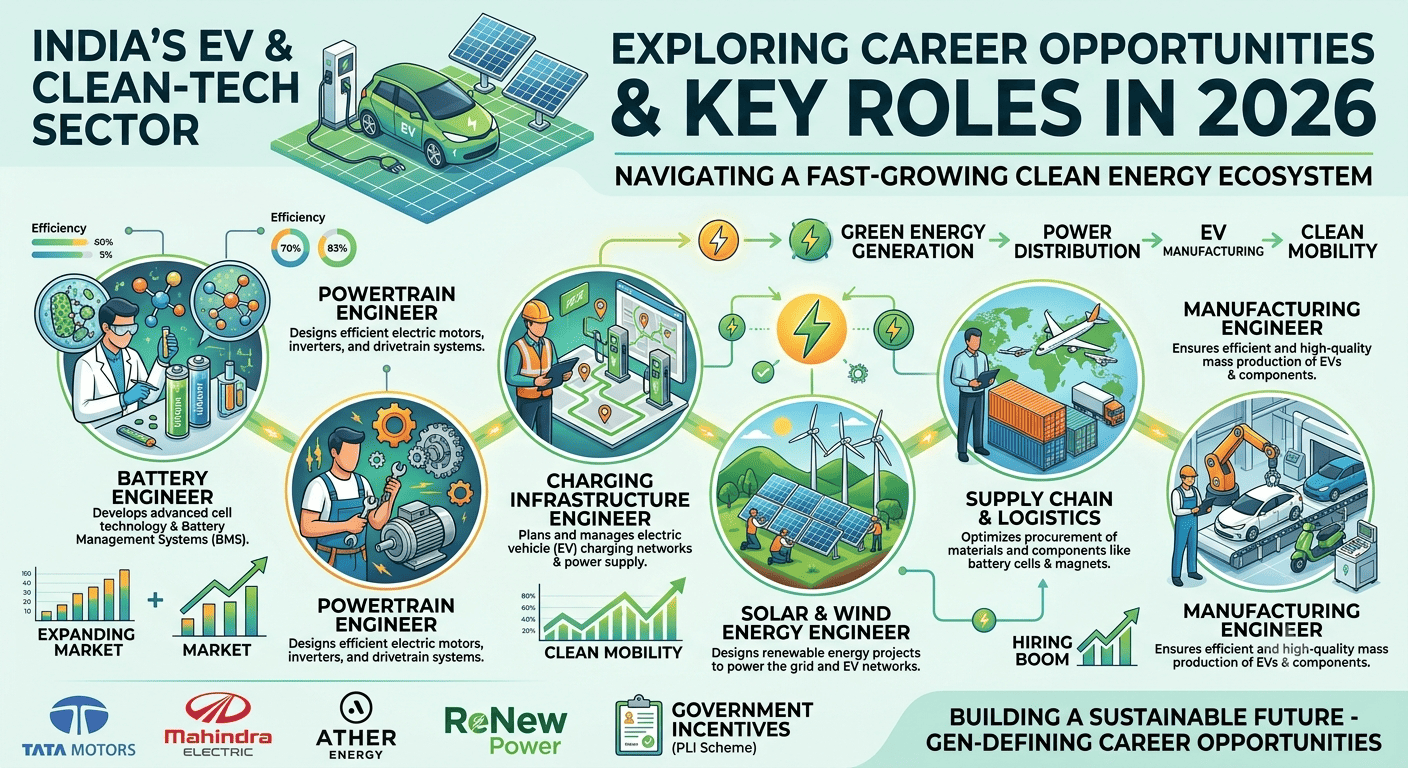
Navigating Career Opportunities in the World’s Fastest-Growing Clean Energy Ecosystem
EV and Renewable-Energy Companies Ramping Up Hiring Across Engineering and Operations Roles in 2026
Introduction: India’s Clean-Tech Revolution
India stands at the precipice of a transformative energy revolution. With ambitious targets to achieve 500 GW of renewable energy capacity by 2030 and dramatically accelerate electric vehicle adoption, the nation’s clean-tech sector has emerged as one of the world’s most dynamic and opportunity-rich industries. This expansion isn’t merely environmental policy—it represents one of the largest employment booms India has witnessed in recent years.
In 2026, India’s EV and clean-tech sectors are experiencing unprecedented hiring across all experience levels. From entry-level engineering positions to C-suite executive roles, organizations are racing to build the talent infrastructure needed to support their rapid expansion. Companies like Tata Motors, Mahindra Electric, Ather Energy, NTPC, ReNew Power, and dozens of emerging startups are collectively recruiting thousands of professionals across engineering, manufacturing, operations, supply chain, and business development functions.
For career-minded professionals—whether freshers or experienced specialists—the EV and clean-tech sector represents an extraordinary convergence of economic opportunity, technological innovation, and environmental impact. This comprehensive guide explores the top jobs, essential skills, compensation structures, and career pathways in this rapidly expanding ecosystem.
The Market Context: Why India’s EV and Clean-Tech Sector Is Booming
Understanding the structural drivers behind India’s clean-tech boom is essential for appreciating the scale of employment opportunities:
Government Policy and Incentives
The Indian government has implemented aggressive policy frameworks to accelerate clean-tech adoption. The Production-Linked Incentive (PLI) scheme offers substantial subsidies to EV manufacturers and battery makers. The Faster Adoption and Manufacturing of Electric Vehicles in India (FAME) scheme provides direct subsidies to EV consumers, driving demand. Additionally, renewable energy targets mandated at the state and central level create guaranteed demand for clean-energy infrastructure.
Market Demand and Domestic Consumption
India’s urban centers are grappling with severe air quality challenges, creating compelling demand for EVs and clean energy solutions. Major cities like Delhi, Mumbai, and Bangalore are becoming increasingly pro-EV, with state governments implementing stricter emission standards and offering additional incentives. Simultaneously, India’s energy demand is projected to double by 2040, and renewables are increasingly viewed as the most economical path to meeting this growth.
Global Supply Chain Reorganization
Following supply chain disruptions and geopolitical tensions, multinational companies are diversifying manufacturing away from China and Southeast Asia. India, with its large skilled workforce, favorable demographics, and policy support, has become an attractive alternative. Leading global battery manufacturers and EV components suppliers are establishing manufacturing hubs in India, each creating thousands of jobs.
EV and Clean-Tech Sector Size and Growth Trajectory
The numbers tell a compelling story about the scale of opportunity:
-
Electric Vehicles: The electric vehicle market is projected to grow from $8.2 billion in 2024 to $16.5 billion in 2026, representing a compound annual growth rate (CAGR) of 41.5%.
-
Battery Manufacturing: The battery manufacturing sector is expanding at a CAGR of 67.2%, increasing from $3.1 billion in 2024 to an estimated $8.7 billion in 2026.
-
Renewable Energy: The renewable energy segment is expected to rise from $18.5 billion in 2024 to $28.3 billion in 2026, registering a CAGR of 24.3%.
-
EV Charging Infrastructure: EV charging infrastructure is growing at a CAGR of 72.8%, climbing from $0.8 billion in 2024 to a projected $2.4 billion in 2026.
-
Energy Storage Solutions: The energy storage solutions market shows the highest expansion rate at a CAGR of 77.6%, surging from $1.2 billion in 2024 to $3.8 billion in 2026.
These growth rates—with some segments exceeding 70% CAGR—reflect the extraordinary expansion happening in real time. This growth directly translates to massive job creation across the entire value chain.
Top Jobs in India’s EV and Clean-Tech Sector
1. Battery Engineer / Electrochemist
Batteries are the heart of the EV revolution. Battery engineers and electrochemists are among the most sought-after professionals, working on cell design, chemistry optimization, thermal management, and battery pack integration.
Key responsibilities:
• Design and optimize lithium-ion battery chemistry and cell architectures
• Develop battery management systems and thermal management solutions
• Conduct durability testing and validate battery performance across temperature ranges
• Collaborate on solid-state battery development and next-generation energy storage
Required skills:
Advanced degree in electrochemistry or materials science, lithium-ion chemistry expertise, familiarity with MATLAB/Simulink, knowledge of battery testing protocols
Salary range:
₹18-30 LPA for mid-career professionals; ₹40-60 LPA for senior specialists with 7+ years experience
2. Powertrain Engineer (Electric Motors and Drivetrains)
Converting electrical energy from batteries into mechanical motion requires sophisticated engineering. Powertrain engineers design electric motors, inverters, gearboxes, and drivetrain systems that convert EV battery power into wheel rotation.
Key responsibilities:
• Design motor and inverter architectures for optimal efficiency and performance
• Develop regenerative braking systems and power distribution strategies
• Conduct finite element analysis (FEA) simulations on motor designs
• Optimize power electronics and thermal management for drivetrains
Required skills:
B.Tech in Electrical/Mechanical Engineering, expertise in motor design and power electronics, ANSYS/FEA software, embedded systems knowledge
Salary range:
₹16-28 LPA for engineers with 3-5 years experience; ₹35-55 LPA for principal engineers
3. EV Charging Infrastructure Engineer
The EV Jobs ecosystem requires comprehensive charging networks. Infrastructure engineers design charging stations, power distribution systems, and smart charging management solutions that optimize energy flow and grid stability.
Key responsibilities:
• Design AC and DC fast-charging station architectures
• Develop grid integration and smart charging management systems
• Plan charging network expansion strategies and site selection
• Manage integration with renewable energy sources for green charging
Required skills:
Electrical engineering background, power systems knowledge, IoT and connectivity expertise, charging protocol standards (CCS, CHAdeMO, GB/T)
Salary range:
₹15-24 LPA for mid-career engineers; ₹32-48 LPA for senior infrastructure architects
4. Supply Chain and Procurement Specialist
EV manufacturing requires complex global supply chains for sourcing batteries, semiconductors, rare earth materials, and specialized components. Supply chain professionals ensure reliable sourcing while managing costs and navigating geopolitical complexities.
Key responsibilities:
• Source and negotiate contracts for batteries, semiconductors, and critical materials
• Develop supplier relationships and manage quality across global networks
• Optimize inventory and logistics for just-in-time manufacturing
• Manage supply chain risks including geopolitical tensions and material availability
Required skills:
Supply chain management background, negotiation expertise, global sourcing knowledge, ERP systems proficiency (SAP, Oracle), supplier quality management
Salary range:
₹14-22 LPA for specialists with 3-5 years experience; ₹28-45 LPA for senior procurement directors
5. Manufacturing Engineer / Production Manager
Scaling EV production from concept to mass manufacturing requires sophisticated manufacturing expertise. Engineers optimize production processes, implement automation, ensure quality, and achieve cost targets.
Key responsibilities:
• Optimize manufacturing processes for efficiency, quality, and cost reduction
• Implement lean manufacturing and Six Sigma methodologies
• Design and manage production line layouts and automation
• Ensure compliance with quality standards and regulatory requirements
Required skills:
Manufacturing engineering degree, lean and Six Sigma certification, CAD/CAM proficiency, production planning expertise, quality management systems
Salary range:
₹12-20 LPA for engineers; ₹25-40 LPA for production managers and plant heads
6. Solar/Wind Energy Engineer
Renewable energy is the complement to EVs in India’s clean-tech ecosystem. Solar and wind engineers design, install, and optimize renewable energy systems that power EV charging networks and meet grid-scale energy demands.
Key responsibilities:
• Design solar PV arrays and wind turbine installations
• Conduct site assessment and resource analysis for optimal energy generation
• Manage grid integration and energy storage systems
• Monitor and optimize operational performance of renewable installations
Required skills:
Renewable energy engineering background, solar/wind resource assessment, power systems knowledge, PVTOOLS or similar software, grid integration expertise
Salary range:
₹13-22 LPA for mid-career professionals; ₹30-48 LPA for senior project developers
7. Business Development and Sales Executive
With explosive market growth, companies need aggressive sales and business development teams to capture market share. These professionals identify customer segments, close deals, and expand market presence.
Key responsibilities:
• Identify and develop new market opportunities and customer segments
• Build relationships with fleet operators, corporate buyers, and government agencies
• Negotiate commercial terms and close high-value contracts
• Develop go-to-market strategies for new products and services
Required skills:
Sales and business development background, relationship building, sector knowledge (automotive, energy, fleet management), negotiation expertise, CRM proficiency
Salary range:
₹12-20 LPA base + performance bonus (20-40% of base); ₹25-50 LPA total compensation for senior executives
Comprehensive Job Roles Overview
Here’s a consolidated view of in-demand roles across the EV and clean-tech sector:
-
Battery Engineer: Requires 3 to 7 years of experience and commands a salary range of ₹18–60 LPA with Very High hiring intensity from top employers including BYD, CATL (India), and Reliance Jio.
-
Powertrain Engineer: Candidates need 2 to 8 years of experience for roles offering ₹16–55 LPA, seeing Very High hiring intensity led by companies like Tata Motors, Mahindra Electric, and Ather.
-
Charging Infrastructure Engineer: Involves 2 to 6 years of experience with a compensation bracket of ₹15–48 LPA under High hiring intensity from recruiters such as ChargeZone, Sun Mobility, and Statiq.
-
Supply Chain Specialist: Demands 3 to 9 years of experience and pays between ₹14–45 LPA, experiencing High hiring intensity from major firms including Tata Motors, Reliance, and Hyundai.
-
Manufacturing/Production Manager: Requires 2 to 10 years of experience with salary ranges spanning ₹12–40 LPA, witnessing High hiring intensity across all major OEMs and Tier-1 suppliers.
-
Solar/Wind Engineer: Needs 2 to 7 years of experience for packages of ₹13–48 LPA, driven by Very High hiring intensity from top energy players like ReNew Power, NTPC, and Adani Green.
-
Business Development Executive: Mandates 2 to 8 years of experience offering ₹12–50 LPA, maintained at High hiring intensity across all sector companies.
Key Employers in India’s EV and Clean-Tech Sector
Understanding major employers helps job seekers identify target companies:
Traditional Automotive OEMs Transitioning to EVs
• Tata Motors: Producing Nexon EV, Tigor EV; expanding battery assembly and battery management systems
• Mahindra & Mahindra: XUV 400 and eKUV100 production; significant hiring in battery technology and drivetrains
• Hyundai India: Kona Electric and Ioniq 5 manufacturing; tech center hiring for next-generation platforms
• Maruti Suzuki: Developing EV lineup; partnership with Toyota for battery technology
Pure-Play EV Startups
• Ather Energy: High-performance electric scooters; aggressively hiring in powertrain, battery, and software engineering
• Bajaj Auto (KTM/Husqvarna): Electric two-wheeler and motorcycle development
• Evara Technologies: Commercial EV solutions for logistics and delivery
Battery and Energy Storage Companies
• Reliance Industries: Battery manufacturing through Reliance Industries Limited, supply chain for EV ecosystem
• BYD India: Battery production and EV manufacturing; hiring battery chemists and manufacturing engineers
• Exicom: Energy storage solutions and power conditioning systems
Renewable Energy and Grid Integration
• ReNew Power: Solar, wind, and hydro projects; energy storage development
• NTPC: Transitioning traditional power to renewable energy; hiring energy engineers and sustainability specialists
• Adani Green Energy: Large-scale solar and wind operations across India
Essential Skills and Qualifications
To succeed in EV and clean-tech careers, professionals need a combination of technical expertise, industry knowledge, and adaptive capabilities:
Technical Competencies
• Advanced degree in Engineering (Electrical, Mechanical, Chemical, Materials Science) from recognized institutions
• Specialized knowledge in lithium-ion chemistry, power electronics, or renewable energy systems
• Proficiency with CAD/CAM software (CATIA, SOLIDWORKS), simulation tools (ANSYS, MATLAB), and programming languages (Python, C++)
• Understanding of automotive and energy industry standards and regulations
Industry-Specific Knowledge
• Battery technology and energy density metrics (kWh/kg, cycle life, round-trip efficiency)
• EV architecture, particularly understanding how battery packs, motors, and power electronics integrate
• Grid integration, smart metering, and demand-response mechanisms for renewable energy
• Supply chain complexities including rare earth materials, semiconductor availability, and lithium sourcing
Soft Skills and Adaptability
• Problem-solving in rapidly evolving technological landscapes
• Cross-functional collaboration between hardware, software, and manufacturing teams
• Communication skills to translate technical concepts for diverse stakeholders
• Continuous learning mindset, given rapid technological evolution in batteries and renewable energy
Career Progression and Growth Trajectory
Career progression in EV and clean-tech follows a relatively clear trajectory:
Entry-Level (0-2 years): Graduate Engineer / Associate
• Salary: ₹5-9 LPA
• Responsibilities: Learning technical skills, working on defined components, assisting senior engineers
Mid-Career (2-6 years): Senior Engineer / Specialist
• Salary: ₹12-25 LPA
• Responsibilities: Lead projects, mentor juniors, drive technical innovations, interact with cross-functional teams
Advanced Career (6-10+ years): Principal Engineer / Tech Lead / Project Manager
• Salary: ₹30-60 LPA
• Responsibilities: Strategic technology direction, managing large teams, setting organizational standards, managing P&L
Executive Level (10+ years): Director of Engineering / VP / CTO
• Salary: ₹60-150+ LPA
• Responsibilities: Leading divisions, setting corporate strategy, building organizational culture, board-level reporting
Employment Forecast: Jobs Being Created Right Now
The employment impact of India’s EV Jobs and clean-tech expansion is quantifiable and enormous:
-
Battery & Chemistry: Accounted for 18,500 jobs created between 2024–2026 and is projected to add 32,000 jobs from 2026–2028 under Critical demand intensity.
-
Powertrain & Motors: Generated 22,000 jobs from 2024–2026, with a projected expansion of 38,000 jobs during 2026–2028 under Critical demand intensity.
-
Manufacturing & Operations: Led direct hiring with 35,000 jobs created between 2024–2026, projected to grow by 58,000 jobs from 2026–2028 with High demand intensity.
-
Supply Chain & Logistics: Created 16,000 jobs from 2024–2026 and is forecasted to generate 28,000 jobs between 2026–2028 under High demand intensity.
-
Charging Infrastructure: Added 8,500 jobs during 2024–2026, with projections estimating 18,000 jobs created from 2026–2028 under High demand intensity.
-
Renewable Energy: Contributed 28,000 jobs created between 2024–2026, projected to jump by 52,000 jobs during 2026–2028 under Critical demand intensity.
-
Total Sector Impact: Overall direct job creation rose to 128,000 jobs (2024–2026) and is projected to reach 226,000 jobs (2026–2028), reflecting a total growth rate of 76.6%.
These figures represent direct employment. When accounting for indirect jobs in supporting industries, the total employment impact exceeds 300,000 positions over this two-year period.
Strategies for Landing Top EV Jobs and Clean-Tech Jobs
1. Build Deep Technical Expertise
Pursue specialized certifications in battery technology, power electronics, or renewable energy. Platforms like Coursera, edX, and specialized institutes offer courses in lithium-ion chemistry, motor design, and grid integration. Practical experience through internships at EV manufacturers or renewable energy companies is invaluable.
2. Develop a Track Record of Project Work
Contribute to open-source EV or renewable energy projects. Build prototype EV components or solar systems. Employers value demonstrated ability to execute complex projects under constraints.
3. Network Strategically with Industry Leaders
Attend EV and renewable energy industry conferences. Join professional associations like IEEE Power & Energy Society or industry groups focused on e-mobility. Many positions are filled through referrals before public posting.
4. Demonstrate Understanding of Market Dynamics
Employers value candidates who understand supply chain complexities, regulatory landscapes, and competitive dynamics. Read industry reports, follow market trends, and articulate how technological innovations create value.
5. Highlight Cross-Functional Capabilities
EV and clean-tech success requires collaboration across domains. Candidates who can speak fluently about technical, commercial, and operational dimensions stand out. Showcase projects where you bridged engineering and business perspectives.
The Future: What Lies Ahead for EV and Clean-Tech Careers
Looking beyond 2026, several trends will shape EV and clean-tech careers:
Solid-State Batteries:
Next-generation battery technologies promise higher energy density and faster charging. Engineers specializing in solid-state chemistry and manufacturing will command premium compensation.
Vehicle-to-Grid (V2G) Integration:
As EVs become storage devices for the grid, professionals who understand grid dynamics, vehicle integration, and smart metering will be increasingly valuable.
Autonomous EV Systems:
The convergence of EVs and autonomous vehicles creates demand for professionals who understand both powertrains and autonomous decision systems.
Sustainability and Circular Economy:
Recycling EV batteries and developing sustainable manufacturing processes will create new specializations and career paths.
Conclusion: A Generation-Defining Career Opportunity
India’s EV and clean-tech sectors represent far more than economic opportunity. They embody a commitment to sustainable development and environmental stewardship. For professionals, this creates a unique confluence: the chance to build rewarding careers while contributing to a cleaner planet.
The employment boom in these sectors is just beginning. Companies are racing to build capacity, and the talent gap is acute. Whether you’re a fresh engineering graduate seeking your first role or an experienced professional pivoting careers, the EV and clean-tech ecosystem offers compelling opportunities with competitive compensation, meaningful work, and genuine potential for leadership.
The future of mobility and energy is being written now. The professionals who build that future—through battery innovations, manufacturing excellence, grid integration, and supply chain optimization—will shape not just their own careers but the world their children inherit.
The question is not whether there will be EV and clean-tech jobs. The question is whether you’ll be ready when opportunity knocks. Start building your expertise today. The future is electric—and it’s hiring.
Frequently Asked Questions
1: What high-paying EV jobs are available in India’s EV jobs market within the clean-tech sector?
The top high-paying EV jobs include Battery Engineers, Powertrain Specialists, and Infrastructure Architects driving growth in the clean-tech sector.
2: Why is hiring accelerating for EV jobs across the national clean-tech sector and EV jobs landscape?
Driven by PLI schemes, government subsidies, and global supply chain shifts, EV jobs are growing rapidly across the expanding clean-tech sector.
3: What qualifications are needed to secure top EV jobs in the clean-tech sector for EV jobs applicants?
Most EV jobs require specialized engineering degrees, power electronics knowledge, and technical skills tailored for the clean-tech sector.
4: Which leading companies are currently offering EV jobs in the clean-tech sector and listing new EV jobs?
Top organizations offering EV jobs include Tata Motors, Ather Energy, Reliance Industries, and NTPC within the clean-tech sector.
5: What salary can mid-career professionals expect from EV jobs in the clean-tech sector when applying for EV jobs?
Mid-career specialists securing EV jobs earn between ₹14 LPA and ₹30 LPA across various functions in the clean-tech sector.
6: How does battery manufacturing expansion boost EV jobs in the clean-tech sector for EV jobs seekers?
Rapid growth in battery manufacturing creates huge demand for electrochemists and quality managers in EV jobs across the clean-tech sector.
7: Are entry-level engineering graduates eligible for EV jobs in the clean-tech sector to start their EV jobs career?
Yes, fresh graduates can enter EV jobs with starting packages ranging from ₹5 to ₹9 LPA in the clean-tech sector.
8: How do renewable energy targets drive EV jobs in the clean-tech sector and expand EV jobs capacity?
National targets for 500 GW of renewable capacity directly create complementary EV jobs throughout the clean-tech sector.
9: What soft skills enhance candidate prospects for EV jobs in the clean-tech sector when competing for EV jobs?
Cross-functional collaboration, rapid problem-solving, and continuous learning significantly improve success in securing EV jobs in the clean-tech sector.
10: What long-term growth is projected for EV jobs in the clean-tech sector for future EV jobs expansion?
Direct hiring for EV jobs is projected to exceed 226,000 open roles by 2028 across the clean-tech sector.
Citations & References
[1] International Energy Agency (IEA), “India 2030: Clean Energy Transition Roadmap,” Paris, 2025. [Online].
Available:
https://www.iea.org/
[2] McKinsey & Company, “India’s Automotive Future: The Global EV Shift,” New Delhi, Jun. 2025. [Online].
Available:
https://www.mckinsey.com/
[3] BloombergNEF, “India Battery Market Outlook 2026: Production, Supply Chain, and Technology Trends,” London, 2026. [Online].
Available:
https://about.bnef.com/
[4] Society of Indian Automobile Manufacturers (SIAM), “Indian Automotive Industry Report 2026,” New Delhi, 2026. [Online].Available:https://www.siam.in/
[5] Ministry of Heavy Industries, “National Mission for Electric and Hybrid Vehicles (NMHEV): Progress Report,” Government of India, New Delhi, 2026. [Online].
Available:
https://heavyindustries.gov.in/
[6] J. L. Zhang, L. Zhang, and Z. Sun, “Advances in Lithium-Ion Battery Technology for Electric Vehicles,” Nature Energy, vol. 10, no. 8, pp. 595–610, Aug. 2025. [Online].
Available:
https://www.nature.com/nenergy/
[7] National Institute of Renewable Energy (NIRE), “India’s Renewable Energy Sector: Skills and Employment Outlook 2026-2030,” Gurgaon, 2026.
[8] World Economic Forum, “Future of Jobs Report: India Edition—Green Economy and EV Sector Transformation,” Geneva, 2025. [Online].
Available:
https://www.weforum.org/
[9] EvePlacement. [Online].
Available:
https://eveplacement.com/
Streamline Your Hiring with Eve Placement
Engage, assess, and recruit top talent through tailored AI hiring challenges that go beyond resumes. Ready to hire better? Contact our research team for a custom consultation.