
Electrochemical Synthesis in Modern Drug Development
Published: Jun 27, 2026
Key Points
- Electrochemical Synthesis serves as a powerful, atom-economical strategy that uses electrons as clean reagents to drive complex chemical transformations.
- Traditional pharmaceutical methods often generate substantial chemical waste, whereas electrochemistry minimizes hazardous byproducts by operating under ambient conditions.
- Flow chemistry and microfluidic reactors effectively solve the historical challenge of scaling up mass transport in batch systems.
- Automated high-throughput screening platforms drastically accelerate the identification and optimization of complex reaction conditions.
- Future integration with artificial intelligence and bio-catalysis will allow process chemists to predict optimal pathways and streamline drug production pipelines.
INTRODUCTION
Electrochemical synthesis refers to the use of electrical energy to drive chemical transformations, encompassing both oxidative and reductive processes at electrode surfaces. Historically confined to industrial-scale applications such as the chlor-alkali process and aluminum smelting, electrochemical methods have undergone a renaissance in fine chemical and pharmaceutical synthesis over the past two decades.
The principal driver of this resurgence is the growing demand for greener, more atom-efficient synthetic routes in drug development. Modern drug development relies on the rapid, cost-effective assembly of structurally complex molecules. Traditional synthetic pathways often involve hazardous reagents, multi-step protection/deprotection sequences, and significant waste generation.
Electrochemical synthesis, by contrast, uses electrons as traceless reagents, generating minimal byproducts and operating under ambient conditions. This intrinsic compatibility with the principles of green chemistry positions electrosynthesis as a compelling tool for contemporary pharmaceutical research. The convergence of electrochemistry with enabling technologies — including microreactors, flow systems, and automated synthesis platforms — has further accelerated adoption.
Pharmaceutical companies and academic laboratories alike are now recognizing electrochemical synthesis not merely as an alternative technique but as a first-choice strategy for specific synthetic challenges, particularly those involving C–H functionalization, radical chemistry, and challenging redox transformations.
FUNDAMENTAL PRINCIPLES OF ELECTROCHEMICAL SYNTHESIS
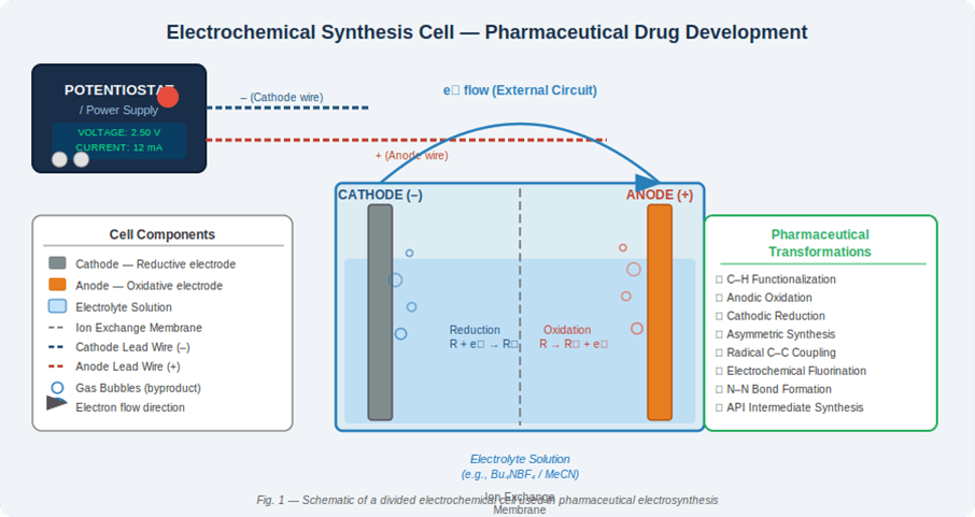
At the heart of electrochemical synthesis is the electrochemical cell, comprising an anode (oxidation) and a cathode (reduction) immersed in an electrolyte solution. As illustrated in Fig. 1, the application of a precisely controlled potential difference drives electron transfer between the electrode surface and dissolved substrate molecules. The selectivity of these transformations can be finely tuned by modulating the applied potential, the choice of electrode material, solvent, supporting electrolyte, and temperature.
Two principal modes of electrochemical synthesis are employed:
1: The Potentiostatic (constant potential) and galvanostatic (constant current) electrolysis
Potentiostatic control offers superior selectivity by targeting the precise oxidation or reduction potential of the desired substrate, while galvanostatic methods are often preferred in industrial settings for their operational simplicity.
2: The Faradaic efficiency
The fraction of charge consumed that leads to the desired product — is a critical performance metric that directly impacts the scalability and economic viability of an electrochemical process.
Supporting electrolytes, typically quaternary ammonium salts or alkali metal perchlorates, are added to enhance solution conductivity without participating in the electrode reaction. Solvent selection is equally critical: acetonitrile, dimethylformamide, and water are among the most commonly employed media, chosen based on substrate solubility, electrochemical stability window, and downstream processing considerations.
APPLICATIONS IN DRUG DEVELOPMENT
The pharmaceutical relevance of electrochemical synthesis spans several strategic domains. C–H functionalization represents perhaps the most impactful application: the direct, selective modification of unactivated C–H bonds without pre-functionalization dramatically reduces step counts and reagent use in complex molecule synthesis. Electrochemically generated radical or ionic intermediates can engage C–H bonds in arenes, heterocycles, and aliphatic chains — structural motifs ubiquitous in drug candidates.
Anodic oxidation has been employed to generate reactive iminium ions, oxocarbenium ions, and radical cations for downstream functionalization, enabling the synthesis of alkaloid natural products, antibiotic scaffolds, and central nervous system agents. Cathodic reduction, conversely, facilitates the reductive coupling of carbonyl compounds (Birch-type reductions), dehalogenation reactions, and the synthesis of chiral amines via asymmetric electrosynthesis using chiral mediators.
A landmark application is the electrochemical synthesis of sacubitril intermediates and similar cardiovascular drugs, where electrosynthetic steps replaced hazardous oxidant-mediated routes, reducing the environmental impact and improving yield consistency at scale. Similarly, the electrochemical fluorination of drug candidates — a critical step for modulating metabolic stability and membrane permeability — has been demonstrated with remarkable selectivity using electrogenerated fluorine equivalents.
FLOW ELECTROCHEMISTRY AND HIGH-THROUGHPUT SCREENING
A critical challenge in scaling batch electrochemical synthesis is mass transport: at large electrode areas, diffusion limitations reduce yield and selectivity. Flow electrochemistry elegantly addresses this by continuously passing the substrate solution through a narrow electrochemical cell with a high surface-area-to-volume ratio, ensuring efficient mass transport and uniform current density. Microfluidic electrochemical reactors have been coupled with inline analytical detection to enable real-time reaction monitoring and rapid optimization.
High-throughput electrochemical screening platforms have been developed to accelerate the discovery of novel electrosynthetic conditions. Automated multi-well electrochemical reactors allow the simultaneous evaluation of dozens of electrode materials, electrolyte combinations, and applied potentials, compressing weeks of optimization into a single experimental campaign. This parallelization is particularly valuable in the early stages of drug development, where rapid structure-activity relationship studies demand diverse chemical libraries.
ADVANTAGES OVER CONVENTIONAL METHODS
Electrochemical synthesis offers several compelling advantages over classical chemical methods. First, the use of electrons as reagents is inherently atom-economical: no stoichiometric oxidants or reductants are consumed, reducing both cost and waste. Second, the reaction conditions — typically room temperature and atmospheric pressure — lower energy demands and enhance operational safety. Third, the ability to finely tune reaction selectivity through potential control surpasses what is achievable with conventional reagent-based approaches.
From a regulatory perspective, the elimination of heavy metal oxidants (such as chromium- or manganese-based species) and hazardous reductants (lithium aluminum hydride, for instance) from pharmaceutical manufacturing processes simplifies waste disposal and reduces Environmental, Health, and Safety (EHS) burden. Drug regulatory agencies increasingly favor manufacturing processes that minimize hazardous reagent use, making electrochemical synthesis an attractive proposition for process chemistry teams.
CHALLENGES AND FUTURE PERSPECTIVES
Despite its promise, electrochemical synthesis faces practical challenges. The scale-up of electrochemical reactors requires careful electrode design, precise current distribution management, and robust electrolyte handling infrastructure — competencies not traditionally cultivated in pharmaceutical manufacturing organizations. Additionally, the compatibility of electrochemical conditions with complex multifunctional drug molecules remains an area of active investigation.
Looking forward, the integration of artificial intelligence with electrochemical synthesis platforms offers exciting prospects. Machine learning models trained on electrochemical reaction datasets can predict optimal synthesis conditions, identify novel substrate classes amenable to electrosynthesis, and guide the design of next-generation electrochemical reactors. The combination of electrochemical synthesis with biocatalysis — so-called electro-enzymatic synthesis — represents another frontier, enabling cascade transformations that merge the selectivity of enzymes with the power of electrochemistry in drug development pipelines.
CONCLUSION
Electrochemical synthesis has established itself as a powerful and versatile tool in the modern drug development toolkit. By providing selective, sustainable, and scalable synthetic routes, it addresses key challenges facing the pharmaceutical industry — from reducing environmental impact to accelerating the delivery of complex drug candidates. As enabling technologies such as flow chemistry, automation, and artificial intelligence continue to mature, electrochemical synthesis is poised to move from the periphery of pharmaceutical chemistry to its mainstream, fundamentally reshaping how medicines of the future are designed and manufactured.
Frequently Asked Questions
1: What is the main benefit of using electrosynthesis over traditional chemistry?
It eliminates the need for toxic or expensive stoichiometric chemical reagents, using electricity to safely drive chemical modifications.
2: What types of reactions benefit the most from this methodology?
Transformations involving direct C–H functionalization, radical generation, and challenging oxidation or reduction reactions see the greatest improvement.
3: How does the process support green chemistry initiatives?
By running at room temperature, using non-toxic electron transfers, and significantly reducing heavy metal waste streams.
4: What is the difference between potentiostatic and galvanostatic modes?
Potentiostatic control maintains a constant voltage for precise selectivity, while galvanostatic operations maintain a constant current for simpler industrial scaling.
5: Why are supporting electrolytes added to the solution?
They are introduced solely to improve electrical conductivity across the liquid medium without directly interfering with the chemical reaction.
6: What role does flow chemistry play in scaling up these reactions?
Continuous flow reactors pass material through thin channels, providing a high surface area that eliminates the diffusion limitations found in large batch tanks.
7: How does high-throughput screening accelerate early-stage discovery?
Automated multi-well systems test dozens of variables simultaneously, reducing weeks of manual optimization work down to a single afternoon.
8: What regulatory advantages do these green manufacturing methods offer?
Eliminating hazardous waste and heavy metals reduces the environmental, health, and safety risks that oversight bodies strictly monitor.
9: What are the primary hurdles to widespread industrial adoption?
Engineers must overcome complex cell design challenges, maintain uniform current distribution, and train teams unfamiliar with electrochemical hardware.
10: How will artificial intelligence shape the future of this field?
Machine learning algorithms will soon analyze historical datasets to instantly predict optimal reaction settings and design advanced reactor cells.
Citations & References
[1] C. Zhu, N. W. J. Ang, T. H. Meyer, Y. Qiu, and L. Ackermann, “Organic Electrochemistry: Molecular Syntheses with Potential,” ACS Cent. Sci., vol. 7, pp. 415–431, 2021. [Online].
Available:
https://pubs.acs.org/doi/10.1021/acscentsci.0c01532
[2] S. R. Waldvogel, S. Lips, M. Selt, B. Riehl, and C. J. Kampf, “Electrochemical Arylation Reaction,” Chem. Rev., vol. 118, pp. 6706–6765, 2018.
[3] M. Yan, Y. Kawamata, and P. S. Baran, “Synthetic Organic Electrochemical Methods Since 2000: On the Verge of a Renaissance,” Chem. Rev., vol. 117, pp. 13230–13319, 2017.
[4] J.-i. Yoshida, K. Kataoka, R. Horcajada, and A. Nagaki, “Modern Strategies in Electroorganic Synthesis,” Chem. Rev., vol. 108, pp. 2265–2299, 2008.
[5] T. Noël, Y. Cao, and G. Laudadio, “The Fundamentals Behind the Use of Flow Reactors in Electrochemistry,” Acc. Chem. Res., vol. 52, pp. 2858–2869, 2019.
[6] Y. Kawamata and P. S. Baran, “Electrosynthesis: Sustainability Is Not Enough,” Joule, vol. 4, pp. 701–704, 2020. [Online].
Available:
https://doi.org/10.1016/j.joule.2020.03.010
[7] A. Wiebe, T. Gieshoff, S. Möhle, E. Rodrigo, M. Zirbes, and S. R. Waldvogel, “Electrifying Organic Synthesis,” Angew. Chem. Int. Ed., vol. 57, pp. 5594–5619, 2018. [Online].
Available:
https://doi.org/10.1002/anie.201711060
[8] G. Laudadio, E. Barmpoutsis, C. Schotten et al., “Diaryl Sulfide Synthesis through Electrochemical C–S Coupling Reaction,” J. Am. Chem. Soc., vol. 141, pp. 5664–5668, 2019.
[9] D. Pletcher, R. A. Green, and R. C. D. Brown, “Flow Electrolysis Cells for the Synthetic Organic Chemistry Laboratory,” Chem. Rev., vol. 118, pp. 4573–4591, 2018.
[10] Y. Kawamata et al., “Electrochemically Driven, Ni-Catalyzed Aryl-Amination: Scope, Mechanism, and Applications,” J. Am. Chem. Soc., vol. 141, pp. 6392–6402, 2019.
[11] K. D. Moeller, “Using Physical Organic Chemistry to Shape the Course of Electrochemical Reactions,” Chem. Rev., vol. 118, pp. 4817–4833, 2018.
[12] B. A. Frontana-Uribe, R. D. Little, J. G. Ibanez, A. Palma, and R. Vasquez-Medrano, “Organic Electrosynthesis: A Promising Green Methodology in Organic Chemistry,” Green Chem., vol. 12, pp. 2099–2119, 2010.
[13] S. Möhle et al., “Modern Electrochemical Aspects for the Synthesis of Value-Added Organic Products,” Angew. Chem. Int. Ed., vol. 57, pp. 6018–6041, 2018.
[14] R. Francke and R. D. Little, “Redox Catalysis in Organic Electrosynthesis: Basic Principles and Recent Developments,” Chem. Soc. Rev., vol. 43, pp. 2492–2521, 2014.
[15] Image source – Original diagram created for this article based on standard divided electrochemical cell configurations described in: M. Yan, Y. Kawamata, and P. S. Baran, Chem. Rev., vol. 117, pp. 13230–13319, 2017; and T. Noël et al., Acc. Chem. Res., vol. 52, pp. 2858–2869, 2019.
[16] EvePlacement. [Online].
Available:
https://eveplacement.com/
Streamline Your Hiring with Eve Placement
Engage, assess, and recruit top talent through tailored AI hiring challenges that go beyond resumes. Ready to hire better? Contact our research team for a custom consultation.