
The Loneliest Atom in the Lab Is Saving Billions Through Catalyst Design
Published: Jun 21, 2026
Key Points
- Catalyst Design is redefining industrial chemistry by enabling single-atom systems where individual metal atoms perform reactions once requiring large clusters.
- This approach dramatically increases efficiency by ensuring every active site contributes directly to chemical transformation rather than remaining unused within larger structures.
- The shift toward single-atom systems allows reactions to proceed with far lower material input while maintaining or improving performance in demanding industrial environments.
- This is particularly important for industries that rely on scarce high-value metallic elements, where supply risk and cost volatility strongly influence production economics.
- Advanced support materials and atomic-scale engineering are essential to stabilizing isolated atoms and preventing them from aggregating under real-world operating conditions.
- Ongoing research suggests that expanding these approaches to more abundant elemental alternatives could further reshape large-scale chemical manufacturing systems.
Introduction
In some lab, probably underfunded and overworked, someone is solving one of the most expensive materials problems in modern industry. The idea sounds almost too clean. Take a single atom of platinum or palladium. Anchor it to a surface. Watch it do the same chemical work that used to need thousands of atoms bunched together.
That is single atom catalysis and the implications for how industry uses precious metals are greater than most people outside the field realise.
How Single Atom Catalysts Are Reducing Precious Metal Usage in Industry
Every industrial chemical process needs something to make it go. Not in a vague sense but in a very specific way, without this the reaction either does not happen or takes so long it becomes a commercially useless sense. That something is a catalyst. It does not get used up. It just makes things work faster and more selectively. Oil refining needs it. Drug manufacturing needs it.
Car emissions systems need it. Fertiliser production needs it. The list goes on longer than most people could ever imagine or expect. For most of industrial history, the metals that did this job best were the expensive ones. Platinum, palladium, rhodium, ruthenium. The kind of metals where a price movement of a few percent in either direction shows up immediately in a manufacturer’s cost model.
They work brilliantly, but they come from the ground in very small quantities, mostly in South Africa and Russia, and the economics of depending on them at scale have always been uncomfortable.
The Traditional Problem With Precious Metal Catalysts
Here is what most people outside the chemistry world do not realise. In a conventional precious metal catalyst, only a tiny fraction of the metal atoms are actually doing any catalytic work. The rest are buried inside nanoparticles, inaccessible to the reactants, essentially just dead weight that costs money and contributes nothing to the reaction.
It is similar to employing a hundred workers when only a handful are actively handling the task, while the rest remain largely uninvolved despite being present and paid.
For decades, this inefficiency was simply accepted because nobody had a reliable way to isolate and stabilise individual metal atoms at the surface level without them clumping together. Atoms want to cluster. That is just what they do at the energies involved in real industrial conditions, and getting them to stay separated and active was an unsolved materials problem for a long time.
What Single Atom Catalysis Actually Does
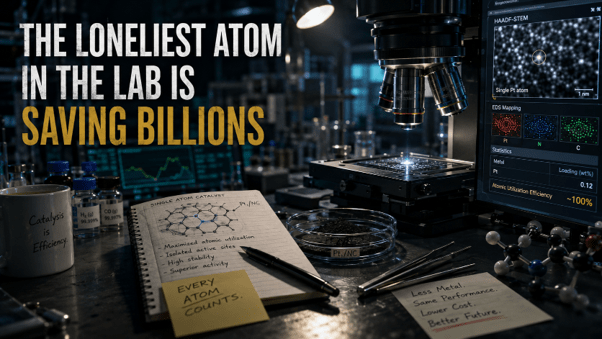
Single atom catalysts, or SACs as they are called in the field, solve this problem by anchoring individual metal atoms onto a support material, usually something like nitrogen doped carbon, metal oxides or two dimensional materials like graphene. Each atom is isolated, stabilised by its interaction with the support and fully exposed to the reaction environment.
The result is that every single atom of precious metal is working. Not a fraction of them. All of them. The concept of atomic utilisation efficiency, which in conventional nanoparticle catalysts might sit somewhere between 5% and 30%, jumps to essentially 100% in a well designed single atom system.
This is where catalyst design becomes the critical discipline. The support material, the way the atom is anchored, the coordination environment around the metal centre, all of these variables determine whether the single atom catalyst is stable under real industrial conditions and whether it is actually more active than the nanoparticle alternative it is replacing.
The Impact on Precious Metal Consumption
These efficiency gains really change the game for industrial supply chains. Platinum, palladium, rhodium, iridium, osmium and ruthenium are precious metals generally mined in South Africa and Russia. In cases where there is uncertainty about the supply chain, prices will begin to rise. Add in the constant, high demand from car manufacturers, and you get a recipe for some serious supply chain headaches.
For now, the most exciting place to put this technology to work is in car exhaust systems. Conventional three way converters currently need several grams of these precious metals to do their jobs. By using single atom catalysts to replace even a chunk of that metal, we could keep the same emission performance while taking a massive amount of pressure off the supply market.
Similar arguments apply in pharmaceutical synthesis where palladium catalysed cross coupling reactions are fundamental to how a large proportion of drug molecules are made. The palladium loadings required, and the cost of recovering and recycling it after the reaction, represent significant process costs that better catalyst design could reduce substantially.
Why Catalyst Design Is Everything
Single atom catalysis sounds simple in principle. Put individual atoms on a surface and use them. In practice, the catalyst design challenge is enormously complex.
The support material has to stabilise the metal atom against sintering, which is the tendency of isolated atoms to migrate across a surface and merge into clusters under reaction conditions. It has to create the right electronic environment around the metal centre to make it catalytically active for the specific reaction you need it to perform.
And it has to do all of this while surviving the temperatures, pressures and chemical environments of real industrial processes, which are considerably harsher than laboratory conditions.
Getting this right requires understanding the interaction between the metal atom and the support at a quantum mechanical level, which is why advances in computational chemistry and materials characterisation have been just as important to the field as the experimental work.
Where the Field Is Going
Single atom catalysis has moved from a laboratory curiosity to a seriously funded research priority in less than fifteen years. China, the United States, Europe, and increasingly India are all investing in this area because the economic implications of reducing precious metal dependency in key industries are enormous.
The next frontier is extending single atom catalyst design beyond platinum group metals entirely, using earth abundant metals like iron, cobalt and nickel in single atom configurations to replace precious metals in reactions where they currently have no viable substitute.
Early results in this direction are genuinely promising and the combination of reduced cost and reduced supply chain vulnerability makes it one of the more strategically important areas of materials research happening right now.
Conclusion
The story of single atom catalysis is ultimately a story about efficiency taken to its logical extreme. If the goal of catalyst design is to maximise the useful work extracted from every atom of precious metal, then the single atom limit is where that logic ends up. Every atom is working. Nothing wasted. No dead weight on the payroll.
Industry runs on catalysts and catalysts have run on precious metals for over a century. The economics of that relationship are under real pressure from supply constraints, price volatility and the scale of demand from emerging clean energy technologies. Single atom catalysts are not a complete solution to that pressure, but they are one of the most promising tools available for doing significantly more with significantly less.
And in industries where the cost of a gram of catalyst can determine the economics of an entire production process, significantly less is worth quite a lot.
Frequently Asked Questions
1: How does Catalyst Design change traditional industrial chemistry approaches?
It shifts systems from bulk particle usage to atom-level engineering, where each active site is individually accessible and fully utilized during reactions.
2: Why is atomic-level efficiency important in modern chemical processes?
Many conventional materials contain large inactive regions, but improved design ensures nearly all active sites contribute to performance, increasing output efficiency. This also improves the value derived from high-cost inputs like metals.
3: What role do support structures play in stabilizing active sites?
They anchor individual atoms, preventing migration and clustering while tuning electronic properties. Catalyst Design relies heavily on this stability to maintain performance under harsh conditions.
4: Which industries benefit most from these advancements?
Sectors such as fuel processing, emissions control, and pharmaceutical synthesis gain major advantages due to reduced waste and improved reaction control.
5: What makes Catalyst Design challenging at industrial scale?
Maintaining stability under high temperature and pressure is difficult because isolated atoms naturally tend to move and cluster unless precisely engineered systems prevent it.
6: How does computational modeling contribute to Catalyst Design development?
Advanced simulations help predict how atoms interact with supports, allowing researchers to refine structures before experimental testing, saving time and resources.
7: Can Catalyst Design reduce reliance on scarce metals?
Yes, it improves utilization efficiency so less material is needed overall. Catalyst Design also supports research into replacing scarce elements with more abundant alternatives. This makes supply chains more resilient.
8: Why is electronic structure control important in these systems?
The surrounding environment of each atom determines how reactants bind and transform, so fine-tuning electronic effects directly impacts catalytic activity.
9: What is the future direction of Catalyst Design research?
Work is moving toward scalable manufacturing methods and replacing high-cost elements with earth-abundant alternatives without sacrificing reaction efficiency.
10: How does atomic dispersion improve reaction outcomes?
By isolating each active site, reactions occur more uniformly and efficiently, reducing wasted material and improving selectivity across industrial processes.
Citations & References
[1] “Research Progress and Application of Single-Atom Catalysts: A Review,” Molecules (MDPI), 2021. [Online]. Available:
https://www.mdpi.com/1420-3049/26/21/6501
[2]”Designing single-atom catalysts: bridging metal–support interaction and adsorption energy optimization,” Chemical Science (RSC Publishing), 2026. [Online]. Available:
https://pubs.rsc.org/en/content/articlehtml/2026/sc/d5sc08100a
[3] “Single-Atom Catalysts: A Perspective toward Application in Electrochemical Energy Conversion,” JACS Au (PMC), 2021. [Online]. Available:
https://pmc.ncbi.nlm.nih.gov/articles/PMC8397360/
[4] “Suzuki cross‐coupling reaction catalyzed by a Pd single‐atom catalyst,” Angewandte Chemie International Edition, 2021. [Online]. Available:
https://www.researchgate.net/figure/Suzuki-cross-coupling-reaction-catalyzed-by-a-Pd-single-atom-catalyst-Adapted-from_fig15_369255438
[5] “Recent advances in carbon-supported non-precious metal single-atom catalysts for energy conversion electrocatalysis,” National Science Open, 2023. [Online]. Available:
https://www.nso-journal.org/articles/nso/full_html/2023/02/NSO20220061/NSO20220061.html
[6] “Single Atom Catalysts Based on Earth-Abundant Metals for Energy-Related Applications,” Advanced Materials Interfaces (PMC), 2024. [Online]. Available:
https://pmc.ncbi.nlm.nih.gov/articles/PMC11565580/
[7] “Design of Single-Atom Catalysts and Tracking Their Fate Using Operando and Advanced X-ray Spectroscopic Tools,” ACS Catalysis (PMC), 2023. [Online]. Available:
https://pmc.ncbi.nlm.nih.gov/articles/PMC9837826/
[8] “Earth-abundant metal catalysts for sustainable CO2 reduction,” Sustainable Energy & Fuels (RSC Publishing), 2026. [Online]. Available:
https://pubs.rsc.org/en/content/articlehtml/2026/se/d5se01290b
[9] EvePlacement. [Online]. Available:
https://eveplacement.com/
Streamline Your Hiring with Eve Placement
Engage, assess, and recruit top talent through tailored AI hiring challenges that go beyond resumes. Ready to hire better? Contact our research team for a custom consultation.