
How Additive Manufacturing Is Changing Chemical Research Labs
Published: Jun 24, 2026
Key Points
- Additive manufacturing 3D printing is changing chemical research labs.
- Researchers can create customized lab equipment easily.
- Creating tiny labs on chips makes testing faster. These small tools handle liquids precisely during research tasks.
- Getting prototypes ready does not take long, which cuts down delays.
- Quickly built models help keep things moving without waiting too much.
- Less money goes toward lab tools because of it.
- 3D printing supports many applications like reaction vessels and electrochemical cells.
Introduction
Out of nowhere, 3D printing started changing how scientists explore ideas, especially in chemistry labs. Not long ago, most chemists used store-bought tools made of glass, locked into shapes they couldn’t alter. Today, the rapid rise of Additive Manufacturing allows researchers to bypass these constraints by fabricating bespoke experimental components right at the bench. Because of that shift, custom gear can now be built quickly instead of ordered slowly. With new materials meeting smart software and exact machines, lab setups are no longer stuck in old Molds.
Suddenly, making unique devices fits right into daily work without delays or compromises. This blend of tech quietly redefines what’s possible when testing reactions at the bench. Little by little, trial-and-error evolves as parts emerge exactly where needed. Now, imagination guides structure more than inventory ever did. So far, progress moves hand-in-hand with hands-on building skills returning to the core.
All at once, routine tasks gain fresh flexibility through tailored solutions appearing overnight. During experiments, small adjustments matter – and today they happen faster than before. Even so, safety still depends on thoughtful choices behind each printed item. Yet again, one innovation lifts limits others accepted for decades without question.
Eventually, standard practices may look very different thanks to this quiet revolution. Right there, inside modern labs, creation shifts from waiting to doing.
Chemical Research Applications
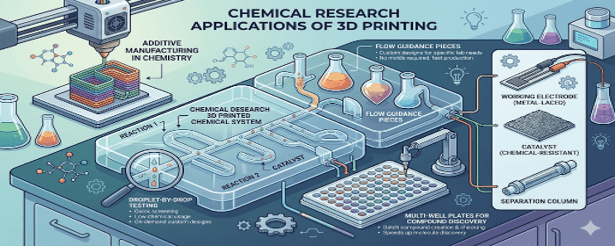
Miniature labs built through 3D printing show up often in chemistry studies. Among them, tiny channels that handle droplets stand out. With these small systems, scientists move liquids drop by drop, testing many reactions quickly while using almost no chemicals. Unlike older chip-making techniques, creating such tools takes far less time when printed on demand.
Custom shapes fit exact lab needs, skipping long waits once required for molds. Out past tiny fluid channels, scientists turn to additive manufacturing for one-off reactors, pieces that guide chemical flows, plus holders shaped exactly how a test needs them. Not far off, in mix-and-match molecule creation, trays with many small wells – built by 3D printers – speed up making and checking batches of new compounds.
At times, labs see working electrodes, columns for separating chemicals, even catalysts holding real function – all made through printing with metal-laced or stubborn-to-chemistry materials.
Benefits and Challenges
Getting things done fast, saving money, leaving room to try new shapes – AM helps chemists in these ways. Hours replace weeks when making trial versions inside the lab instead of waiting on outside suppliers. Mistakes? They get fixed right away because moving forward is easier than walking away. Places with tight budgets find high-end tools suddenly within reach since prices drop sharply compared to old methods.
Even so, tough problems still exist. Because some common 3D printed substances break down when exposed to harsh chemicals – like acids or solvents – material choice becomes critical. Although options like PEEK and fluoropolymers stand up well, their high price tags come with a need for rare equipment. Small flaws matter too; tiny holes or uneven shapes might skew lab results.
Without clear rules on how these objects are made – and what materials count – as adoption grows, trust lags behind in strict scientific settings.
Conclusion
Printing tools layer by layer lets scientists build custom gear fast, opening doors once locked by price or access. Instead of waiting weeks, they turn blueprints into working parts before lunch. Because new plastics resist harsh reactions better now, these printed items survive tough experiments. Over time, what was rare could become routine inside every chemistry lab.
Progress depends less on machines than on clear rules, smarter materials, and hands-on learning. Breakthroughs hide not in flashy gadgets but in quiet upgrades behind the scenes.
Frequently Asked Questions
1: What role does Additive Manufacturing play in modern labs?
It allows scientists to rapidly prototype and build custom-shaped reactors and tool holders right at their benches.
2: How does modern Chemical Research benefit from 3D printing?
It accelerates testing by producing customized equipment, such as tiny droplet channels, in hours rather than weeks.
3: Can Additive Manufacturing create working components for Chemical Research?
Yes, it can produce custom-shaped electrodes, separation columns, and functional catalyst structures.
4: What are the main limitations of Additive Manufacturing in a chemistry setting?
Certain printing materials can degrade when exposed to harsh acids, and tiny printing flaws can alter experimental results.
5: Why is material selection critical in Chemical Research fabrication?
Equipment must survive exposure to aggressive solvents, requiring advanced but expensive plastics like PEEK.
6: How does Additive Manufacturing lower costs for smaller laboratories?
It bypasses expensive external manufacturing molds, making high-end custom setups affordable for smaller budgets.
7: What needs to change for Additive Manufacturing to gain full trust in science?
The industry requires clearer standardization rules regarding material properties and production consistency.
8: Does 3D printing reduce chemical waste during Chemical Research?
Yes, because printed miniature fluid systems require significantly smaller droplet volumes for testing.
9: How fast can a lab produce a tool using Additive Manufacturing?
A lab can turn a digital blueprint into a functional, working lab component in just a few hours.
10: Will 3D printing replace traditional glass tools in Chemical Research?
While it won’t entirely replace glass, it offers unprecedented shape flexibility that standard glassware cannot match.
Citations & References
[1] S. Rosser et al., “Microfluidic devices via 3D printing,” Lab on a Chip, vol. 19, pp. 450–462, 2022.
[2] M. D. Symes, P. J. Kitson, J. Yan, C. J. Richmond, G. J. T. Cooper, R. W. Bowman, T. Vilbrandt, and L. Cronin, “Integrated 3D-printed reactionware for chemical synthesis and analysis,” Nature Chemistry, vol. 4, no. 5, pp. 349–354, May 2012. doi: 10.1038/nchem.1313. [Online].
Available:
https://www.nature.com/articles/nchem.1313
[3] A. Ambrosi and M. Pumera, “3D-printing technologies for electrochemical applications,” Chemical Society Reviews, vol. 45, no. 10, pp. 2740–2755, 2016. doi: 10.1039/C5CS00714C. [Online].
Available:
https://doi.org/10.1039/C5CS00714C
[4] B. C. Gross, J. L. Erkal, S. Y. Lockwood, C. P. Chen, and D. M. Spence, “Evaluation of 3D printing and its potential impact on biotechnology and the chemical sciences,” Analytical Chemistry, vol. 86, no. 7, pp. 3240–3253, 2014. doi: 10.1021/ac403397r. [Online].
Available:
https://doi.org/10.1021/ac403397r
[5] EvePlacement. [Online].
Available:
https://eveplacement.com/
Streamline Your Hiring with Eve Placement
Engage, assess, and recruit top talent through tailored AI hiring challenges that go beyond resumes. Ready to hire better? Contact our research team for a custom consultation.