Blockchain Timestamping in the 21st Century Digital Age: Growing Trust and Integrity in Application Submissions
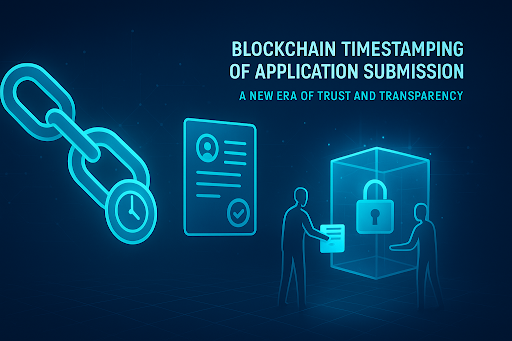
Table of Contents
Introduction
What is Blockchain Timestamping?
Why Timestamping Matters in Application Filings
Proof of Filing
Transparency and Fairness
Dispute Resolution
Long-Term Preservation
Real-World Applications
University Admissions
Job Applications
Government Contracts
Legal & Compliance Filings
Challenges and Considerations
Integration
Scalability
Privacy
Regulation
Looking Ahead: A Trust-Based Future
Conclusion
- FAQs
References
As digital processes drive the way people and organizations communicate, trust has now become the basis of every transaction. Whether one is applying for a university, seeking a government license, or submitting a corporate bid, applicants must be assured that documents are accepted, recorded, and stored without tampering or prejudice. Most, if not all, traditional networks are neither centralised nor transparent to this extent that they could even offer such a high degree of fact-based certainty. And then there’s blockchain timestamping—a disruptive solution that makes sure every application submission is time-stamped with authenticity, integrity, and transparency.
What is Blockchain Timestamping? Blockchain time-stamping logs the specific time a submission or transaction is added to a ledger. This moment is recorded as a timestamp. Blockchains are secure, permanent, and decentralized. Therefore, the timestamp serves as unquestionable evidence that proof with which something took place exists. When a document is modified, an application’s electronic fixed “fingerprint” is produced, and subsequently, a date and timestamp are appended. This serves as incontrovertible evidence that, on a specific date and time, a document existed unchanged and in the stated form.
Why Timestamping Matters in Application Filings
Proof of Filing: Candidates are concerned about whether their filings arrived on time. A blockchain timestamp creates undeniable evidence of receipt.
Transparency and Fairness: In issues of competition like employment hiring, university admissions, or tender awards, timestamping is a feature which promotes fairness. All put forth are to be in terms of time of presentation, with no room for manipulation. Apps cannot be altered, forged, or deleted once timestamped, ensuring integrity throughout the process.
Dispute Resolution: Conflicts are reduced by timestamping. If a candidate claims to have submitted earlier than the deadline, blockchain records have no doubt about it.
Long-Term Preservation: Blockchain records are irreversible. Years down the line, organizations can verify the authenticity and timing of submissions.
Real-World Applications: University Admissions: Submission deadlines for students are easily and accurately documented within the system due to the precise timestamps stored at the moment of application submission.
Job Applications: The application process claims to be unbiased, but places unwarranted faith in itself.
Government Contracts: The bidding for contracts is supported by the absence of bias, manipulation, and an open presentation of the bidding process.
Legal & Compliance Filings: Timestamped records can be subpoenaed as admissible evidence where records are missing during legal and compliance hearings or other regulatory procedures.
Challenges and Considerations
Despite the numerous advantages of blockchain technologies, certain challenges remain:
Integration: Existing submission tools must be designed to work in tandem with blockchain infrastructures.
Scalability: High-volume submissions demand cheap, high-performance blockchain solutions.
Privacy: Intelligent information is secured with only document fingerprints—not entire content—being retained on-chain.
Regulation: Institutions and governments must establish the legal establishment of blockchain timestamps as valid evidence.
Looking Ahead: Into a Trust Based Future.
Blockchain timestamping has brought about a shift beyond what we see as improved tech. It is a change in the way we build trust into digital processes.Future application systems may be fully blockchain-native, with submissions entered, verified, and even auto-judged through the medium of smart contracts. In this future, future applicants won’t need to wonder: “Was my submission counted?” They will be able to know—in cryptographic certainty—that their application has been recorded in an immutable record of fact.
Conclusion
Blockchain timestamping of application submission refocuses transparency, accountability, and equity in online interactions. Through balancing precision with permanence, blockchain timestamping safeguards applicants and institutions equally, ensuring that each application is preserved as an original record in the history of development.
As we move toward a more trust-oriented digital age, blockchain timestamping will be a guardian of equity, a keeper of integrity, and a guide toward an era where processes build confidence, not doubt.
FAQs
What is blockchain timestamping?
Blockchain timestamping records the exact time a document or transaction is logged onto a blockchain, proving authenticity.Why is blockchain timestamping important in applications?
It ensures submissions are transparent, verifiable, and tamper-proof.How does blockchain timestamping prevent manipulation?
Once recorded, data on a blockchain cannot be altered, forged, or deleted.Can blockchain timestamping prove timely submissions?
Yes, timestamps create undeniable evidence of when a submission was received.Is blockchain timestamping legally valid?
Many jurisdictions are recognizing blockchain records as admissible legal evidence.Does timestamping protect document privacy?
Yes, only digital fingerprints (hashes) are stored, not the actual document.What industries use blockchain timestamping?
Education, recruitment, government contracts, law, and compliance sectors.How does timestamping help in dispute resolution?
It offers immutable proof of submission time, reducing conflicts.What is the role of smart contracts in timestamping?
They can automate verification and judgment of submissions.How does timestamping ensure fairness in hiring?
Applications are recorded transparently with equal opportunity for all candidates.Is blockchain timestamping scalable for mass submissions?
Yes, but it requires high-performance, cost-effective blockchain solutions.What challenges exist in blockchain timestamping adoption?
Integration, scalability, privacy, and regulatory recognition.How does timestamping support university admissions?
It verifies deadlines and prevents disputes over late submissions.What’s the difference between digital signatures and blockchain timestamps?
Digital signatures prove authorship; blockchain timestamps prove existence at a certain time.How does timestamping help with government tenders?
It ensures fair, unbiased, and transparent bidding processes.What makes blockchain timestamping better than traditional methods?
Its decentralized and tamper-proof nature builds trust and transparency.Does blockchain timestamping work internationally?
Yes, as blockchains are decentralized and not limited by geography.Can blockchain timestamping reduce fraud?
Absolutely, since records cannot be altered or forged after logging.How long are blockchain timestamps valid?
Indefinitely, as blockchain records are permanent.What is the future of blockchain timestamping?
Fully blockchain-native systems with smart contracts and automated verification.
References
[1] Timed Signatures and Zero-Knowledge Proofs – Timestamping in the Blockchain Era — A formally-defined paper on how blockchain can provide secure timestamping, such as proofs, signed knowledge, and backdating/postdating attack resistance.
[2] Ethereum Blockchain-based Smart Contracts for Accurate and Decentralized Timestamping — Discusses how Ethereum smart contracts + external time providers can enhance timestamp accuracy and trust.
[3] Decentralized Trusted Timestamping Based on Blockchains — Offers architecture and approaches to trusted timestamping of digital data to provide integrity and proof of existence.
[4] Stampery Blockchain Timestamping Architecture (BTA) – Version 6 — A cost-effective, scalable system for blockchains anchoring/certifying large sets of data with verifiable proofs.
[5]Concept Timestamping on Blockchain and Decentralization of Patents (Springer) — Blockchain used to register inventions / patent claims through structured graphs + timestamping to assert innovation.
Penned by Reema
Edited by Aarti Gupta, Research Analyst
For any feedback mail us at [email protected]
Streamline Your Hiring with Eve Placement’s Custom Assessments
Eve Placement helps you engage, assess, and recruit top talent through tailored hiring challenges that go beyond resumes. From technical quizzes and real-world case studies to psychometric evaluations and audio/video submissions, our platform enables smarter, data-driven hiring decisions. Advanced security features ensure authenticity and eliminate fraud, giving you reliable results. Ready to hire better? Know More.
Mail us at [email protected]