The Role of Digital Note-Taking in Modern Education
Topics: digital note-taking in education
My Messy Notebook Phase
I will be honest. I was the student who used to have five different notebooks, all half-filled, stuffed into my bag like cushions. My economics graphs looked like abstract art, but without colors, and my coding notes? It looked like I just dropped several dead mosquitoes on the paper. Because you know what, not everyone can match the lecturer’s pace of speaking. My small, cursive writing didn’t support that. And that was my breaking point.
I switched to digital notes out of desperation and became a digital notes student. And wow, it DID things have changed. So, I’ll talk about the merits and demerits of technology in study habits.
Why Digital Noting Just Makes Sense.
Here’s the whole point in a few words—”I love efficiency”. If something saves me time and stress, let’s do it. Digital note-taking provided me with:
- No more “I lost my notes” panic (Google Drive is my savior)
- The facility to read my writing was an absolute game-changer during exams.
- Easy editing, no more scratching out mistakes like a frustrated scientist.
- Quick searches, try finding that one Keynesian theory in a pile of notebooks, where you might even tear off some pages unknowingly. Versus typing “Keynes” into a search bar. What is easier?
But that’s still not the real win. It helped me connect my two worlds, economics and coding. I can simply paste code snippets right next to the economic models and watch how data analysis is applied to real-world problems.

The Life-changing Perks
What impressed me the most wasn’t just the practicality—it was how it modified my learning:
- Active listening: Instead of frantically writing every word, I started summarizing each piece of writing/lecture in my terms. Psychologically, if we indulge in summarising something ourselves, it makes us do higher-order thinking and the information transfers to our permanent memory.
- Visual learning: Snippets of textbook diagrams + my neat scribbles are equal to better retention
- Classroom Collaboration: Sharing notes with classmates improved them. Unsurprisingly, it turns out that four brains are better than a single one.
And here’s a cute secret—when my professor noticed my clearer, well-organized submissions in everything from assignments to class test papers? That little bit of recognition made me motivated to want to up my note-taking game even more.
The Hiccups (Because of course, Nothing’s Perfect in this world). Of course, there were drops and distractions:
The distraction trap: One minute you’re taking notes, next minute you’re deep in memes and reels.
Battery anxiety: The panic when your laptop hits 10% mid-lecture is real stress.
Overly indulged in organizing: I used to spend two hours color-coding notes instead of studying them. So, That’s just one demerit of technology in study habits.
- How do I fix them? Pretty Simple:
- Use focus apps like I use the “Tree” app to block distractions.
- No matter what, carry a charger everywhere and a backup pen—old habits die hard
- Set a strict timer when organizing (20 minutes max, then study please!)
My Hybrid Approach
Recently, I have discovered my sweet spot:
- Typing for fast-paced lectures and coding concepts
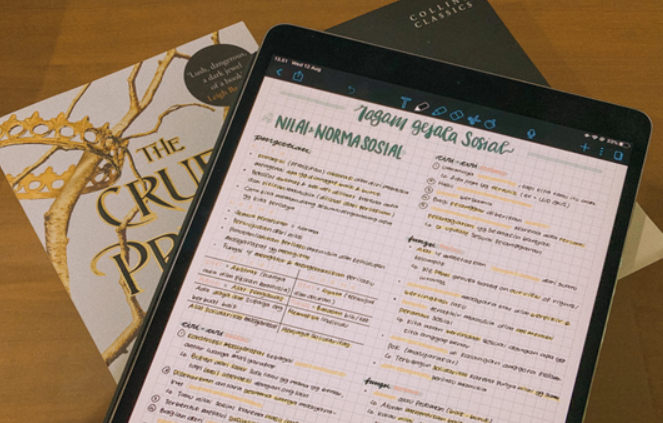
- Handwriting on a tablet for economics diagrams and formulas
- Voice notes for those “aha! I missed it” moments, juggling between classes
See, it is not about adapting a completely digital method, but it’s about using the suitable tool for different tasks.
Final Thoughts:
From a pen paper notes student to a digital notes student not just dropped the weight of my backpack, but it has also transformed my learning methods and habits.Inculcating technology in study habits gave me more time to understand concepts rather than just record them in writing. And fields like economics and coding, where everything builds on prior knowledge? That is simply precious.
If you are in a dilemma, try it for a week. Begin with a single subject. You might just find yourself contemplating how you ever survived with paper alone.
Commonly Asked FAQs:
1. What is digital note-taking in education?
Digital note-taking in education refers to the practice of recording, organizing, and reviewing lecture notes, ideas, and study materials using digital devices such as laptops, tablets, or smartphones. Unlike traditional handwritten notes, this method allows students to use applications like OneNote, Evernote, or Google Docs for faster note creation, editing, and storage. It enables better searchability, collaboration, and integration with multimedia elements such as images, audio, and coding snippets, making the learning process more efficient.
2. How does digital note-taking improve learning efficiency?
Digital note-taking in education significantly enhances efficiency by reducing time spent on searching for notes, rewriting, and organizing. With features like search bars, tagging, and cloud storage, students can instantly retrieve key terms, such as “Keynesian economics,” without flipping through multiple notebooks. Moreover, editing is simpler—mistakes can be corrected instantly, and information can be rearranged without rewriting entire pages. This allows students to focus more on understanding concepts instead of being stuck in the mechanics of note creation.
3. What are the main benefits of digital note-taking in education?
-
Organization: Notes can be neatly structured with folders, colors, and highlights.
-
Accessibility: Students can access their notes anytime, anywhere using cloud-based apps.
-
Collaboration: Sharing notes with peers helps in group learning.
-
Integration: Ability to embed images, diagrams, audio clips, or coding snippets alongside text.
-
Memory Retention: Summarizing digitally encourages active listening and deeper learning.
These advantages make digital note-taking in education a powerful tool for modern learners.
4. Can digital note-taking replace traditional handwritten notes?
Not entirely. While digital note-taking in education offers speed, organization, and accessibility, handwritten notes have their cognitive benefits too. Research shows that writing by hand helps in memory retention and conceptual understanding. That’s why many students adopt a hybrid approach—using digital notes for theory-heavy, fast-paced lectures and handwriting (often on tablets) for diagrams, formulas, or visual concepts. Instead of replacing one with the other, blending both methods often brings the best results.
5. What are the common challenges of digital note-taking in education?
-
Distractions: Social media and notifications can break concentration.
-
Battery Dependency: Devices can run out of charge mid-lecture.
-
Over-organizing: Students may spend too much time formatting instead of studying.
-
Screen Fatigue: Prolonged screen use can cause eye strain.
These issues can be minimized with focus apps, time management strategies, and hybrid note-taking practices.
6. How does digital note-taking help in academic collaboration?
Collaboration is one of the strongest aspects of digital note-taking in education. Students can share notes instantly with peers, whether through cloud storage, note-sharing apps, or collaborative platforms like Google Docs. Group projects, exam preparation, and brainstorming sessions become easier when everyone has access to well-organized and updated notes. Additionally, multiple students can edit and annotate the same file in real time, creating a richer and more comprehensive resource.
7. Is digital note-taking effective for visual learners?
Absolutely. Digital note-taking in education provides various tools that make concepts easier to visualize. For instance, students can insert diagrams, flowcharts, or graphs directly into their notes. They can use stylus pens on tablets to draw economic curves, chemical structures, or mathematical functions. Visual learners benefit from combining images, mind maps, and text in one organized space, which improves comprehension and retention of complex concepts.
8. Which devices are best for digital note-taking in education?
-
Laptops: Best for typing lengthy lecture notes and research-based subjects.
-
Tablets with Stylus: Ideal for math, science, and economics students who rely on diagrams and formulas.
-
Smartphones: Useful for quick notes, voice memos, and reminders on the go.
For most college students, a tablet-laptop hybrid device (e.g., Microsoft Surface or iPad with keyboard + stylus) works best as it combines typing speed with drawing flexibility.
9. How can students avoid distractions while using digital note-taking?
-
Use focus apps like Forest or Tree to block distracting websites.
-
Enable Do Not Disturb mode during lectures.
-
Separate devices—use one for notes and another for browsing.
-
Set timers for organizing notes to prevent over-indulgence.
By managing distractions, students can enjoy the full benefits of digital learning.
10. Does digital note-taking improve exam performance?
Yes, digital note-taking in education can boost exam performance if used effectively. Since notes are well-organized and searchable, students can revise faster and focus on weak areas. Collaborative note-sharing also helps them access different perspectives on the same topic. Additionally, digital notes allow for integration with flashcards, mind maps, and quizzes, further strengthening memory recall. However, success depends on consistent usage and disciplined study habits.
11. Is digital note-taking cost-effective for students?
At first glance, digital devices may seem expensive compared to paper notebooks. However, in the long run, digital note-taking in education can be cost-effective. Students save money on pens, notebooks, highlighters, and printing. Free cloud storage and note-taking apps also reduce recurring costs. Plus, since digital devices serve multiple purposes (assignments, research, communication), they provide long-term value beyond just note-taking.
12. How does digital note-taking support mental health and reduce academic stress?
A cluttered study routine often causes stress among students. Digital note-taking in education reduces this burden by organizing materials neatly and providing instant access. Students no longer have to panic about misplaced notes or rewriting entire notebooks. The ability to summarize lectures in their own words also fosters higher-order thinking, improving self-confidence and reducing exam anxiety.
13. Is digital note-taking suitable for all learning styles?
-
Auditory learners: Can record lectures and integrate voice notes.
-
Visual learners: Can use diagrams, color coding, and charts.
-
Kinesthetic learners: Can use stylus pens for drawing and handwriting.
This flexibility makes it suitable for a wide range of learners compared to traditional note-taking.
14. What apps are most effective for digital note-taking in education?
-
Microsoft OneNote: Great for structured notes and integration with Office tools.
-
Evernote: Excellent for organizing notes with tags and multimedia.
-
Notion: Perfect for project management and connected databases.
-
Google Docs: Simple, collaborative, and accessible.
-
GoodNotes/Notability: Ideal for handwritten tablet notes.
Each app has unique strengths, and the best choice depends on a student’s study style.
15. How can students balance between digital and handwritten notes?
-
Use typing for theory-heavy, fast-paced subjects like history or coding.
-
Use a tablet and stylus for subjects that require diagrams, math formulas, or flowcharts.
-
Use voice notes for quick reflections or missed content.
This balance ensures students maximize the benefits of digital note-taking in education while retaining the cognitive advantages of handwriting.
16. How does digital note-taking prepare students for future careers?
Digital note-taking in education builds essential professional skills like organization, digital literacy, and collaboration. In workplaces, professionals rely on digital tools to manage projects, share documents, and record data. By practicing digital note-taking in college, students develop habits that directly transfer to career environments, making them more adaptable and efficient.
17. Are there environmental benefits to digital note-taking in education?
Yes. By reducing paper consumption, digital note-taking in education contributes to sustainability. Students can cut down on notebooks, pens, and printing, which collectively reduces waste and supports eco-friendly practices. Universities encouraging digital methods can also lower their carbon footprint.
18. Final thoughts: Is digital note-taking in education worth adopting?
Yes, adopting digital note-taking in education is highly beneficial. While it has minor challenges, the advantages—better organization, collaboration, accessibility, and improved learning efficiency—far outweigh the drawbacks. With the right balance of focus, discipline, and hybrid methods, students can transform their learning journey, boost academic performance, and prepare themselves for professional success

Citations
- Mueller, P. A., & Oppenheimer, D. M. (2014). The Pen Is Mightier Than the Keyboard: Advantages of Longhand Over Laptop Note Taking. Psychological Science, 25(6), 1159–1168.
- Mayer, R. E. (2005). The Cambridge Handbook of Multimedia Learning. Cambridge University Press.
Penned by Swarna Sharma
Edited by Sneha Seth, Research Analyst
For any feedback mail us at [email protected]
Streamline Your Hiring with Eve Placement’s Custom Assessments
Eve Placement helps you engage, assess, and recruit top talent through tailored hiring challenges that go beyond resumes. From technical quizzes and real-world case studies to psychometric evaluations and audio/video submissions, our platform enables smarter, data-driven hiring decisions. Advanced security features ensure authenticity and eliminate fraud, giving you reliable results. Ready to hire better? Know More.
Mail us at [email protected]