
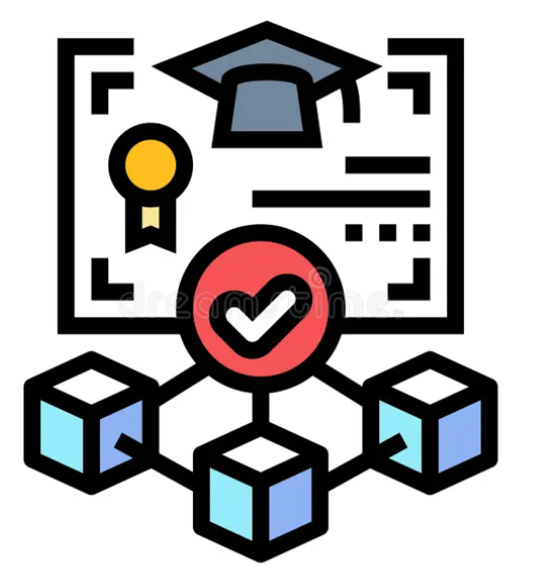
Let’s learn about blockchain first. Imagine a book where each page is going to be treated as a block, and once you write something on that page, you can go back, or you simply can’t delete it, you can make new entries and a new page or block, but can’t change the Previous one. And then you make a copy of this notebook available to all parties who are concerned, so no one can mess with the entries secretly. That is precisely what blockchain is. Technically, A blockchain is a form of digital database or ledger that keeps information in a secure, transparent, and tamper-proof manner.
Rather than holding all the information in a single central location (such as a bank or firm server), blockchain retains copies of the data on a network of computers. Everyone on the network can view and concur on the information, making it extremely difficult to cheat or modify.
Now, it will be simple to comprehend what blockchain credential hiring is. It is the application of blockchain technology to confirm whether a candidate’s academic credentials, certificates, or work credentials are genuine. It is essentially an anti-fraud credentialing system that speeds the recruitment process.
How Does It Prevent Fraud?
Fraudulent records are virtually impossible since only authorised issuers (e.g., certifying agencies, universities) can append credentials. Credentials are stored with cryptographic keys, essentially an access security code that will enable decoding of the data, guaranteeing authenticity.
Records are open and permanent, meaning no one can modify or remove them. This guarantees employers are looking at verified, tamper-resistant data, not merely what is printed on a resume. In short, it is an anti-fraud credentialing system.
Advantages to Employers in Recruitment
Faster Recruitment: Traditionally, the process of hiring involves a lengthy process comprising background checks, contacting institutions, or relying on third-party verification services. Employers are now in a position to rapidly verify the degree, certification, or experience of a candidate with the advent of blockchain technology, which shortens the process from taking weeks to seconds.
This is a prime example of how anti-fraud credentialing speeds up hiring.
Lower Costs: Businesses typically invest considerable money in outside agencies to screen resumes. Blockchain credential hire takes away that middleman by offering direct, tamper-proof access to credentials. It lowers the cost of hiring in the long run.
Fraud Prevention: A significant hiring risk is resume fraud, which includes things like overstated grades, phoney degrees, or work history that never occurred. Once added to the ledger, blockchain credentials cannot be changed. This reduces financial and reputational risk and prevents companies from hiring underqualified employees.
Increased Trust: Employers are confident that the credentials they are checking are 100% genuine. That reassures them about their hiring process. It also solidifies the employer-employee relationship from the beginning since there is no question about qualifications.
Benefits for Candidates
Ownership of Credentials: Applicants can store their verified digital credentials securely in a protected blockchain wallet rather than having to rely on colleges, training centres, or employers to verify their papers every time. They will be able to share their credentials with one click and retain ownership and management of them.
International Recognition: Qualifications locked on blockchain can be validated by employers worldwide. An Indian or European degree, can be verified in real time by an employer in America without additional forms. This helps a great deal towards the internationalisation of careers and global mobility and reflects the universal appeal of anti-fraud credentialing.
Transparency and Efficiency: Applicants don’t have to submit their certificates and letters of recommendation again and again for applying for different jobs. The blockchain record becomes a single source of truth that saves time in the hiring process and minimises candidate frustration.
Real-World Applications
Universities and Academic Institutions: There are already a number of global universities, MIT and the University of Nicosia, issuing blockchain-based diplomas and transcripts. This makes graduates’ accomplishments tamper-proof and verifiable.
Professional Certifications: Leading organisations such as IBM provide blockchain-enabled digital certificates for verifying technical competencies. They can instantly verify these certificates online, enhancing their authenticity in the labour market.
Recruitment platforms and HR tech: HR technology platforms and startups are adopting blockchain to perform background checks automatically. For example, platforms can give recruiters verified work history, certifications, and education records instantly compared to conventional methods.
Conclusion
Blockchain credential hire is revolutionising the hiring landscape. Replacing outdated and insecure verification procedures with a secure, transparent, and efficient one avoids forgery, saves resources, and speeds up the recruitment process. In addition, anti-fraud credentialing enhances trust by making it is almost impossible for fake documents to go through. For employers, hiring is assured. For job seekers, it ensures their hard-earned credentials are instantly verified globally.
Commonly Asked FAQs:
1. What is blockchain credential verification?
Blockchain credential verification is a process where academic and professional records are stored on a secure blockchain ledger, making them tamper-proof and instantly verifiable.
2. How does blockchain credential verification prevent fraud?
It ensures only authorized institutions can issue records. Once added to the blockchain, credentials cannot be altered or faked.
3. Why is blockchain credential verification faster than traditional methods?
Traditional checks take days or weeks. Blockchain credential verification reduces the process to seconds by allowing instant access to verified records.
4. How does blockchain credential verification reduce hiring costs?
It removes the need for third-party verification services, cutting administrative expenses while ensuring high trust.
5. Do candidates control their blockchain credentials?
Yes. Individuals store their verified credentials in a secure digital wallet and share them with employers when needed.
6. Can blockchain credential verification be used globally?
Yes. Credentials stored on blockchain can be verified anywhere in the world without additional paperwork.
7. How does blockchain credential verification build employer trust?
Employers know the records are genuine, eliminating doubts about forged degrees, inflated resumes, or false work histories.
8. Is blockchain credential verification already being used?
Yes. Universities like MIT and organizations like IBM are issuing blockchain-based diplomas and certificates.
9. What are the main benefits for employers?
Employers gain faster hiring, lower costs, fraud prevention, and greater confidence in their recruitment decisions.
10. How does blockchain credential verification help candidates?
Candidates save time, gain international recognition, and maintain ownership of their verified records.
11. Can blockchain credential verification replace resumes?
Not fully, but it makes resumes more reliable by backing them with verified credentials.
12. Is blockchain credential verification secure?
Yes. Credentials are encrypted and stored across multiple nodes, making them virtually impossible to tamper with.
13. Can blockchain credential verification speed up background checks?
Absolutely. It eliminates the need for lengthy manual verification, helping recruiters move quickly.
14. How does blockchain credential verification handle expired credentials?
Issuers can set expiration dates or revoke credentials, and updates appear instantly on the blockchain.
15. Do recruiters need special tools to use blockchain credential verification?
Most platforms provide simple dashboards or APIs that integrate with existing HR systems.
16. What role do universities play in blockchain credential verification?
They act as authorized issuers, providing verified diplomas and transcripts directly onto the blockchain.
17. How does blockchain credential verification affect job seekers abroad?
It allows instant verification of degrees and certifications across borders, boosting global career mobility.
18. What industries benefit most from blockchain credential verification?
Education, healthcare, IT, finance, and government hiring see major advantages due to high fraud risks.
19. Can blockchain credential verification improve employer branding?
Yes. Companies that adopt secure verification show commitment to trust and innovation.
20. Are blockchain credentials easy to share?
Yes. Candidates can share a link or QR code that provides employers with verified access.
21. How does blockchain credential verification ensure transparency?
Every record is visible, timestamped, and permanent, eliminating manipulation.
22. Can employees update their blockchain records?
No. Only authorized issuers can add or update, ensuring data integrity.
23. Does blockchain credential verification work with certifications?
Yes. Professional certifications can be issued and verified securely on blockchain.
24. Is blockchain credential verification cost-effective for institutions?
Yes. It reduces paperwork, fraud disputes, and administrative overhead.
25. How do blockchain wallets store credentials?
They act as secure apps where verified documents are saved and managed by the credential owner.
26. Can blockchain credential verification integrate with LinkedIn or job portals?
Yes. Many platforms allow blockchain-verified badges to appear on profiles or applications.
27. How does blockchain credential verification prevent fake universities?
Only recognized institutions can issue credentials on the blockchain, blocking unaccredited issuers.
28. Do governments support blockchain credential verification?
Several countries are testing or adopting blockchain systems for education and workforce records.
29. How reliable is blockchain credential verification compared to traditional methods?
It is more reliable since credentials cannot be forged, lost, or altered once verified.
30. Can blockchain credential verification reduce hiring bias?
Yes. By focusing on verified skills and achievements, it reduces reliance on unverified claims.
31. Does blockchain credential verification benefit gig workers?
Yes. Freelancers can showcase verified project histories and certifications instantly.
32. How does blockchain credential verification affect recruitment platforms?
It enhances their trust factor by offering employers pre-verified candidate data.
33. Can blockchain credential verification store work history?
Yes. Employment records can also be issued and validated by past employers.
34. Is blockchain credential verification scalable for large organizations?
Yes. The system can handle thousands of verifications simultaneously without delays.
35. How does blockchain credential verification fight resume fraud?
It makes falsifying degrees, grades, or job history nearly impossible.
36. Do candidates save time with blockchain credential verification?
Yes. They avoid resubmitting paperwork and rely on a single verifiable source.
37. Can blockchain credential verification work for short courses?
Yes. Even online courses and micro-credentials can be issued on blockchain.
38. How does blockchain credential verification impact employer-employee trust?
It ensures both sides start the relationship with transparency and confidence.
39. Are blockchain credentials permanent?
Yes. Once issued, they remain securely on the blockchain forever.
40. How is blockchain credential verification shaping the future of hiring?
It’s creating a world where trust, speed, and transparency define recruitment.
References
[1] “What is blockchain credential verification?”, dock.io, [online], available: https://www.dock.io/post/blockchain-verification
[2] “Advantages of blockchain verification” verifyed.io, [online], available: https://www.verifyed.io/blog/the-revolution-in-credential-verification–how-blockchain-is-cha