
AI Trending Analytics Placement: Powering the Future of Campus Recruitment with Job Market Forecasting
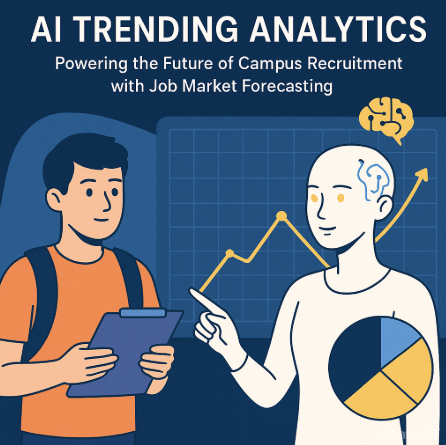
Topics: AI trending analytics placement, Job market forecasting
AI in today’s world has become an essential tool that is transforming campus recruitment methods through its trending analytical placement processes and also provides the status of upcoming opportunities in the job market, resulting in bringing positive changes to how students, recruiters, and institutions approach hiring. By making better use of machine learning and data-driven insights, institutions can achieve 21% better demand alignment, reduce time-to-hire by up to 36%, and significantly improve placement outcomes.
Introduction
The interlinking of AI-trending analytics placement in the campus recruitment process is bringing something new and essential for the future of student employability. The year 2025 has witnessed a rise in AI-driven platforms that change the whole concept of the entire hiring pipeline, from resume screening to data-backed decision-making. These innovations result in more efficiency, accuracy, and fairness for the users and are completely different from the previously used traditional practices. This whole new concept has received a good response in the rapidly evolving employment landscape.
AI-Driven Analytics in Recruitment
AI analytics engines involve the processes that collect and have large numbers or bundles of student data, like academic records, skills, and extracurriculars, to detect key placement trends and help students get placed at companies for a better future. With the help of predictive models such as Random Forests and neural networks, institutions can forecast which profiles are likely to be recruited, leading to smarter allocation of training resources. For example, platforms like mUni ATS deliver end-to-end visibility in campus placements, resulting in a 19% rise in candidate quality and a 25% reduction in hiring cycles.
Forecasting the Job Market
The process that uses AI in forecasting job market demand is a game-changer for workforce planning, as it provides better results in the long run. This empowers placement cells and recruiters to preemptively train students for high-demand roles and adjust strategies when the market shifts.
Numbers That Matter
Several powerful statistics highlight the AI advantage:
- If we talk about numbers, then almost 30% of current U.S. jobs can be fully operated through AI means by the year 2030.
- Machine learning placement systems have boosted efficiency by up to 21% and reduced biases significantly for better results in the long run.
- Predictive placement solutions result in a 25% reduction in time-to-hire and up to 19% higher candidate quality for employers.
- Data-driven interview scheduling and automated resume screening save hundreds of recruiter hours each year with the help of AI-driven methods.
Overcoming Traditional Bottlenecks
Traditional recruitment depends heavily on manual assessments and subjective screening, often leading to bottlenecks and overlooked talent, and is also time-consuming and requires more labour from the employees. But if we talk about AI-driven methods and tools for campus recruitment, then they have the option to enable personalized student recommendations and help institutions to design targeted skill-building programs based on emerging market demands that increase the chance for selection of that student.
Conclusion
We can definitely say that the future of campus recruitment belongs to those who have full knowledge of AI-trending analytics and placement tools, and who have the leverage to advance forecasting job market methods. Institutions and workplaces that adopt these technologies have reported significant and efficient improvements in placement rates, process fairness, and cost-effectiveness.
References
- How AI Can Revolutionize Campus Placements and Internships https://content.bloomingpros.ai/blog/how-ai-can-revolutionize-campus-placements-and-internships
- AI-Powered Job Demand Forecasting https://www.jobspikr.com/blog/ai-powered-job-demand-forecasting/
📌 FAQ Section: AI Trending Analytics Placement & Job Market Forecasting
1. What is AI trending analytics placement in campus recruitment?
AI trending analytics placement refers to the use of artificial intelligence and machine learning tools to analyze student data, forecast hiring trends, and match candidates with opportunities more effectively. It transforms traditional recruitment by automating resume screening, providing insights into skill demands, and reducing biases in hiring decisions. Universities and recruiters use these AI-driven systems to align academic preparation with market requirements, ultimately enhancing student employability. This approach not only accelerates the hiring process but also provides students with a fairer evaluation system. By leveraging AI trending analytics placement, institutions gain a competitive edge in ensuring better placement outcomes.
2. How does AI improve the efficiency of campus recruitment?
AI makes recruitment faster by automating repetitive tasks such as resume sorting, skill-matching, and interview scheduling. With predictive analytics, recruiters can identify which students are more likely to succeed in certain roles, reducing time-to-hire significantly. Reports suggest that AI tools cut hiring cycles by up to 36% while improving candidate quality by nearly 19%. Unlike traditional manual methods, AI provides structured data insights, ensuring that recruiters don’t miss out on qualified candidates. This efficiency allows placement cells to focus on strategic planning and student mentoring rather than administrative burdens.
3. What role does job market forecasting play in student employability?
Job market forecasting uses AI-driven models to predict future demand for specific job roles and skills. By analyzing trends across industries, it helps institutions tailor training programs to better equip students for in-demand roles. For example, if forecasts show rising demand in cybersecurity or data science, placement cells can design workshops and certifications around these areas. This forward-looking approach ensures students aren’t just employable today but are also prepared for the job landscape of the next five years. Essentially, job market forecasting bridges the gap between academia and evolving industry requirements.
4. How do predictive analytics support AI trending analytics placement?
Predictive analytics uses algorithms such as Random Forests, regression models, and neural networks to analyze historical and real-time student performance data. These models forecast the likelihood of placement success for different student profiles. For example, a student with strong academic records but weaker soft skills may be recommended for communication workshops before interviews. Predictive analytics ensures resources are allocated efficiently, helping institutions personalize placement support. Within AI trending analytics placement, predictive analytics plays a central role in aligning student preparation with employer expectations, boosting both placement rates and student confidence.
5. Can AI reduce bias in the recruitment process?
Yes, AI-driven systems significantly reduce human bias in recruitment by relying on objective data rather than subjective impressions. Traditional interviews often involve unconscious bias based on gender, background, or appearance. AI tools, however, assess skills, qualifications, and performance data, ensuring fairer candidate evaluations. When integrated with ethical safeguards, these systems promote inclusivity and diversity. AI trending analytics placement platforms are designed to minimize discrimination, thereby increasing trust between students, recruiters, and institutions. However, continuous monitoring is necessary to ensure algorithms remain unbiased and free from data-driven prejudice.
6. What are the main benefits of AI for recruiters?
Recruiters benefit from AI in multiple ways: reduced hiring time, better candidate matching, and enhanced accuracy in identifying talent. Automated screening filters large volumes of applications within minutes, while natural language processing tools evaluate resumes for relevant keywords and experiences. Job market forecasting helps recruiters anticipate demand shifts, ensuring their hiring strategies remain competitive. Furthermore, AI improves communication efficiency by automating interview scheduling and candidate engagement. Overall, AI integration not only saves time but also provides recruiters with a smarter, data-backed approach to talent acquisition.
7. How do students gain from AI-driven placement systems?
Students benefit from AI trending analytics placement because it offers transparency, fairness, and personalized guidance. Instead of depending solely on grades, AI evaluates extracurriculars, soft skills, and certifications, giving students a holistic placement profile. Job market forecasting further informs students about high-demand skills, motivating them to upskill in relevant areas. Many AI tools also provide feedback reports that guide students on how to improve interview readiness and resume quality. These systems empower students by aligning their preparation with real-world industry expectations, improving employability prospects.
8. How accurate are AI-based job market forecasts?
AI-driven forecasts are highly accurate, especially when large datasets are analyzed. By studying employment patterns, industry growth rates, and skill trends, AI systems predict future demand with precision. For instance, forecasts may indicate a 25% rise in demand for cloud computing specialists over the next five years. Such data allows institutions to redesign training modules accordingly. While external factors like economic downturns may impact forecasts, overall accuracy remains strong. AI trending analytics placement platforms continuously refine their predictions with new data, ensuring adaptability and relevance.
9. What challenges exist in adopting AI for campus recruitment?
Despite its benefits, challenges include high implementation costs, data privacy concerns, and the risk of algorithmic bias. Smaller institutions may struggle to afford advanced AI platforms. Moreover, reliance on student data requires strict compliance with data protection regulations to safeguard privacy. Another challenge is ensuring faculty and recruiters adapt to the new technology. Without proper training, AI tools may be underutilized. Addressing these challenges requires a balanced approach where institutions invest in ethical AI, staff training, and robust cybersecurity measures.
10. How do AI platforms handle resume screening?
AI-powered resume screening tools use natural language processing to scan thousands of applications within seconds. They highlight relevant keywords, work experiences, and educational backgrounds aligned with job descriptions. Unlike manual screening, AI avoids oversight and ensures qualified candidates aren’t missed. Some platforms even rank resumes based on suitability scores, helping recruiters shortlist quickly. In AI trending analytics placement, resume screening not only speeds up recruitment but also ensures fairness by focusing on skills and qualifications rather than subjective impressions.
Penned by Ankit Raj
Edited by Ridhima Sharma, Research Analyst
For any feedback mail us at [email protected]
Streamline Your Hiring with Eve Placement’s Custom Assessments
Eve Placement helps you engage, assess, and recruit top talent through tailored hiring challenges that go beyond resumes. From technical quizzes and real-world case studies to psychometric evaluations and audio/video submissions, our platform enables smarter, data-driven hiring decisions. Advanced security features ensure authenticity and eliminate fraud, giving you reliable results. Ready to hire better? Know More.
Mail us at [email protected]