
How AI Tools Influence Shortlisting in Recruitment
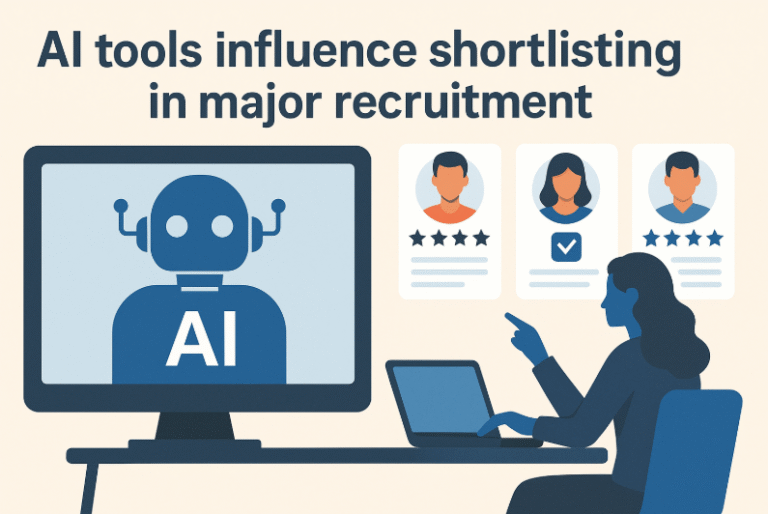
Recruitment is a mix of speed, judgment and pressure. With thousands of applications pouring in for a role, large companies rely on AI systems to help them sort the noise. However, AI systems do not replace recruiters. They change how the early stages work and what gets noticed. Recruiters still guide the process.
Faster Screening Occurs when the Volumes Increase Exponentially
AI works well when it has to sift through large pools of applicants. Recruiters used to spend hours reading each resume line by line. Now, they can just upload the resumes into AI tools that sort and score each profile. The software looks for job experience, required skills, education, and project keywords. With the help of AI, sorting that used to take days now just takes minutes. The faster turnaround helps companies respond faster and keep the hiring process moving.
Better Matching of Skills to Job Needs
Nowadays, recruitment is not a checklist. The companies want people who can actually do the work. They do not care if the resume looks different. AI models can identify the skill patterns, experience, and abilities that humans may miss. Someone who may not have a specific job title, but can still possess the problem-solving and multitasking skills required for a corporate role. This gives the applicants a fair chance.
Consistency and Fewer Human Blind Spots
While human judgment is important, it also brings bias. AI tools do not eliminate bias completely; however, they can apply rules consistently. When the recruiters set rules, the systems evaluate every applicant on the scale. The effect of preferences or assumptions goes down. The lower effect of preferences or assumptions makes the shortlist more organized.
Spotting Red Flags Early
AI tools catch missing information, vague role descriptions, inflated job titles, and inconsistencies in the application. When this happens, recruiters can act away from waiting until later in the hiring cycle. AI tools flag those problems early before the process moves forward, thus saving time for recruiters and for candidates. Recruiters keep the focus on the people, not on the paperwork. Many people fear that AI will take over hiring, but it usually does the opposite. AI frees recruiters to build relationships. When the AI system handles tasks such as sorting resumes and cross-checking qualifications, recruiters can focus on interviews, candidate experience, and deeper assessment. The human element becomes stronger because the administrative load becomes lighter.
Possible Challenges and the Need for Oversight
AI is not perfect. It can make mistakes. If the data AI learns from is skewed, the rankings AI generates can be skewed too. Some tools over‑emphasize keywords and may end up pushing talent to the background. Other tools may misunderstand context. They might misread job gaps that happen because of health or family reasons. That is why strong oversight matters. Recruiters need to review the shortlists, adjust the rules and make sure the system is not leaving out people.
As the world progresses towards the use of artificial intelligence, recruitment becomes relatively easy compared to the traditional way. Although AI cannot replace human recruiters, it surely cuts down the time taken. With the correct supervision, shortlisting through AI can make recruitment more efficient.
References
[1] A. Tursunbayeva, “Artificial intelligence and digital data in recruitment,” International Journal of Information Management, 2025. [Online].
Available: https://www.sciencedirect.com/science/article/pii/S0263237325000416
[2] “Application of Artificial Intelligence in Recruitment and Selection,” Academic Journal of Science and Technology, vol. 9, no. 2, 2024. [Online].
Available: http://researchgate.net/publication/381287541_Application_of_Artificial_Intelligence_AI_in_Recruitment_and_Selection_The_Case_of_Company_A_and_Company_B
[3] J. Fraij and V. László, “Artificial intelligence impact on the recruitment process: A literature review,” International Journal of Engineering and Management Sciences, vol. 6, no. 1, pp. 14–22, 2021. [Online].
Available: https://www.researchgate.net/publication/351630517_literature_Review_Artificial_Intelligence_Impact_on_the_Recruitment_Process
[4] “The Role of AI in Recruitment: A Systematic Literature Review,” Journal of Future Workforce Systems, 2025. [Online].
Available: https://zenodo.org/records/15572327
FAQs :-
1. What is AI in Recruitment Process?
AI in Recruitment Process refers to the use of artificial intelligence technologies to streamline the hiring process by analyzing resumes, matching candidates’ skills to job requirements, and automating repetitive tasks. By implementing AI in Recruitment Process, companies can reduce manual effort, save time, and ensure that qualified candidates are identified efficiently, making recruitment more accurate and structured.
2. How does AI in Recruitment Process improve hiring speed?
AI in Recruitment Process improves hiring speed by quickly processing large volumes of applications and scoring candidates based on experience, skills, and project relevance. With AI in Recruitment Process, tasks that once took days, such as reviewing resumes line by line, can now be completed in minutes. This faster screening allows recruiters to respond promptly to top candidates and move the hiring process along without unnecessary delays.
3. Can AI in Recruitment Process replace human recruiters?
AI in Recruitment Process cannot completely replace human recruiters because hiring decisions still require judgment, interpersonal skills, and understanding of organizational culture. However, AI in Recruitment Process supports recruiters by handling early-stage filtering, cross-checking qualifications, and identifying key skills, freeing human recruiters to focus on interviews, candidate engagement, and final selection decisions.
4. How does AI in Recruitment Process ensure better skill matching?
AI in Recruitment Process ensures better skill matching by analyzing candidates’ experience patterns, education, certifications, and project work. Even if a candidate does not have a specific job title, AI in Recruitment Process can identify relevant problem-solving, multitasking, and technical skills. This allows applicants to be assessed fairly based on capabilities rather than just titles or resume format.
5. Does AI in Recruitment Process reduce bias in hiring?
AI in Recruitment Process can reduce bias by applying consistent evaluation criteria to all applicants, which minimizes the influence of human preferences or assumptions. While AI in Recruitment Process cannot completely eliminate bias, it ensures that the rules set by recruiters are applied uniformly, resulting in a more organized and fair shortlist of candidates.
6. How does AI in Recruitment Process help spot red flags?
AI in Recruitment Process helps identify red flags such as gaps in employment, vague job descriptions, inflated roles, or inconsistent information early in the recruitment cycle. By flagging these issues, AI in Recruitment Process enables recruiters to address potential problems sooner, saving time for both recruiters and candidates and ensuring that only qualified applicants move forward.
7. What challenges exist with AI in Recruitment Process?
Despite its benefits, AI in Recruitment Process faces challenges including dependence on historical data, potential overemphasis on keywords, and occasional misinterpretation of career gaps or context. AI in Recruitment Process requires proper oversight to ensure that candidates are not unfairly excluded and that the system remains balanced and accurate in its recommendations.
8. How can companies optimize AI in Recruitment Process?
Companies can optimize AI in Recruitment Process by regularly updating the system rules, monitoring candidate shortlists, and training AI on unbiased and comprehensive data. Optimizing AI in Recruitment Process ensures that the technology works in harmony with human judgment, enhancing the recruitment process rather than replacing critical human decision-making.
9. Why is oversight critical in AI in Recruitment Process?
Oversight is critical in AI in Recruitment Process because, without careful monitoring, AI may misread resumes, overlook talented candidates, or give undue weight to irrelevant keywords. Human recruiters must supervise AI in Recruitment Process outputs, adjust filters as needed, and ensure that the final selection reflects both the automated analysis and human insights.
10. What benefits do candidates experience from AI in Recruitment Process?
Candidates benefit from AI in Recruitment Process by receiving faster responses, fair evaluation based on actual skills, and equal opportunities regardless of resume style. With AI in Recruitment Process, the hiring process becomes more transparent, efficient, and focused on real capabilities, giving all applicants a better chance to be considered for their desired roles.
Penned by Arushi
Edited by Jinal Kapadia , Research Analyst
For any feedback mail us at [email protected]
Streamline Your Hiring with Eve Placement’s Custom Assessments
Eve Placement helps you engage, assess, and recruit top talent through tailored hiring challenges that go beyond resumes. From technical quizzes and real-world case studies to psychometric evaluations and audio/video submissions, our platform enables smarter, data-driven hiring decisions. Advanced security features ensure authenticity and eliminate fraud, giving you reliable results. Ready to hire better? Know More.
Mail us at [email protected]