
The Next Wave: AI in the Student Learning Revolution
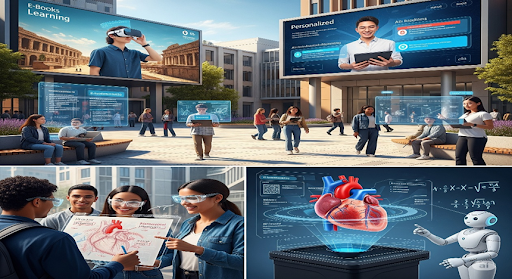
AI in Education
Education is a vital method in training the human resource of a nation. AI has brought a transformative change in every sector, including the education sector. AI has reshaped traditional learning methods. In today’s times, education tech trends are focused on personalised, interactive, and AI-driven learning experiences. AI-learning students most commonly use chatbots, virtual assistants, image recognition, speech recognition, etc., to educate themselves.
Ed tech trends are more prevalent in higher education than in secondary education. India has seen notable innovation in the higher education system and the integration of technology to facilitate remote learning and digital classrooms. NEP 2020 is following a holistic approach towards education, which is focusing on providing flexible programs that help students to develop industrial skills and knowledge to address complex societal challenges. AR and VR are examples of ed tech that provide immersive learning experiences to students. For example, in the medical field, AI learning students will understand complex medical concepts more easily with the help of AR and VR real-life effects.
Role of AI in Education
- Personalised Learning: Knowledge gap is one of the disadvantages of traditional school. Not every student in schools has the same level of knowledge and IQ. Every student learns at their own pace. AI makes personalised learning schedules and tailors learning resources according to each student’s needs.
- Smart Learning resources: AI can generate learning with visualisation effects and simulation, making it easy to understand difficult concepts.
- Automation: Administration tasks, grading, and replying to students become more efficient and less time-consuming.
- Accessible to special needs students: AI has opened new ways to interact with special students.
- AI tutor: Students can learn outside the classroom, and the AI doesn’t need extra time like teachers to explain complex topics to students. Students can ask many doubts from the AI tutor without any hesitation.
According to Forbes, 60% of educators use AI in the classroom, and AI-powered educational games are the most common AI tools used in classrooms, followed by adaptive learning platforms and automated grading systems.
Most Common AI Tools Used in Classrooms
Recent literature reveals that there is an upward trend in scientific publication on AI used as a tool to support more immersive and responsive learning systems. So researchers are finding various different AI-driven teaching methods to provide equitable education to all. According to Forbes, 60% of teaching is using AI in the classroom in the higher education system.
Every revolution comes with its pros and cons.
Pros of Education Technology
- Increased Engagement: AI makes personalised content and learning schedules for students, which makes them special. This encourages students to study hard and effectively during lessons.
- Less pressure: AI learning students feel less embarrassed and pressured as they don’t need to ask queries in front of the whole class. Instead, they type in AI chatbots and virtual assistants and get it cleared.
- 24/7 access to learning: Students can study outside of the classroom without any specific time and place constraint.
Cons of Education Technology
- Bias: AI-driven infrastructure requires huge investment, and every institution doesn’t have the ability to bear such cost, so this leads to inequality in terms of quality of education.
- Privacy Concern: Student data collection and analysis raises various privacy concerns related to students. So we need a strong regulation to prevent the misuse of student data.
- Overdependence on Technology: Students are becoming consumers of technology rather than inventors of technology. AI is reducing young youth creativity and critical thinking ability.
- Ethical Consideration: AI in education raises questions related to transparency, accountability, and equity.
Conclusion
AI has emerged as a transformative force in education, with potential benefits, but it is essential to consider the associated risks with it. Education technology trends include AR/VR tools, AI tutors, simulation, etc., though these tools will improve student learning experience, retention, and understanding of concepts. A recent study shows that AI-driven has reduced the gap between academic outcomes and industrial demands. In India, the unemployment rate among the educated is at an alarming rate, so the integration of technology in education will help reduce the unemployment rate. The new education system will equip AI learning students with practical knowledge that will actually help them in their jobs.
But the government has to make strict regulations regarding privacy, transparency, accountability, and equity concerns related to AI-driven education systems.
FAQs
Q1. What is AI in education?
AI in education refers to the use of artificial intelligence tools such as chatbots, adaptive platforms, and AR/VR to enhance learning.
Q2. How does AI in education support personalized learning?
AI in education tailors content, tracks progress, and creates flexible learning paths to match each student’s unique pace and needs.
Q3. What are the benefits of AI in education for teachers?
AI in education automates grading, manages administrative tasks, and provides smart insights, saving teachers time and effort.
Q4. How do students benefit from AI in education?
AI in education offers 24/7 access, reduces classroom pressure, and provides immersive simulations that improve understanding.
Q5. Which tools are commonly used for AI in education?
Popular tools of AI in education include AI tutors, chatbots, adaptive learning platforms, automated grading, and educational games.
Q6. What are the pros of AI in education?
AI in education increases engagement, offers personalized content, provides flexible access, and improves retention of knowledge.
Q7. What are the cons of AI in education?
Challenges of AI in education include bias, privacy risks, high costs, overdependence on tech, and ethical concerns.
Q8. How does AI in education help special needs students?
AI in education enables new learning methods, using voice, text, and visual recognition to support accessibility for diverse learners.
Q9. Is AI in education widely adopted in classrooms?
Yes. According to Forbes, about 60% of educators use AI in education, especially for adaptive platforms and grading systems.
Q10. What is the future of AI in education?
The future of AI in education lies in immersive AR/VR, equitable access, data-driven insights, and aligning skills with industry demands.
References
- https://www.forbes.com/advisor/education/it-and-tech/artificial-intelligence-in-school/
- https://www.digitallearninginstitute.com/blog/education-technology-trends-to-watch-in-2025
- https://www.statista.com/statistics/1001039/india-unemployment-rate-by-education-level/
- https://www.ed.gov/sites/ed/files/documents/ai-report/ai-report.pdf
- https://www.ed.gov/sites/ed/files/documents/ai-report/ai-report.pdf
- file:///C:/Users/sonka/Downloads/ssrn-4901474.pdf
- https://www.academikamerica.com/blog/the-next-wave-emerging-trends-in-e-learning-by-2025
- https://www.forbes.com/advisor/education/it-and-tech/artificial-intelligence-in-school/
Penned by Manshika
Edited by Sneha Seth, Research Analyst
For any feedback mail us at [email protected]
Streamline Your Hiring with Eve Placement’s Custom Assessments
Eve Placement helps you engage, assess, and recruit top talent through tailored hiring challenges that go beyond resumes. From technical quizzes and real-world case studies to psychometric evaluations and audio/video submissions, our platform enables smarter, data-driven hiring decisions. Advanced security features ensure authenticity and eliminate fraud, giving you reliable results. Ready to hire better? Know More.
Mail us at [email protected]