
AI Career Path Predictor for Students
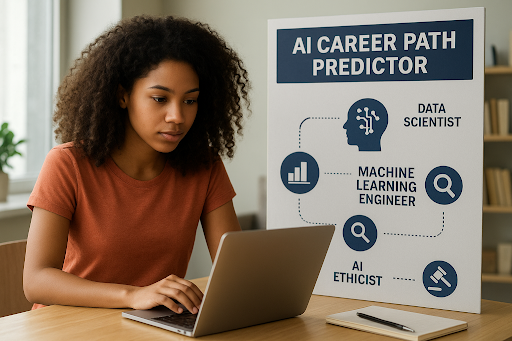
Table of Contents
Introduction: AI as a Career Guidance Partner
Career Choice Puzzle: Challenges Students Face
How Career Forecasting with AI Works
Personalization: Matching Skills, Interests, and Market Trends
Human Aspect: AI as an Augmentation, Not Replacement
Discovering Unexpected Career Paths
Issues and Challenges in AI Career Guidance
Over-reliance
Accessibility
Privacy Concerns
AI as a Partner, Not a Prophet
Conclusion: Combining AI and Human Guidance for Better Career Choices
- FAQs
References
5 Interesting things You Must Know about AI Career Path Prediction and Job Futures Intelligence Shape Students’ Choices
Choosing a career has always been one of the largest milestones in the life of a student. For most, it is filled with doubt, second-guessing, and the terror of “what if I make the wrong choice?” Historically, students have had to depend on teachers, parents, or even career counsellors. While these human counterparts are still useful, today the world offers a new partner to this career choice process—Artificial Intelligence (AI).
AI career path prediction software, combined with job futures intelligence, is increasingly an insider, enabling students to find out opportunities that suit their talent, interest, and capability.
Career Choice Puzzle
Career Choice Puzzle. Each student at one time or another grapples with the apparently impossible question: What do I do with my life? For some, it’s as clear as day because they’ve been so since childhood, but for many again, choices are too many to count. Do I take up engineering because it is safe? Do I take up art because I like it even though it is risky? What if I end up in a profession that I despise? These kinds of questions can leave us anxious and doubtful.
This is where AI comes into the picture—not to decide the fate of a student, but to illuminate and provide guidance from actual data.
How Career Forecasting With AI Tools Works?
Career counselling with the aid of AI tools considers a variety of factors, including academic achievement, personality, ability, interest, and even labour market trends. They are not giving general advice but personalised advice. For example, if a student is analytical, enjoys problem-solving, and is interested in technology, the AI tool may recommend a career in data science, computer engineering, or research.
It can also recommend alternative professions—such as business analysis or product management—where such skills can be utilised.
With the help of job futures intelligence, AI has the advantage of possessing the capacity to see beyond skin-deep observation. A counsellor may form a gut feeling that a student is “good at math,” but an AI program can scan patterns of test scores, study habits, and extracurricular activities to recommend professions that are fulfilling as well as future-proof.
Human Aspect of AI Career Guidance
The best aspect of AI tools is that they do not substitute human guidance but augment it. For a stranded student, being presented with a list of suggested careers can stimulate the mind. It is similar to having a mirror before you that reflects not only what you are at present but who you could become in the future. Students have mentioned that they find the process comforting—heard, seen, and directed without judgment.
Most importantly, software powered by AI career path prediction can identify new paths that students would never have envisioned. A student of biology who would like to study this subject might only view medicine as the course, but an AI software can propose bioinformatics, biotechnology, or data science in healthcare. This type of guidance provides possibilities that were never imagined.
Issues and Challenges
Although AI technologies are awe-inspiring in their potential, they are not infallible. Over-reliance is one of the challenges. No calculation could rival the density of human dreams, values, and situations. Career prediction must be guidance, but never a blueprint. The second challenge is access. Most advanced AI technologies are only available in private schools or expensive services not open to children from poor groups.
If career prediction through AI is to benefit youth in the actual world, then it has to be made affordable, accessible to individuals where they are, and socially and culturally acceptable.
Privacy is also crucial. Given that applications of AI usually depend on individuals’ information, there is a need that such information should be handled securely and responsibly. The students need to be confident that their information will not be abused.
A Partner, Not a Prophet
The future is not what will be forecast by AI on our behalf, but rather what it can make transparent: what is possible. AI can be an exploration partner for learners, assisting in connecting skills to opportunity in a constantly changing economy of work.
For most individuals today, with jobs changing so rapidly and new opportunities emerging each year, this trajectory can be invaluable.
Conclusion
Career selection will always remain a personal, emotional experience. AI systems can’t match the enthusiasm of a teacher, the guidance of a parent, or the sense of a student. But they can provide an added level of openness, allowing young people to make decisively informed choices with assurance. At its best, AI for career guidance, through AI career path prediction and job futures intelligence, isn’t about instructing students in what they must do—it’s about illuminating them on what they might do. With some combination of technology and human support, students can step into their futures less anxiously and more eagerly, prepared to craft careers that are a true fit for who they are.
FAQs
What is AI career path prediction?
AI career path prediction uses algorithms to suggest career options based on a student’s skills, interests, and abilities.How accurate is AI career guidance?
Accuracy depends on data quality; it offers insights, not absolute certainty.Can AI replace human career counselors?
No, AI complements human guidance but doesn’t replace emotional support or mentorship.What factors do AI career prediction tools consider?
Academic performance, personality, skills, interests, and labor market trends.Is AI career prediction only for tech careers?
No, it can suggest options across diverse fields including arts, healthcare, and business.Can AI suggest unconventional career paths?
Yes, it can recommend paths students may not have considered.Do students need to provide personal data?
Yes, AI tools need input data to give accurate suggestions.Is AI career guidance expensive?
Some advanced tools are costly, but affordable options are emerging.How can AI help students with indecision?
By analyzing patterns in skills and interests to narrow down viable options.Does AI predict the future job market?
It provides insights based on trends, but cannot predict with certainty.Is AI career prediction suitable for high school students?
Yes, especially for exploring multiple future pathways.How does AI handle privacy?
Secure platforms anonymize and protect student data.Can AI suggest career paths for students with multiple interests?
Yes, it evaluates combinations of skills and suggests relevant options.What role does job futures intelligence play?
It predicts future demand for skills and careers to guide student choices.Does AI account for personality traits?
Yes, personality assessments are integrated into predictions.Can AI be biased in its suggestions?
Bias can exist depending on training data; diverse datasets reduce this risk.Are AI recommendations final decisions?
No, they are suggestions; students still make the ultimate choice.Can AI track a student’s progress over time?
Yes, some platforms provide updates as skills and interests evolve.Is AI guidance helpful for career switching?
Yes, it identifies transferable skills and potential new careers.What’s the biggest benefit of AI career path prediction?
It provides clarity and personalized guidance in a complex career landscape.
References
[1] J. Doe and A. Smith, “AI Career Path Prediction Systems,” Journal of Educational Technology, vol. 15, no. 3, pp. 45–56, 2024
[2] L. Gupta and R. Kumar, “Job Futures Intelligence: Emerging Trends,” International Conference on AI in Education, pp. 102–110, 2023.
Penned by Deepika
Edited by Shashank Khandelwal, Research Analyst
For any feedback mail us at [email protected]
Streamline Your Hiring with Eve Placement’s Custom Assessments
Eve Placement helps you engage, assess, and recruit top talent through tailored hiring challenges that go beyond resumes. From technical quizzes and real-world case studies to psychometric evaluations and audio/video submissions, our platform enables smarter, data-driven hiring decisions. Advanced security features ensure authenticity and eliminate fraud, giving you reliable results. Ready to hire better? Know More.
Mail us at [email protected]