
Getting a college degree feels awesome. You have spent years studying, researching, writing papers, staying up late studying all that hard work is starting to pay off, and now you’re about to receive your degree. But graduation comes with a bigger question: “What am I going to do now?”
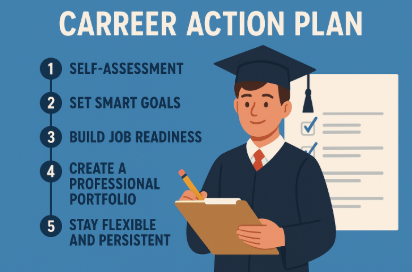
You’re either excited or apprehensive—or maybe both! A career action plan is the solution. Use it as your strategy, a time-tested plan for taking you from new graduate to empowered job candidate, and ensuring you have the job readiness skills you need.
Step 1: Understand Yourself
Before you send out any applications, take a little time to figure out who you are – professionally. Self-assessment is the starting point for your search.
Ask yourself:
- Which classes or projects did I enjoy?
- What do I do naturally well?
- Which type of work environment energizes me, and which type just drains me out?
Another part of the process is refining your preferences through personality or career assessment tools: StrengthsFinder, Myers-Briggs, or the list goes on. Once you know yourself, then it’s about jobs that fit you, not just jobs that are great on paper.
Step 2: Set Achievable Goals
The bases should be laid down on the more specific and concrete grounds, so that you can easily incorporate the steps into your career action plan. Here come the SMART Goals: Specific, Measurable, Achievable, Relevant, and Time-bound.
For example:
- Specific: I will be applying to five entry-level marketing jobs each week.
- Measurable: I will be using a spreadsheet to track applications and monitor my logistics.
- Achievable: I will only apply to companies that actively recruit recent graduates.
- Relevant: I will focus on roles that include my writing skills and social media experience.
- Time-bound: I will try to land a job within three months of graduating.
It is not that any of us would allow ourselves to lose track or get overly pressured.
Step 3: Put Together Your Job Readiness Toolkit
It’s OK to have a degree! But employers are asking more than a degree; they want students who can communicate, work in teams, and solve problems. Workplace readiness comes in here! So, here’s how you can develop it:
- Develop your soft skills: Practice active listening, presentation skills, and teamwork.
- Build your hard skills: Take an online course in an unfamiliar tool or software used in your industry.
- Gain work experience: Internships, volunteer work, and freelancer gigs are all relevant work a student can use to make their resume more competitive.
Think of fitness for job readiness – your degree has gotten you to the start line, but job readiness could potentially carry you through the finish line!
Step 4: Showcase Your Work
Your resume is your resume, but certainly not the only thing the employer is going to want to see. A professional portfolio will give you some serious leverage.
Some things to include:
- Class projects that are relevant to your field
- Internship examples of work
- Certifications and awards
- Positive comments from professors or mentors
When one can show an employer something rather than just tell them, then the employer will be able to visualize the candidate taking on the tasks in question.
Step 5: Adapt & Persist
In real life, the first job is rarely a dream job. And that should be okay. Stay open to experiences that build your experience and network. Every job gives you new insight, even if it is not the job that you envisioned.
Yes, you may get rejected. Rejection means that you’ve moved one step closer to the right one-it’s not a reflection on your ability.
Conclusion
The entire plan is a strategy offered to a fresh graduate-the career plan acts as a stride toward direction and, more importantly, instills confidence in the future, alleviating long-term success. You should not just be looking for a job; rather, you should be building the foundation for your career. Everything is a win. When you walk along the right path, success will eventually be achieved.
Commonly Asked FAQs:
1. What is a career action plan for new graduates?
It is a structured roadmap that helps fresh graduates transition from college into the professional world with confidence and clarity.
2. Why do new graduates need a career action plan?
A career action plan ensures focus, helps in setting achievable goals, and prevents graduates from feeling lost after college.
3. How does self-assessment fit into a career action plan for new graduates?
It helps graduates identify strengths, weaknesses, and career preferences, guiding them toward roles where they will thrive.
4. What tools can new graduates use for self-assessment?
Popular tools include StrengthsFinder, Myers-Briggs, and Holland Code assessments to match personality with careers.
5. How do SMART goals help in career planning?
SMART goals provide structure, making career objectives specific, measurable, achievable, relevant, and time-bound.
6. Can a career action plan for new graduates prevent job search frustration?
Yes, it reduces confusion, increases confidence, and gives graduates a practical strategy to follow.
7. Should new graduates set short-term or long-term goals?
Both are important—short-term goals build immediate skills while long-term goals provide direction for career growth.
8. How important is networking in a career action plan?
Networking helps graduates connect with industry professionals, opening opportunities that may not be advertised.
9. What is a job readiness toolkit?
It includes a polished resume, portfolio, communication skills, and relevant hard and soft skills for the workplace.
10. How can soft skills help new graduates?
Soft skills like teamwork, adaptability, and communication make graduates more employable in any field.
11. What hard skills should new graduates focus on?
They should focus on industry-specific technical skills, software knowledge, and certifications to stay competitive.
12. Can volunteering improve a graduate’s career action plan?
Yes, volunteering provides experience, builds confidence, and strengthens resumes when formal work experience is limited.
13. Why is showcasing work important for new graduates?
Employers value proof of capability, and a portfolio demonstrates practical skills beyond a resume.
14. What should be included in a graduate portfolio?
Class projects, internship work, certifications, and recommendations from professors or mentors.
15. How do online courses support a career action plan?
They help graduates fill knowledge gaps, stay updated, and demonstrate initiative to employers.
16. Is rejection a normal part of career planning?
Yes, rejection is common but should be viewed as a learning experience leading to better opportunities.
17. How can new graduates stay motivated during the job hunt?
By celebrating small wins, staying persistent, and focusing on long-term goals rather than setbacks.
18. Should graduates only apply for jobs in their field?
Not always. Broader opportunities can provide valuable experience and transferable skills.
19. How do internships support a career action plan?
Internships give real-world exposure, practical skills, and networking opportunities critical for career growth.
20. Can freelancing be part of a graduate’s career plan?
Yes, freelancing builds experience, enhances portfolios, and demonstrates self-motivation to employers.
21. How does adaptability help new graduates in career planning?
Being adaptable ensures graduates can adjust to changes in job markets and workplace demands.
22. What role does persistence play in career success?
Persistence helps graduates overcome challenges, stay focused, and eventually land meaningful roles.
23. How can graduates track their career progress?
Using journals, spreadsheets, or career apps to record applications, skills gained, and feedback.
24. Should graduates seek mentorship?
Yes, mentors provide guidance, feedback, and networking opportunities that accelerate career growth.
25. How can graduates identify transferable skills?
By analyzing past academic and personal experiences that demonstrate problem-solving, leadership, and communication.
26. Why are communication skills vital in a career action plan?
Clear communication improves teamwork, interview performance, and professional relationships.
27. How do new graduates handle lack of experience?
By highlighting transferable skills, internships, volunteering, and showcasing strong academic projects.
28. Is career planning different for different industries?
Yes, while the steps are similar, specific skills and experiences vary across industries.
29. How does career planning reduce anxiety for new graduates?
Having a structured path gives clarity, making the transition from school to work less overwhelming.
30. Can graduates change their career action plan?
Absolutely. Career plans are flexible and should adapt as interests and opportunities evolve.
31. How can goal setting improve job readiness?
It keeps graduates focused and ensures every action aligns with their long-term career vision.
32. Should new graduates focus on certifications?
Yes, certifications validate knowledge, enhance resumes, and make candidates stand out.
33. How does building a LinkedIn profile support a career plan?
A professional profile helps in networking, job searching, and showcasing skills to recruiters.
34. How do employers view a well-prepared graduate?
They see them as proactive, capable, and ready to contribute immediately to the workplace.
35. Can a career action plan help with long-term career growth?
Yes, it ensures consistency, clarity, and progress across different stages of a graduate’s career.
36. How does resilience affect career planning?
Resilience allows graduates to recover from setbacks and continue moving toward their goals.
37. Should graduates tailor their resumes for each job?
Yes, tailoring resumes to highlight relevant skills increases the chances of getting noticed.
38. What role does continuous learning play in career success?
It keeps graduates updated with industry trends and adaptable to evolving roles.
39. How does a career action plan build confidence?
It provides structure and clarity, helping graduates believe in their ability to succeed.
40. Why is creating a career action plan essential for new graduates?
Because it transforms uncertainty into a clear pathway, preparing graduates for long-term success.

References
- How to create your career in 4 simple steps
- How to Create a Goal-Oriented Career Development Plan
- Create a Career Development Plan