
Instant Feedback on Aptitude Tests and Interviews: 8 Steps to Improve Recruitment Outcomes
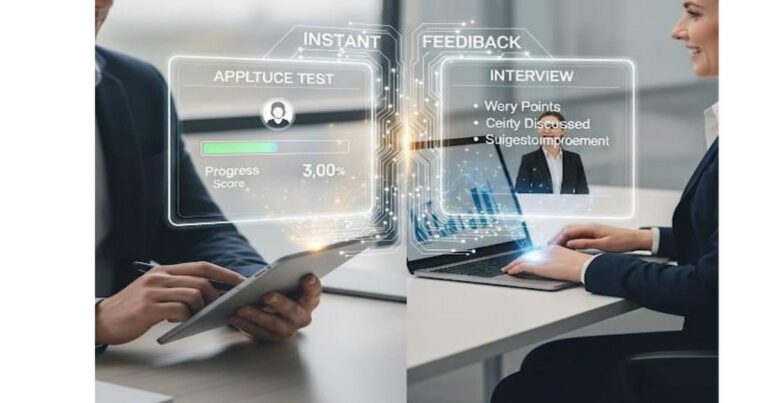
Traditional Recruitment ways frequently involve lengthy stay ages between original assessments, interviews, and final opinions, leaving campaigners uncertain and employers vulnerable to losing top talent.
Implementing structured comment practices ensures that aptitude assessments and interviews grow to be more than evaluation checkpoints—they become opportunities for getting to know possibilities for each facet.Furnishing on-the-spot feedback during the reclamation process not only enhances the seeker experience but also improves decision-making for employers
Here are 8 steps to improve recruitment strategies with instant feedback mechanisms:
1: Define Clear Evaluation Criteria
Instant comments can be powerful if they’re firmly grounded in obvious and measurable evaluation standards.
Employers should establish unique benchmarks for flair checks (e.g., problem-solving, numerical reasoning, logical evaluation) and interviews (e.g., verbal exchange abilities, technical knowledge, cultural health).
These benchmarks must be communicated to applicants prematurely so that they understand what’s being assessed.
2: Automate Feedback for Aptitude Tests
Modern evaluation structures allow employers to offer automated, real-time remarks right away after applicants’ whole aptitude assessments. Instead of only displaying a rating, systems can highlight strengths (e.g., robust in fact interpretation) and areas for development (e.g., desire for exercise in summary reasoning).
This on-the-spot reaction gives candidates clarity while lowering administrative effort for recruiters.
3: Train Interviewers in Constructive Feedback Delivery
Interviews are more subjective than exams; however, structured remarks are still vital. Recruiters and interviewers have to learn to deliver positive, balanced comments that are specific and actionable.
For example, in preference to pronouncing “your technical solution changed into susceptible,” interviewers should say, “You validated desirable foundational know-how; however, you want to bolster carried-out coding trouble-fixing beneath time pressure.”
Recruiters can input scores during interviews, and applicants can receive summary notes rapidly after the consultation. This no longer only accelerates the system but also reduces human blunders or forgotten details, which could arise if feedback is not on time.
4: Use Digital Tools for Real-Time Scoring
Integrating applicant tracking structures (ATS) and virtual scoring equipment allows comments to be recorded and shared right away. Recruiters can input scores during interviews, and applicants can receive summary notes rapidly after the consultation. This no
longer only accelerates the system but also reduces human blunders or forgotten details, which could arise if feedback is not on time
5: Balance positive and developmental insight
Effective response is not only about highlighting the weaknesses—it should balance the recognition of strength with areas for improvement.
Candidates are more likely to accept the response and attach positively when they feel that their efforts are given importance. For example, the reaction may begin with acknowledgment of strong communication skills before addressing gaps in analytical logic.
6: Personalize the response to the candidate engagement
General reactions such as “not chosen due to lack of fit” disappoint candidates. The personal response, even if brief, shows respect for the candidate’s time.
Employers can use structured templates that allow quick adaptations—for example, “You performed well in logical but need to improve time management during problem-solution tasks.”
7: Include feedback in continuous learning
Quick response should not only serve the candidates but also help employers in refining their recruitment process.
Analysis of response trends can suggest that the qualification tests are very difficult, the interview questions are unclear, or the evaluator is inconsistent.
8: Close the Loop with Actionable Next Steps
Feedback is only when it includes steering for candidates’ future boom. Employers can endorse resources, practice regions, or may be endorse reapplying after ability improvement.
Conclusion
Instant remarks on flair tests and interviews transform the recruitment method right into an obvious, attractive, and developmental experience.
By following these **eight steps—defining criteria, automating take a look at remarks, schooling interviewers, leveraging virtual gear, balancing insights, personalizing responses, the usage of remarks for continuous studying, and remaining with actionable.
steps—employers can beautify candidate satisfaction, reduce hiring delays, and support their skills pipeline.
In an aggressive task marketplace, remarks are no longer optionally available; they’rea strategic necessity.
References
[1] LinkedIn Talent Solutions, Global Talent Trends 2022: The Reinvention of Company Culture, Jan. 2022. Available: https://business.linkedin.com/talent-solutions/global-talent-trends/archival/global-talent-trends-january-2022 LinkedIn
[2] SHRM, Feedback to and from Candidates Will Improve Your Hiring Process, Jan. 12, 2018. Available: https://www.shrm.org/topics-tools/news/talent-acquisition/feedback-to-candidates-will-improve-hiring-process SHRM
[3] SHRM, Communicating with Job Candidates, Feb. 6, 2013. Available: https://www.shrm.org/topics-tools/news/talent-acquisition/communicating-job-candidates.
FAQ: Instant Feedback placement test
This FAQ focuses on the growing importance of instant feedback placement test strategies and AI-powered assessments in recruitment. Below are the most frequently asked questions that help recruiters and organizations enhance their hiring outcomes.
1. What is an instant feedback placement test?
An instant feedback placement test is an aptitude or skill-based assessment that delivers real-time results to candidates and recruiters. It eliminates delays by providing immediate insights into candidate performance, enabling faster hiring decisions.
2. How does an instant feedback placement test improve recruitment outcomes?
The instant feedback placement test improves recruitment by reducing turnaround time, identifying top talent quickly, and eliminating manual evaluation errors. It allows HR teams to act on candidate insights without waiting for manual scoring.
3. Why should companies use instant feedback placement tests?
Using an instant feedback placement test enhances candidate experience, streamlines evaluations, and supports data-driven hiring decisions. It ensures that applicants are assessed fairly and quickly, improving overall recruitment efficiency.
4. What role does AI play in instant feedback placement tests?
AI enhances the instant feedback placement test by analyzing responses, detecting patterns, and generating predictive insights. AI-based analytics help recruiters understand cognitive, behavioral, and technical skills beyond surface-level results.
5. What are the 8 steps to improve recruitment using instant feedback placement tests and AI analytics?
-
Define clear assessment goals
-
Choose a reliable instant feedback placement test platform
-
Integrate with your applicant tracking system
-
Set up automated, real-time scoring
-
Use AI analytics to evaluate test results
-
Personalize interview rounds using test data
-
Automate candidate shortlisting
-
Continuously improve test formats and questions
6. Can an instant feedback placement test reduce hiring bias?
Yes. An instant feedback placement test offers standardized scoring and removes subjective interpretation. When combined with AI analytics, it promotes unbiased and inclusive hiring decisions.
7. Are instant feedback placement tests suitable for all job roles?
Absolutely. Whether you’re hiring for tech, marketing, customer service, or finance roles, an instant feedback placement test can be tailored to suit job-specific competencies and required skills.
8. How does instant feedback benefit candidates during placement tests?
Candidates appreciate an instant feedback placement test because they receive immediate insights into their performance. It boosts engagement, transparency, and motivation—even when they’re not selected.
9. What kind of platforms offer instant feedback placement test features?
Top platforms with instant feedback placement test capabilities include:
-
HackerRank
-
TestGorilla
-
Mettl
-
Codility
-
Talview
These platforms also support AI analytics to improve recruitment outcomes.
10. What metrics can be captured with an instant feedback placement test?
An instant feedback placement test can capture:
-
Accuracy and completion time
-
Behavioral insights (via AI)
-
Question difficulty level
-
Competency mapping
These data points inform smarter hiring decisions.
11. Is it possible to personalize interviews based on instant feedback placement test results?
Yes. Recruiters can tailor interview questions based on how a candidate performed in the instant feedback placement test, creating a more meaningful and relevant interview experience.
12. Do instant feedback placement tests help reduce time-to-hire?
Absolutely. The instant feedback placement test allows for immediate shortlisting, reducing time-to-hire significantly compared to manual scoring methods.
13. How often should a company update their instant feedback placement tests?
To ensure effectiveness, update your instant feedback placement test quarterly or whenever your role requirements change. Regular updates keep the content relevant and aligned with your recruitment goals.
14. Can small businesses use instant feedback placement tests affordably?
Yes. Many vendors offer scalable pricing, allowing small businesses to use instant feedback placement test systems cost-effectively while improving hiring accuracy.
15. Are instant feedback placement tests mobile-friendly?
Modern instant feedback placement test platforms are mobile-responsive, ensuring candidates can take tests conveniently from any device.
16. How secure are instant feedback placement tests?
Security is a priority. Reputable platforms offering instant feedback placement test tools provide anti-cheating measures, identity verification, and proctoring capabilities.
17. What’s the difference between a traditional test and an instant feedback placement test?
Traditional tests require manual scoring and delayed results, whereas an instant feedback placement test offers immediate evaluation, reducing bottlenecks in the hiring process.
18. What are the best practices for implementing an instant feedback placement test?
-
Align test questions with job roles
-
Keep tests under 60 minutes
-
Provide constructive feedback
-
Use AI insights for scoring
These tips help you make the most of your instant feedback placement test strategy
💡 Final Thoughts
Implementing an instant feedback placement test system, powered by AI analytics, helps you improve recruitment outcomes through speed, accuracy, and better candidate experiences. This modern approach is essential for hiring success in 2025 and beyond.
Penned by Shrutt
Edited by Seema Acharya, Research Analyst
For any feedback mail us at [email protected]
Streamline Your Hiring with Eve Placement’s Custom Assessments
Eve Placement helps you engage, assess, and recruit top talent through tailored hiring challenges that go beyond resumes. From technical quizzes and real-world case studies to psychometric evaluations and audio/video submissions, our platform enables smarter, data-driven hiring decisions. Advanced security features ensure authenticity and eliminate fraud, giving you reliable results. Ready to hire better? Know More.
Mail us at [email protected]