
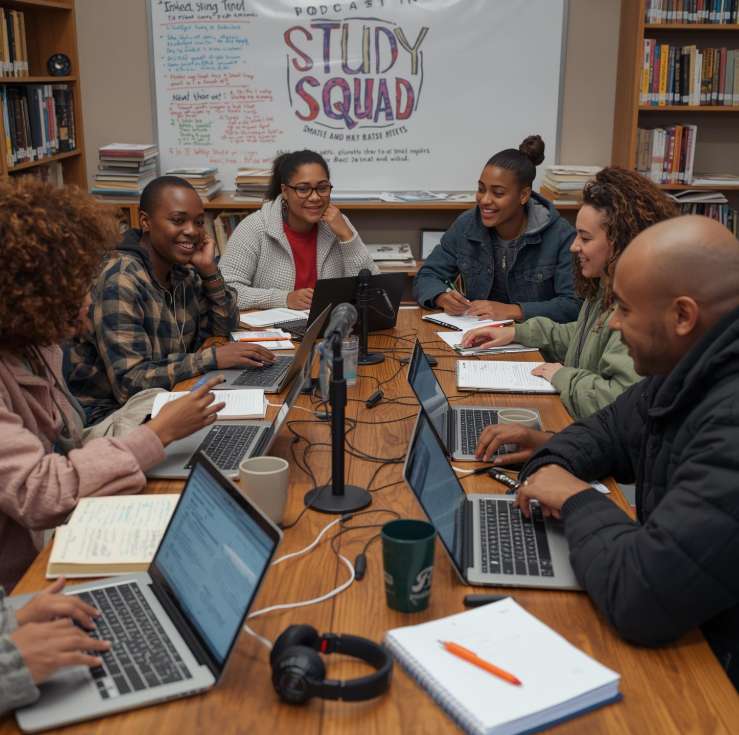
Turn Up the Volume on Your Revision: The Rise of the Podcast Study Group
The lone figure of a student, leaning over a textbook beneath a dim light, is a timeless picture. Yet in this hyper-connected earth, a new, more energetic style of exam revision is slashing the quiet: the podcast study group.
This cutting-edge method brings the versatility of audio learning together with the rich benefits of social revision and produces a highly effective tool for academic achievement. Beyond passive listening, this model resuscitates podcasts from an isolated lecture to become an active launch pad for collaborative revision, developing enhanced comprehension and long-term retention in a manner that individual cramming can’t possibly replicate.
The idea is beautifully straightforward. Rather than a single person learning his own content on his own, a small group of students choose a suitable educational podcast series or make their own audio or sometimes video notes. They listen to their own pre-arranged episodes separately, at their own convenience for instance, on a commute, at the gym, or during household chores.
The alchemy of the brain does not occur while listening; meanwhile, it occurs in the focused discussion session afterwards.

This is the heart of learning. It is more than just agreeing that everybody heard the same thing. It’s a formal debate, a questioning round, and a learning activity all in one. A member may describe a complicated theory referenced during the podcast from their own vocabulary, making their own understanding clear and clear for others.
Another member may question an argument, initiate an argument that requires the group to look again at their notes and fundamentals concepts to locate evidence. Through this recurring process of defining, defending, and re-framing arguments, surface-level knowledge is shaped into critical and higher order understanding.
The format itself has special benefits compared to conventional study approaches. First, it is extremely inclusive of varying learning styles. Auditory learners soak up the main content, while verbal and social learners do very well with the discussion stage.
The process of listening and then speaking about something activates a number of different cognitive channels, making stronger neural bonds and making the information simpler to remember under exam conditions.
Second, the element of responsibility is enormous. You can so easily get out of canceling after reading a chapter, but knowing that your group is relying on you to contribute to the discussion of an episode gives you a strong motivational nudge.
This sense of shared responsibility creates a feeling of togetherness that divides the pressure and reduces alienation that frequently accompanies us during the exam time. Members can exchange mnemonics with each other, quiz one another from the podcast, and together work through challenging problem sets, sharing the brainy burden
and distributing up challenging material into bite-sized chunks.
If we want this to be effective, though, the structure is quite important. Groups need to be small—three to five committed members being the optimum size—to guarantee that every member of the group has a say.
Selecting the right podcast is crucial to this method; it has to be academically heavy, nicely-paced, and highly relevant to the given syllabus. Groups need to schedule a sure-shot meeting and listening session, either remotely with video meeting or best is face-to-face.
Designating roles for each session would be functional: a facilitator who will lead the discussion, a “devil’s advocate” to come up with critical thinking, and a summarizer to clear out main conclusions.
Sure, there’s no process without its difficulties. It does take a dedicated group where every member contributes. The podcast used needs to be accurate, since misinformation learned early on can be difficult to reverse.
Also, it needs to augment, not take the place of, other studies such as essay practice or problem-solving. It is a method for curating foundational knowledge and forming strong critical thinking, not a silver bullet.

In short, the podcast study group is a shining example of how technology is definitely augmenting, but it cannot obviate human interaction. It takes on-demand listening to power a much more dynamic, interactive form of learning, fulfilling the advantage of the convenience. Turning participatory conversation, passive listening into active.
This model of collaborative revision is able to convince students to not merely hear the content, but to actually cut apart, comprehend, and claim knowledge for their own in their brains.
So from now on, whenever the next exam stress builds up, plan about silencing the distractions, hitting play on a podcast, and then calling your friends. The chat that would ensue your most functional study aid and not just fun.
Commonly Asked FAQs:
1. What is a podcast study group and how does it work?
A podcast study group is a collaborative revision method where students agree on a set of educational podcast episodes to listen to individually and then meet to discuss them. This format combines the convenience of on-demand audio learning with the deeper understanding that comes from active group discussion. By first listening independently, then debating key points, participants transform passive listening into active engagement, reinforcing memory and critical thinking skills.
2. Why is a podcast study group better than solo studying?
Solo studying can be isolating and often leads to cramming, which limits long-term retention. A podcast study group encourages accountability, as every member prepares to contribute. This social learning model taps into peer teaching — one of the most effective ways to cement knowledge — while also exposing students to different perspectives on the same content. Hearing others explain complex topics can clarify misconceptions and deepen comprehension.
3. How does a podcast study group benefit different learning styles?
Not every student learns the same way, and a podcast study group is inclusive of multiple styles. Auditory learners benefit from the podcast itself, visual learners can take notes or draw diagrams during the discussion, and social learners thrive during the collaborative review.
The process of listening and then articulating thoughts out loud activates multiple cognitive pathways, making recall easier during exams.
4. What type of podcasts work best for exam preparation?
Choosing the right podcast is crucial. Ideally, episodes should be syllabus-relevant, well-paced, factually accurate, and engaging enough to keep students’ attention. Many educational institutions, subject experts, and exam coaches now produce high-quality study podcasts.
A good podcast study group selects content that matches their curriculum and divides episodes into manageable chunks for structured weekly sessions.
5. How big should a podcast study group be for maximum effectiveness?
The ideal size is three to five members. This ensures everyone has a chance to speak, avoids overcrowding, and keeps scheduling simple. Larger groups risk losing focus, while smaller groups may lack diverse perspectives. In an effective podcast study group, each member can take on a role — such as facilitator, devil’s advocate, or summarizer — to keep discussions structured and productive.
6. Can podcast study groups improve memory retention?
Yes, they can significantly improve memory. When students listen, then discuss, they are engaging in retrieval practice — a proven technique for reinforcing neural pathways. Explaining a concept to peers forces you to organize your thoughts and recall information, strengthening long-term memory. A podcast study group transforms passive exposure into active recall, which is key to exam success.
7. How does a podcast study group help with motivation?
One of the biggest challenges during exam prep is staying consistent. A podcast study group introduces a sense of accountability, as members know they will need to contribute to discussions. This peer pressure is positive and helps maintain regular study habits. It also reduces the feeling of isolation, as students share the stress, exchange tips, and build a sense of camaraderie.
8. What challenges might a podcast study group face?
Some common challenges include members not listening to episodes in advance, poorly chosen podcast content, or off-topic discussions. Technical issues may also arise if the group meets online. The key to avoiding these pitfalls is to set clear expectations, choose content carefully, and stick to a schedule. A successful podcast study group relies on commitment and structure.
9. How do you structure an effective podcast study group session?
A productive session usually starts with a quick recap of the episode by a designated member, followed by open discussion. The group can then quiz each other, challenge ideas, or work through related practice questions. Assigning rotating roles — like facilitator, note-taker, and summarizer — keeps sessions organized and ensures balanced participation. A podcast study group benefits from ending with a brief summary of key takeaways.
10. Can podcast study groups work for online students?
Absolutely. Many podcast study groups operate virtually using video conferencing tools or group chats. Online students can listen to the podcast asynchronously and then join a scheduled call to discuss. Virtual podcast study groups are particularly helpful for students who live in different locations or study remotely, providing social interaction and shared learning opportunities.
11. Do podcast study groups replace traditional study methods?
No, they complement them. A podcast study group is excellent for building conceptual understanding and encouraging critical thinking, but it should be paired with individual problem-solving, essay practice, or mock exams. Think of it as a supplement that enhances comprehension and recall rather than a complete replacement for traditional study techniques.
12. How do podcast study groups improve exam performance?
They improve performance by deepening understanding, reducing procrastination, and reinforcing knowledge through discussion. Explaining concepts to peers mimics teaching, one of the most powerful learning methods. A podcast study group also introduces variety into the revision routine, which keeps the brain engaged and reduces study fatigue — both crucial for peak performance.
13. Are podcast study groups helpful for all subjects?
Yes, they can be adapted for almost any subject. For theoretical subjects like history, literature, or economics, they work well for debating ideas and themes. For STEM fields, a podcast study group can discuss problem-solving approaches, clarify formulas, and explain concepts. The key is to pick podcasts that are accurate and relevant to the subject area.
14. How do you keep a podcast study group engaging over time?
To prevent sessions from becoming repetitive, groups can vary their format — adding quizzes, creating flashcards, or inviting guest participants for certain episodes. Some podcast study groups even record their own short recaps for future review. Consistent novelty and interactive activities keep members invested and eager to attend.
15. What role does technology play in podcast study groups?
Technology makes this format possible by providing access to podcasts, recording tools, and online collaboration platforms. Group members can share notes in real time, host virtual meetings, or use shared drives to keep track of discussion summaries. Modern podcast study groups are often hybrid, combining digital tools with face-to-face meetings for maximum flexibility.
16. Can podcast study groups reduce exam stress?
Yes, they can. Discussing difficult topics in a podcast study group creates a support network where members encourage each other and share coping strategies. This reduces feelings of isolation, helps break large topics into manageable portions, and transforms exam prep into a shared journey rather than a solitary struggle.
17. How do you measure the success of a podcast study group?
Success can be tracked by improved grades, better recall during mock exams, or even higher levels of confidence among members. Some groups also use self-assessment checklists to see if they are covering enough material. The most successful podcast study groups report feeling more prepared and less anxious heading into exams.
18. What makes a podcast study group sustainable long-term?
Consistency, commitment, and good communication are key. Setting a fixed schedule, rotating responsibilities, and occasionally reviewing the group’s goals keeps it productive. Sustainable podcast study groups remain flexible, adapting as members’ needs change, ensuring they stay beneficial beyond a single exam season.
19. Are podcast study groups useful outside of academics?
Yes — professionals preparing for certifications, language learners, and hobbyists can also benefit. The same principles of listening, reflecting, and discussing apply to workplace training, personal development, or book clubs. A podcast study group can be a lifelong learning tool, not just an academic one.
20. How do podcast study groups build confidence before exams?
Repeatedly discussing topics with peers allows students to test their knowledge in a low-pressure setting. A podcast study group creates a safe space to make mistakes, ask questions, and refine understanding. This confidence boost carries into the exam hall, reducing panic and improving performance under timed conditions.
References
[1] M. F. Verde, “The collaborative encoding benefit in memory retrieval,” J. Appl. Res. Mem. Cogn., vol. 8, no. 1, pp. 1–6, Mar. 2019, doi: 10.1016/j.jarmac.2018.11.004. [Online]. Available: https://www.sciencedirect.com/science/article/pii/S2211368118301078
[2] G. C. Williams, “The impact of group study on retention and academic performance in undergraduate anatomy,” Med. Sci. Educ., vol. 30, pp. 1451–1457, Aug. 2020, doi: 10.1007/s40670-020-01049-1. [Online]. Available: https://link.springer.com/article/10.1007/s40670-020-01049-1