Okay, so virtual career fairs are… weird, right? Like, one second you’re sitting on your bed with a hoodie on, and the next you’re supposed to “wow” a recruiter in under a minute while your Wi-Fi lags. It’s not like those huge, noisy halls where you could at least wander around and grab a free tote bag.
Here it’s literally you, your laptop camera, and someone deciding if you’re worth remembering. And honestly, that’s kind of terrifying but also kind of freeing? Anyway, that’s where the elevator pitch comes in.
Without one, you’ll end up mumbling something random about your major and sounding like you didn’t even want to log in. Whether you’re a computer science major, a student exploring digital marketing, or just trying to figure out your first elevator pitch virtual fair, this short intro can make or break the impression you leave.

6 Strong Reasons Why It’s Not Just Some Silly Thing Professors Push
Why It’s Not Just Some Silly Thing Professors Push
You know how in real life you can sometimes get by with just a smile and a handshake? Yeah, that’s gone. In the online setup, nobody has patience.
You’ve got like, I don’t know, 30 seconds before they mentally check out. And recruiters talk to dozens of students in a row, so if you’re not sharp, you’re wallpaper.
Doesn’t matter how good your GPA is; they won’t even care. I used to think it was overhyped until I literally blanked once and just repeated my resume line by line… safe to say, didn’t hear back from that company.
Keeping It Short (But Not Robot Short)
Everybody says “30 seconds,” but nobody tells you that sounding like a robot ruins it. If you look like you memorized every comma, it’s dead.
Think of it more like a TikTok intro — casual but with a point. You kind of know what you’re going to say, but it comes out a little different each time. That’s good. That makes you sound alive.
The Formula (That Doesn’t Totally Suck)
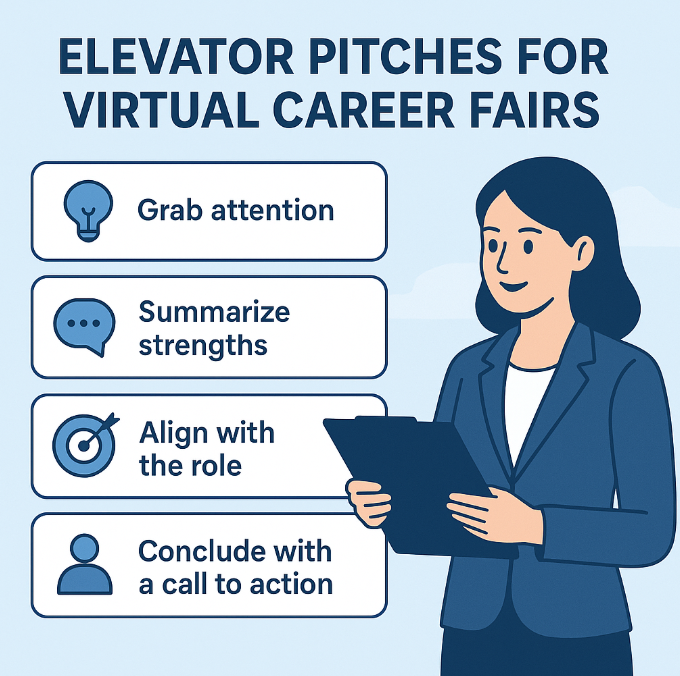
Honestly, it’s just four things:
Name + what you’re studying (not your life story).
One thing you can actually do (like “I’ve built apps” instead of “I love tech”).
What you want (internship, entry-level, whatever).
Why do you like their company (literally one sentence, so they know you bothered)?
It’s so simple, but people still trip because they try to cram too much in.
Practice Without Losing Your Soul
Yes, you should practice. But like… don’t turn into Siri. I literally recorded myself once and cringed so hard I deleted it. But it showed me where I rambled and where I needed to shut up. Do it a couple of times, then stop. If you overdo it, you’ll freeze when one word doesn’t come out exactly like your script.
Make It Feel Like Them
Here’s the secret nobody tells you: recruiters hate generic. Like, if you just say “I’m passionate about business” they will tune out. But if you throw in, “I liked how your company did that project with [whatever],” boom — their eyes light up.
Doesn’t need to be deep research, just one little detail makes you stand out. It’s basically the difference between a DM that says “hey” and one that actually mentions something from your profile.
Don’t End on a Dead Stop
Ending with “thank you” is just… flat. Better to toss in a question so it feels like an actual conversation. Something easy like, “What skills do you value in interns?” or “What do grads usually do in their first year here?” It makes them talk, you listen, and suddenly it’s not just a monologue. Plus, they’ll remember you as the one who actually got them talking.
Final Thoughts
At the end of the day, look — elevator pitches aren’t about being perfect. You’ll mess up a word, you’ll pause too long, your cat might even jump into frame. Doesn’t matter. What matters is that you come off clear, not boring, and a little personal.
Virtual career fairs are chaotic, you know, and recruiters are as tired as you are. But if you give them something that feels human, not rehearsed, you’re ahead of half the crowd already. And honestly? That’s all you need.
Commonly Asked FAQs:
1. What is an elevator pitch for virtual career fairs?
An elevator pitch for virtual career fairs is a short 30–60 second introduction where you share who you are, what you do, and what you’re looking for. Unlike casual networking, the online format forces you to make a strong impression quickly because recruiters meet many students in back-to-back sessions.
2. Why do I need an elevator pitch for virtual career fairs if I already have a resume?
Resumes sit in a file, but conversations are live. Recruiters may not even open your resume until later, so your elevator pitch for virtual career fairs is the hook that makes them want to remember your name when they go back through applications.
3. How long should an elevator pitch for virtual career fairs be?
The sweet spot is about 30 seconds, or roughly 80–100 words. Anything longer risks sounding like a monologue. In a virtual setup, attention spans are shorter, so brevity matters even more.
4. What should I include in an elevator pitch for virtual career fairs?
-
Your name and field of study.
-
One key strength or achievement.
-
What role you’re seeking (internship, entry-level, etc.).
-
One reason you’re interested in the company.
This keeps your elevator pitch for virtual career fairs focused and memorable.
5. Should my elevator pitch for virtual career fairs sound memorized?
Not at all. The point is to sound prepared but natural. Over-memorizing often leads to robotic delivery. Instead, rehearse the key points, then let your delivery vary slightly each time. That balance makes your elevator pitch for virtual career fairs sound authentic.
6. How do I practice without over-rehearsing?
Record yourself on video. Watching it back highlights where you ramble or lose clarity. Practice two or three times, then stop. Over-rehearsal makes your elevator pitch for virtual career fairs stiff instead of engaging.
7. Should I tailor my elevator pitch for each recruiter?
Yes, tailoring matters. Mentioning a project, value, or initiative tied to their company shows effort. Even a single customized line in your elevator pitch for virtual career fairs can transform you from “generic student” to “candidate who did homework.”
8. How do I open my elevator pitch for virtual career fairs confidently?
Start with your name and current focus: “Hi, I’m Sarah, a data science major passionate about applying machine learning to healthcare problems.” This kind of crisp start makes your elevator pitch for virtual career fairs feel professional right away.
9. What are common mistakes students make in their elevator pitch for virtual career fairs?
Common errors include rambling about irrelevant details, overloading with jargon, reciting resumes, or speaking too quickly. Another mistake is forgetting to mention what you’re looking for. A strong elevator pitch for virtual career fairs avoids these traps.
10. Should I end with a question?
Yes, ending with a question creates a two-way conversation. Questions like “What qualities do you value in interns?” or “What projects do new hires usually work on?” make your elevator pitch for virtual career fairs interactive rather than flat.
11. How can I sound confident if I’m nervous?
Confidence in an elevator pitch for virtual career fairs comes from clarity. Knowing your talking points prevents panic. Smiling, keeping your tone conversational, and remembering that recruiters expect some nerves also help reduce pressure.
12. Can I mention personal passions in my pitch?
Yes, but only if they connect to the role. For example, if you’re into building apps in your free time, mention that when talking to tech recruiters. This makes your elevator pitch for virtual career fairs more human and relatable.
13. How do I highlight both soft and hard skills?
Blend them. For instance: “I’ve led student marketing projects where I improved engagement by 30%, and I enjoy working with diverse teams.” This makes your elevator pitch for virtual career fairs well-rounded instead of one-dimensional.
14. How do I prepare my background setup for virtual delivery?
A clean, quiet space with good lighting is ideal. Your pitch loses impact if distractions pull attention away. A polished environment complements your elevator pitch for virtual career fairs by making you look more professional.
15. What if my internet lags during my pitch?
Keep it calm. If your video freezes or lags, apologize briefly and continue. Recruiters know tech glitches happen. Having your elevator pitch for virtual career fairs written in notes nearby can help you recover smoothly.
16. Should I adjust my pitch depending on whether it’s group or one-on-one?
Yes. In group settings, keep your elevator pitch for virtual career fairs tighter so others get their turn. In one-on-one chats, you can expand slightly and add a question or two.
17. Is humor appropriate in an elevator pitch for virtual career fairs?
Light humor can work if natural, but don’t force it. A simple smile and warmth are usually enough. The main goal of your elevator pitch for virtual career fairs is clarity, not comedy.
18. How do I stand out among dozens of students?
Specificity is key. “I designed a financial model that helped my team win a university competition” is far more memorable than “I’m good at finance.” Specific details make your elevator pitch for virtual career fairs stick.
19. Should I adjust my pitch based on industry?
Absolutely. Tech recruiters expect skills-based highlights, while creative industries value storytelling. An elevator pitch for virtual career fairs should reflect what matters most in the recruiter’s world.
20. How often should I update my pitch?
Review it before every major career fair. Update with new skills, internships, or projects. A stale elevator pitch for virtual career fairs signals lack of growth, while a fresh one keeps you relevant.
21. Can I use my elevator pitch outside virtual career fairs?
Yes. The same introduction works for networking calls, LinkedIn messages, and even professional meetups. Building a strong elevator pitch for virtual career fairs gives you a versatile tool for multiple career moments.

References
[1] M. D. Smith, Virtual Job Fairs: A Practical Guide for Career Seekers and Recruiters, New York, NY: Routledge, 2021.
[2] National Association of Colleges and Employers (NACE), “Tips for success at virtual career fairs,” NACE, Sep. 2022.
[3] L. D. Cardon, Business Communication Essentials: Crafting Messages for Virtual and Global Audiences, Boston, MA: Pearson, 2020.
[4] Indeed Editorial Team, “How to create an elevator pitch for interviews and networking,” Indeed Career Guide, Mar. 2023. [Online]. Available:
[5] Handshake, “How to stand out at a virtual career fair,” Handshake Blog, Nov. 2021. [Online]. Available: