Preparing Portfolios for Young Professional Roles
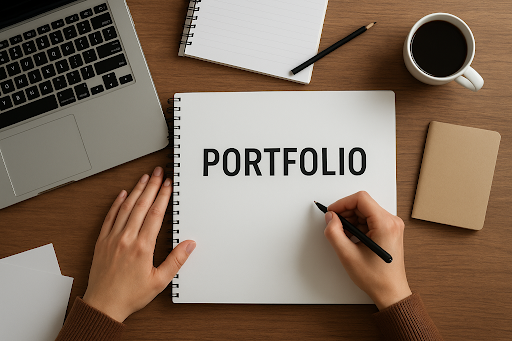
When entering the job space, creating a portfolio for young professionals becomes an important step in the professional world. Ranging from recent graduates to working individuals, this process can be both exciting and exhausting. A well-created portfolio for young professionals can immediately set you apart by serving as a job application showcase that highlights your skills, projects, and achievements.
7 Powerful Ways to Create a Job-Winning Portfolio
Portfolio vs. Résumé
A résumé is a limited and professional structure of your achievements. A portfolio for young professionals, on the other hand, allows you to showcase all your skills and achievements by providing a detailed structure with evidence of your work.
Why Portfolios Matter for Young Professionals
Besides screening your academic scores or previous experiences, employers also look at your LinkedIn and other documents to make a decision. Your problem-solving skills, creativity and delivery are certain skills that recruiters wish to see, and that proof is provided to them through your portfolio for young professionals.
It tells about what you know and how you have used that knowledge in practice. Various fields like design, content, marketing, engineering and IT require a portfolio in addition to a résumé. But aside from these fields, a portfolio for young professionals can provide insights into various projects, research analysis or leadership roles you have conducted that reflect your capability and strengthen your job application.
Key Elements of a Strong Portfolio
Introduction – Provide a short write-up about yourself, your interests and your skills for the start of your portfolio.
Résumé Summary – Give a brief description of the education, experiences, skills and other relevant information mentioned in your résumé.
Work Samples and Projects – Giving context about your academic projects and research papers, internships and volunteer work, presentations, reports or designs, coding projects, case studies or prototypes can make an effective portfolio for young professionals.
Skills Showcase – Highlight your hard skills as well as your soft skills by giving relevant examples.
Reflections and Learning – Employers look for what you have learned through your projects and internships.
Testimonials – Adding references from your professors and mentors can provide credibility to your portfolio for young professionals.
Contact Information and Links – Adding links to your digital portfolios helps make a better online presence and enhances your job application.
Digital vs. Physical Portfolios
Creating a digital portfolio for young professionals is necessary for today’s rapidly growing job market. Digital portfolios are an excellent tool as they are easily accessible, easy to share and update as soon as you have a job growth. Various tools like GitHub, Google Drive and Behance can help you make your online presence. Aside from that, keeping a physical copy of your portfolio for young professionals for in-person interviews can leave a strong impression and support your job application.
Tips to Stand Out
Tailor your Portfolio – Create a portfolio that matches the job and industry you are applying for.
Keep it Brief – Always prefer quality over quantity. Giving details about two to three strong projects is much better than ten average experiences.
Update Regularly – Updating your portfolio for young professionals regularly helps you keep track of your growth and removes outdated data, ensuring a stronger job application.
Conclusion
A good portfolio for young professionals can be a great investment to safeguard your future. By presenting your work through a portfolio, you can increase your chances of gaining a good role, improving your job application, and laying a foundation for long-term professional development.
FAQs
Q1: Why do young professionals need a portfolio?
A portfolio allows young professionals to showcase skills, projects, and achievements with evidence, going beyond what a résumé provides.
Q2: What should I include in my portfolio as a recent graduate?
Include academic projects, internships, research work, skills showcase, reflections, and testimonials from mentors.
Q3: Is a digital portfolio more important than a physical one?
Yes, digital portfolios are crucial for accessibility and sharing. However, carrying a physical copy for in-person interviews makes a strong impression.
Q4: How often should I update my portfolio?
Update regularly — ideally after completing a new project, internship, or gaining a new skill.
Q5: Which tools can I use to build an online portfolio?
Popular platforms include GitHub, Behance, Google Drive, WordPress, and LinkedIn.
References
1. “What Is a Work Portfolio? (Plus How To Build One), ” Indeed.com, 2025. [Online] Available : https://www.indeed.com/career-advice/resumes-cover-letters/build-your-work-portfolio Indeed
2. “How To Build a Professional Portfolio,” University of Phoenix Blog, Apr. 23,2025 [Online]. Available : https://www.phoenix.edu/blog/how-to-build-a-professional-portfolio.html
Penned by Aditi Gupta
Edited by Shashank Khandelwal, Research Analyst
For any feedback mail us at [email protected]
Streamline Your Hiring with Eve Placement’s Custom Assessments
Eve Placement helps you engage, assess, and recruit top talent through tailored hiring challenges that go beyond resumes. From technical quizzes and real-world case studies to psychometric evaluations and audio/video submissions, our platform enables smarter, data-driven hiring decisions. Advanced security features ensure authenticity and eliminate fraud, giving you reliable results. Ready to hire better? Know More.
Mail us at [email protected]