
Green Careers: Exploring Opportunities in the Sustainability Sector
Introduction
Green careers focus on job market that contribute to the preserving or resorting the environment or preserving it. these roles often involve renewable energy waste management, sustainability design or conservation. Green careers are on the rise due to government prioritizing climate action which influence consumer demand for sustainable products and services.

Career Opportunities and Emerging roles
The green sector has been emerging as a major job provider with exponential increase in the job sector as
- Projected Green Job By (2027-2028) – 7.29 million new jobs with 3 million in renewable sector
- Projected Green jobs in – 38 million more jobs by 2030 globally
What are Green Skills
Simply put, green skills are the knowledge, abilities, values and attitudes needed to live in, develop and support a sustainable and resource-efficient society. The need to transition towards more environmentally sustainable modes of production and consumption has become imperative, for developed as well as for developing countries (UNIDO)
As Allen Blue from LinkedIn explain “Green skills are sustainable, meaning that basically they are going to be things that are applicable and useful for building a career for decades to come, because so much work needs to occur in the world of the climate transition. Also, if you have climate skills, it makes you very easy to hire for other future climate jobs”.
22.4% of share of job posting requiring at least one green skills. Renewable energy industries face high level of gender gap with 34% of workers in the industry to be women and other sustainable industries 44% of workers being women, which show gender gap in the progressing industry.
Essential Skills and Education for Green Careers
- Multidisciplinary Nature: green careers often require a blend of technical, analytical, and soft skills.
- Technical Skills: Specific knowledge in renewable energy technologies, environmental science, data analysis, engineering principles.
- Analytical and Problem-Solving: Ability to assess environmental impacts, analyses data, and develop sustainable solutions.
- Project Management: For implementing green initiatives and projects.
- Communication and Collaboration: Essential for working with diverse stakeholders, educating others, and advocating for sustainability.
- Adaptability and Lifelong Learning: The green sector is rapidly evolving, requiring continuous upskilling.
- Educational Pathways: environmental science, engineering, business, policy) and the importance of vocational training, certifications, and practical experience
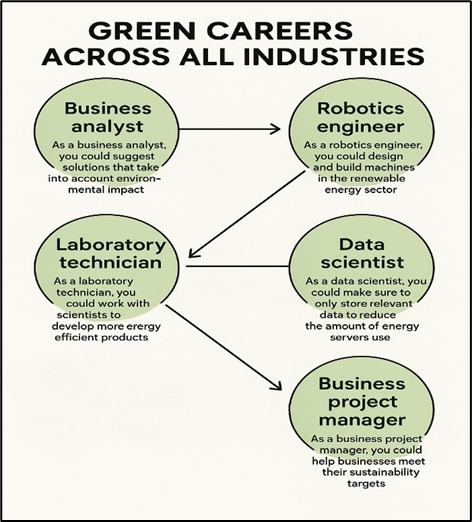
The STEM related backgrounds like mathematics, engineering, hardware & software, basic digital services are more prone to transition to green jobs while fields like hospitality management, art, transport, finance, consulting etc are less prone to transition to green careers as not much role or impact they can have on sustainability, with technological advancements , even traditional non green jobs are becoming more sustainability oriented, however they may face challenges like
Challenges and Future Outlook
- Limited Awareness and Skill Gaps: The applicants lack skills required for green careers; the job recruiters seek rapid technological shifts which lead to profound unawareness which disturbs the equilibrium for demand and supply in the labour market.
- Infrastructure Limitation: Limited access to clean energy, water and transport network mainly in the countryside hinder adoption and growth of green industries.
- Cultural Attitudes and Mindsets: The century old practices may damage environment, as their attitude differs society to society some select short term gains leading to long term destruction leading to distrust towards green initiative’s.
- Financial Constraints: Lack of financial incentives, high initial costs, uncertainties of the market and support mechanisms can discourage investments in sustainable projects and startups. Access to finance, including loans through donations, grants, and investment funds could be, especially for smaller businesses or projects.
Conclusion and way forward
Integration of technology in renewable energy, electric vehicles, smart grids, and green construction is crucial for the growth of green jobs and for a sustainable world. Advancements in wind, solar, hydroelectric and energy storage, waste management and precision farming are cutting carbon emissions and improving resource efficiency. Through education, a boost of renewables, and a green business push, communities can spark an engine for economic development and solidify a sustainable future for their descendants.
Citations
- Explore Green careers, National careers services
https://nationalcareers.service.gov.uk/
- Green job vacancies are on the rise – but workers with green skills are in short supply (February, 2024), world economic forum
https://www.weforum.org/stories/2024/02/green-jobs-green-skills-growth/
- Green careers in India: Addressing challenges and seizing opportunities for sustainable development, Ashwini Malani (July 2024)
- Empirical research on green jobs: A review and reflection with practitioner
Panel Bradley P, Whitter D, Green E, Brooks I, Hanna R, (June 2025), Science direct
https://www.sciencedirect.com/science/article/pii/S2666188825000978
- The Rise of Green Careers: Top Sustainable Jobs in 2025, University of Haridwar. (January 2025)
https://huroorkee.ac.in/blog/the-rise-of-green-careers-top-sustainable-jobs-in-2025/
- What are green skills? (2022) UNIDO
https://www.unido.org/stories/what-are-green-skills
FAQS on
Green Careers: Exploring Opportunities in the Sustainability Sector
What are Green Careers?
Green Careers are job roles that focus on preserving, restoring, and sustaining the environment. They often involve renewable energy, waste management, sustainable construction, and conservation efforts.Why are Green Careers important today?
Green Careers are essential as they help combat climate change, reduce pollution, conserve natural resources, and promote sustainable development across industries.What sectors offer the most Green Careers?
Green Careers are prominent in sectors like renewable energy (solar, wind, hydro), environmental consulting, sustainable agriculture, green construction, and eco-tourism.Are Green Careers growing in demand?
Yes, Green Careers are rapidly growing. Globally, an estimated 38 million green jobs are projected by 2030, making it a high-potential employment sector.What kind of education is needed for Green Careers?
Most Green Careers require a background in STEM fields, environmental science, engineering, or policy. Vocational training and certifications are also valuable.
Penned by Priyansh Sharma
Edited by Sneha Seth, Research Analyst
For any feedback mail us at [email protected]
Streamline Your Hiring with Eve Placement’s Custom Assessments
Eve Placement helps you engage, assess, and recruit top talent through tailored hiring challenges that go beyond resumes. From technical quizzes and real-world case studies to psychometric evaluations and audio/video submissions, our platform enables smarter, data-driven hiring decisions. Advanced security features ensure authenticity and eliminate fraud, giving you reliable results. Ready to hire better? Know More.
Mail us at [email protected]