How to Get Recruiters to Notice Your LinkedIn Profile and Attract Inbound Messages
Although LinkedIn might appear to be a web-based CV, it’s essentially a searchable database of professionals. Job title, skills, experience, location, and more are used by recruiters to search LinkedIn Recruiter for candidates. There’s no need to have a flawless profile to appear. It’s what it communicates to the employer about your ability and your desired job position that is what is important. That’s more important than appearance.
How recruiters find candidates
Recruiters search with roles, locations, skills, and other filters. Additionally, Boolean searches and natural-language queries are supported with LinkedIn. The system determines which profile(s) appear relevant, and the outcome varies based on the profile searcher and the search string. One keyword or headline will not push you to the top by itself.
Skills still matter, and they matter a lot. LinkedIn says Recruiter can spot skills in the Skills section and elsewhere, including the headline, summary, experience descriptions, certificates, and other profile sections. Use the right terms across your profile instead of stuffing the same keywords into every box.
Use open to work strategically.
LinkedIn’s feature shows you are looking for new jobs. You can make it public or keep it limited to recruiters. The public setting adds the #OpenToWork frame. With recruiters only, LinkedIn tries to hide the signal from people at your current company, though that privacy is not perfect.
Job positions, locations, and preferences such as remote, hybrid, and/or on-site can be included. On the Indian marketplace, recruiters can also view the notice period, joining availability, and expected annual wage. Pick the roles that fit.
Does open to work actually help?
It can bring your profile to more recruiters, but it doesn’t guarantee a job. This matters most when your experience already fits the roles you want. LinkedIn reports that candidates who recently turned on the feature were 78% more likely to accept a recruiter InMail than those who hadn’t signaled they were open to work. However, that comes from LinkedIn’s own platform data, not independent research. It shows a connection, not a certain result.
Write a headline that says something useful.
Your headline is one of the first things recruiters see, so don’t fill it with information that says almost nothing. Rather than “Student at ABC University,” use the space to show your direction more clearly.
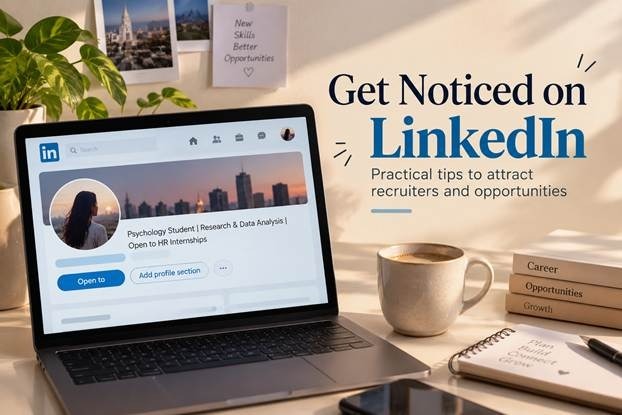
One useful format is the target role or field, relevant skills, and then evidence or a clear goal. For example, a psychology student might write “MA Psychology Student | Research, Psychometrics & Data Analysis | Exploring HR and Organizational Psychology.” Someone new to the field of analytics could use “Aspiring Data Analyst | Excel, SQL & Power BI | Building Data Projects.”
Be accurate. If your profile does not really support “Data Analyst,” “Aspiring Data Analyst” is better and more honest.
Build keywords into the whole profile.
Don’t leave them sitting in the headline alone. Take a look at the job advertisements for the jobs you’re interested in and identify recurring skills, tools, qualifications, and job titles. Then use those terms naturally across your profile.
LinkedIn warns against keyword stuffing, and its Recruiter guidance says searches can pick up skills from different parts of a profile, including the listed skills and related wording in the text. A clear account of what you actually did beats a paragraph stuffed with random buzzwords.
Show what you actually did.
After someone opens your profile, keywords won’t do much. Your Experience and Projects sections need to spell out what you handled and, where possible, what came out of it.
Instead of “Responsible for social media,” say what you actually did: “Created and scheduled social media content for a student-led campaign and monitored engagement.” Add numbers when you have them. “Increased event registrations by 25%” feels real. Don’t add figures to make it look stronger.
If the work does not have a measurable outcome, tell about the project, what you did, what tools you used, and what you learned. Internships, projects, volunteering, research, campus activities, freelance work, and portfolios may be used as proof to be given by students and freshers.
Keep your profile current.
A current profile helps recruiters see where you are now. Check your headline, about section, education, experience, skills, location, and job preferences whenever your direction changes. Remove things that no longer fit, and add new projects or experience as you get them.
Activity can help build a professional presence, but there is no need to post constantly. Thoughtful comments, useful posts, and relevant conversations make a profile feel alive. Activity alone will not guarantee more recruiter messages.
Make it easy to contact you.
When looking for inbound opportunities, provide a viable method for recruiters to contact you. This is where LinkedIn messages come in handy, but you can also include a professional email address in your contact info. Keep your location and industry accurate, since recruiters may use both to narrow their searches.
Be careful with recruiter messages.
Increased visibility brings appropriate opportunities, but unwanted or bogus messages are also attracted. Check the recruiter’s profile and the company, job, and contact information before sending out any personal information. Exercise caution before you are asked to pay a fee, provide financial details, or have your ID passed around prior to the job being fully verified.
When it comes to the job, the company, location or work environment, primary duties and compensation, a real recruiter should be able to answer those questions. When the position is not a good fit, it is sufficient to send a brief polite message. If the position is not a fit, a short polite reply is enough. No need to write a long explanation.
The Bottom Line
Getting noticed on LinkedIn doesn’t come from some secret formula. It depends on making your professional story clear enough to follow. Use Open to Work if it fits your situation, choose the visibility settings carefully, and add keywords that match skills and experience you can prove. Keep the profile current as well. Every section should support what the headline claims. A searchable profile may help a recruiter find you, but solid evidence is what gives them a reason to send a message.
References
- LinkedIn, “Let recruiters know you’re Open to Work,” LinkedIn Help, 2026. LinkedIn Help – Open to Work
- LinkedIn, “Filter search results in Recruiter and Recruiter Lite,” LinkedIn Help, 2026. LinkedIn Help – Recruiter Search Filters
- LinkedIn, “Recruiter and Recruiter Lite search filters and definitions,” LinkedIn Help, 2026. LinkedIn Help – Recruiter Search Filters and Definitions
- LinkedIn, “Skills filter in Recruiter and Recruiter Lite,” Recruiter Help, 2026. LinkedIn Recruiter – Skills Filter
- LinkedIn, “Search in Recruiter and Recruiter Lite FAQ,” LinkedIn Help, 2026. LinkedIn Recruiter – Search FAQ