How to Write a LinkedIn Headline: A Practical Guide for Freshers and Students
Your LinkedIn headline is a brief line; however, it has a reasonably vital role to play. It is displayed after your name and will convey what you are studying, what you do, or what you hope others remember about you. LinkedIn also puts it in search results, and it doesn’t have to match your current job title. That matters for students and freshers who may not have a formal role yet.
What a LinkedIn Headline Actually Does
A common mistake is treating the headline as a label that only says “Student at XYZ University.” Your university matters, though the headline can say more about you. In fact, it’s LinkedIn’s way of sharing your expertise and students’ advice and also asks students to describe their interests and where they would like to go next. The title of a useful headline provides someone with a snapshot of your studies, skills, interests, or career direction.
How Long Should Your Headline Be?
Though you can use up to 220 characters in your professional headline on LinkedIn, it’s not necessary to do so. Put the most important part first. Users should be able to see where you are going quickly if you are being profiled. The first 50 or 60 characters don’t always display, and every headline doesn’t necessarily need to be under 70. It will rely on the screen and location that it shows up on. That’s why it’s important to be clear rather than searching for a magic number.
A Simple Formula for Students
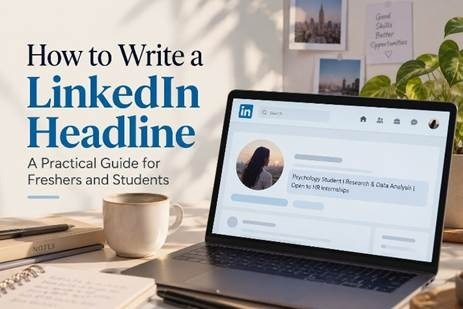
When you don’t know where to start, follow this format: [Current identity or field + relevant skills or interest + career direction or opportunity]. For instance: “Psychology Student | Research, Psychometrics & Organizational Psychology | Interested in HR Roles.” A computer science student might write: “Computer Science Student | Python, SQL & Data Analysis | Exploring Analytics Roles.”
Use Keywords Naturally
Keywords matter, but stuffing your headline with every skill you have ever encountered makes it hard to read. LinkedIn cautions against overusing words and phrases and suggests employing some appropriate keywords rather. Choose words that reflect your experiences, classes, projects, or the field you desire.
Be Specific About Your Direction
Being a student does not have to be your whole professional identity. Instead of just “MA Psychology Student,” you could mention a specialization, research interest, or career direction. “MA Psychology Student | Research Methods & Psychometrics | Exploring Organizational Psychology” tells someone a lot more, without pretending you already have years of work behind you.
It’s okay to say this directly when you’re seeking an internship or entry-level position. People get more info from “Seeking Research Internship” or “Open to HR Internships” than “Looking for Opportunities.” Just don’t use a job title you haven’t earned yet. If your goal is data analysis, “Aspiring Data Analyst” is more honest than calling yourself a “Data Analyst” when your experience doesn’t really support it.
Show Evidence, Not Empty Buzzwords
The concept of passion, energy, motivation, hard work, and similar words is not in itself bad, but they don’t have much impact by themselves. Specific information is stronger: a project, internship, research area, certification, technical skill, or achievement provides people with something tangible to understand and evaluate.
Remember that the headline is not your whole profile.
A good headline may catch someone’s attention, but it can’t carry your whole profile. LinkedIn’s student guidance suggests using the About section to explain what kind of work interests you, which problems you like solving, and what strengths you can offer. The Experience, Projects, Education, and Skills sections then need to back up those claims with real evidence.
This matters a lot for freshers. You do not need years of work to look credible. What you have actually done can be demonstrated through coursework, academic projects, volunteer work, student groups, internships, competitions, freelance work, and personal projects. LinkedIn’s advice for students specifically highlights project, volunteer, internships, and student activities as areas that will help demonstrate strengths.
Examples You Can Adapt
For engineering students, a headline might be: “Mechanical Engineering Student | CAD & Product Design | Exploring Automotive Internships.” A commerce student could use: “B. Com Student | Excel, Financial Analysis & Accounting | Seeking Finance Internship.” A media student might write, “Mass Communication Student | Content Writing & Social Media | Interested in Digital Media.”
Relevant courses are “Psychology Student | Research Methods, Psychometrics & Data Analysis | Exploring HR and Organizational Psychology” or “MA Psychology Student | Research & Behavioral Science | Interested in People-Focused Roles.” The best version is the one that you have the means to back up on your profile elsewhere.
Do Not Treat Searchability Like a Secret Formula
It’s easy to believe LinkedIn has one perfect headline formula that guarantees recruiters will notice you. It doesn’t. Search visibility depends on your whole profile and LinkedIn’s search system, not just on putting a certain phrase at the front of your headline. Keywords are useful signals, not a shortcut. The headline still needs to sound natural to an actual person. This matters more than chasing a supposedly clever ranking trick.
Your headline should fit your real stage too. A first-year student may concentrate on learning, projects, or interests, or a student with internships may refer to practical experience. Don’t pretend to know more than you do. Simply explain your current experience.
The balance is the key to the usefulness of a headline—if you make your profile introduction sound like an advertisement for everyone, no one will be interested in it.
Mistakes Worth Avoiding
Do not make the headline so broad that it could belong to thousands of people. “Student | Dreamer | Future Leader” says almost nothing. Do not turn it into a long list of random skills either. A headline stuffed with ten tools, a few career paths, and the usual buzzwords just feels messy.
A Final Check Before You Publish
Read your headline as if you were looking at your profile for the first time. Is it obvious what you study or do? Does it use terms that actually matter? Does it point to the kind of work you want? Can you back up every claim somewhere else on your profile? Most of all, does it sound like a person wrote it, not a pile of career keywords?
There’s no need to make your LinkedIn headline sound like it is. It must be clear, specific, truthful, and helpful. You can build one as a student or fresher, since you already have enough material in your field, skills, projects, interests, and direction. Use the headline to tie them together, and then the rest of your profile should prove that.
References
- LinkedIn, “Edit Your Headline,” LinkedIn Help. LinkedIn Help – Edit Your Headline
- LinkedIn, “Find how you match up with jobs on LinkedIn,” LinkedIn Help. LinkedIn Help – Job Match and Profile Skills
- LinkedIn, “Filter search results in Recruiter and Recruiter Lite,” LinkedIn Help. LinkedIn Help – Recruiter Search Filters
- LinkedIn, “Search in Recruiter and Recruiter Lite FAQ,” LinkedIn Help. LinkedIn Help – Recruiter Search FAQ
- LinkedIn, “Search on LinkedIn,” LinkedIn Help. LinkedIn Help – Search on LinkedIn