
7 Proven Ways to Stay Consistent with Your DSA Roadmap (Even When Motivation Disappears)
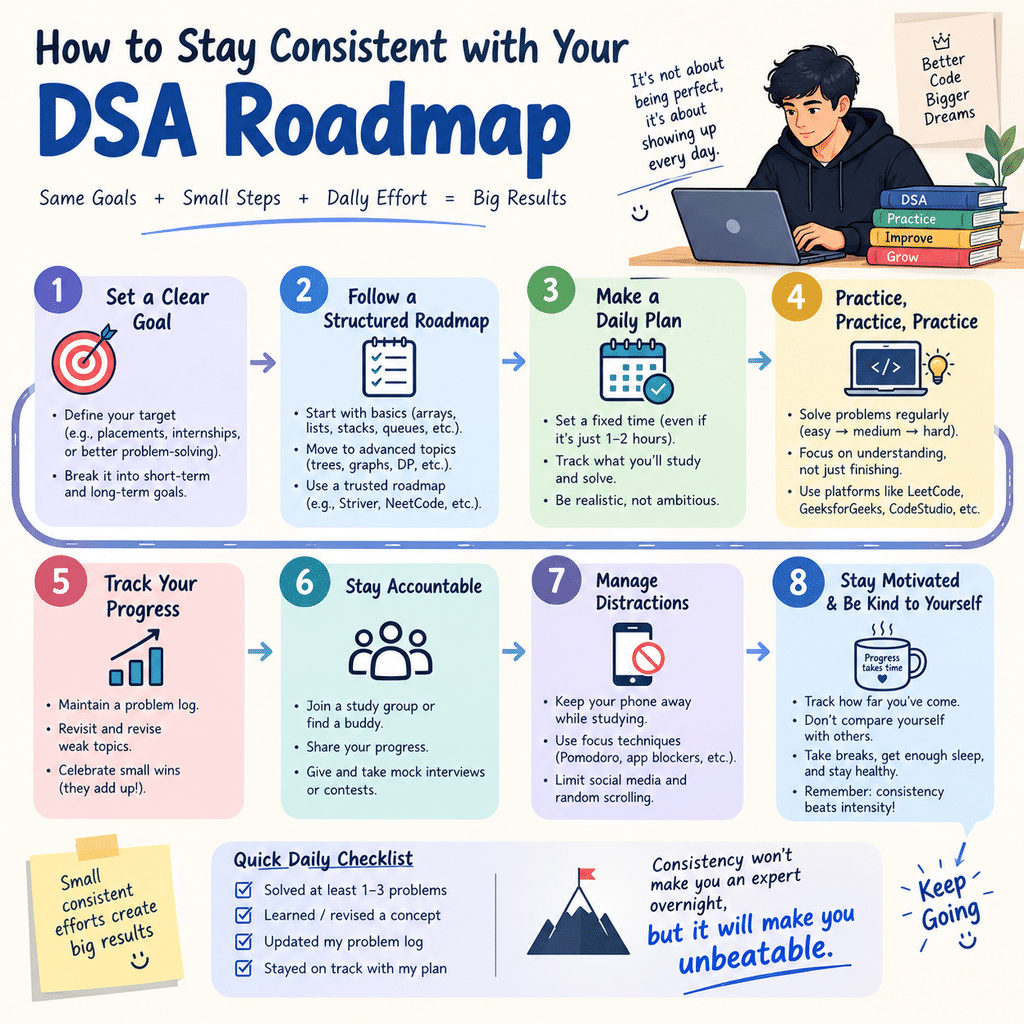
Source – ChatGPT
You bought the roadmap, bookmarked the sheet, and told your friends you are starting on Monday. By the second Thursday, you’ve missed two days, a graph problem has humbled you, and the whole plan feels like it belongs to someone more disciplined. That’s normal. Most people who try to stay consistent with their DSA roadmap don’t fail because the material is too hard. They fail because the routine around it is too fragile. Here’s how to build one that survives bad weeks.
1. Stop Waiting for Motivation and Shrink the Daily Goal
Motivation is unreliable, so build the habit around something small enough to do on your worst day. One DSA developer who documented his own streak puts it plainly commit to the smallest daily goal you can keep, even one problem a day. That sounds almost too modest, but a streak of one problem beats a plan of five that you abandon on day four.
2. Give It Time, Because Habits Take Longer Than You Think
The “21 days to build a habit” line is a myth. In a well known study from University College London, participants took an average of 66 days before a new behaviour felt automatic, and
people varied in how long it took. So if your DSA routine still feels like effort at week three, nothing is wrong with you. You’re simply mid-process.
3. Missing a Day Won’t Ruin You, but Vanishing Will
This is the most reassuring finding I know. In that same study, missing a single opportunity did not significantly affect habit formation. What did hurt was being very inconsistent over time. So when you skip a day, don’t spiral into “I’ve ruined my streak. Treat it as a blip and do the next session. A fallback also helps. On busy days, reading and summarizing an editorial still counts as practice.
4. Decide the “When” and “Where” in Advance
Vague plans like “I will practice this week” lose to tiredness every time. The research on implementation intentions, which are specific if-then plans, is built on exactly this idea, and a meta-analysis of that work was published in 2006. For DSA, it can be as simple as “After dinner, at my desk, I’ll solve one problem before I open my phone.” Block fixed time each day, even if it’s short.
5. Space Out Your Practice Instead of Cramming
Seven problems on Sunday won’t stick like one problem a day. A large meta-analysis of 839 assessments across 317 experiments found that how you space out learning sessions affects how much you retain, and the best gap between sessions grew as the retention interval got longer. In practice, that means revisiting arrays and trees days later, not just once. A weekly cycle works well here: learn a concept, implement it, solve related problems, revisit and optimize, then do mixed practice and reflect.
6. Test Yourself, Don’t Just Re-Read Solutions
Re-reading an editorial feels productive. It mostly isn’t. In classic experiments, students who took memory tests retained far more after two days and a week than students who simply restudied the material, and restudying only won at a five-minute delay. Worse, restudying made students more confident even though testing worked better. So close the solution tab and re-solve last week’s problem from scratch. Building structures without built-in libraries and explaining concepts out loud are both good versions of this.
7. Track a Few Numbers and Time-Box the Struggle
Keep a simple log with the problem link, time spent, the key idea, the bug that slowed you down, and a confidence score out of five. Track only a few metrics, like streak, topic coverage, and average confidence. And cap each problem at around 45 minutes, then study the official approach instead of grinding for hours. Burnout usually comes from endless struggle, not from the workload.
A Simple Week That Actually Works
If you want something concrete, try this. Pick one topic for the week, say two pointers. Spend the first two days on the concept and easy problems. Do medium problems when your energy is high and review when it’s low. Resolve two old problems midweek, and use the weekend for a timed mixed set. It’s not glamorous, but it’s repeatable, and repeatable wins.
The Real Goal
A DSA roadmap isn’t a sprint you win with intensity. It’s a long, slightly boring habit that quietly compounds. Make the daily goal small, forgive the missed day, space your practice, test yourself, and write things down. Do that for a couple of months, and the consistency you were hoping to find mostly takes care of itself.
Meta description
Learn how to stay consistent with your DSA roadmap: 7 proven habits, from tiny daily goals to spaced practice, that survive missed days.
References
[1] P. Lally, C. H. M. van Jaarsveld, H. W. W. Potts, and J. Wardle,How are habits formed: Modelling habit formation in the real world. Available: https://openresearch.surrey.ac.uk/esploro/outputs/99783513802346
[2] How long does it take to form a habit?, UCL News, Aug. 4, 2009. Available: https://www.ucl.ac.uk/news/2009/aug/how-long-does-it-take-form-habit
[3] N. J. Cepeda, H. Pashler, E. Vul, J. T. Wixted, and D. Rohrer, “Distributed practice in verbal recall tasks: A review and quantitative synthesis, Available: https://www.yorku.ca/ncepeda/publications/CPVWR2006.html
[4] H. L. Roediger and J. D. Karpicke, Test-enhanced learning: Taking memory tests improves long-term retention. Available:
[5] P. M. Gollwitzer and P. Sheeran, Implementation intentions and goal achievement: A meta-analysis of effects and processes. Available: https://www.socmot.uni-konstanz.de/publications/implementation-intentions-and-goal-achievement-meta-analysis-effects-and-processes
[6] R. Patra, How I turned daily problem solving into a DSA habit (and stuck with it), Jul. 7, 2025, updated Apr. 2, 2026. Available: https://www.rabinarayanpatra.com/blogs/how-i-turned-daily-problem-solving-into-a-dsa-habit
[7] “How can I practice DSA daily?,” DesignGurus. Available: https://designgurus.io/answers/detail/how-can-i-practice-dsa-daily
FAQs
Q1: How long does it actually take to build a consistent DSA habit?
A: Forget the “21 days” myth. A well-known University College London study found that habits take an average of 66 days to feel automatic, with significant variation between individuals. If your routine still feels like effort at week three, you’re simply mid-process — not failing.
Q2: I missed a day of practice. Have I ruined my streak?
A: No. The same UCL study showed that missing a single session did not significantly affect habit formation. What actually hurts is prolonged inconsistency over time. Treat a skipped day as a blip and do the next session. On busy days, even reading and summarizing an editorial counts as practice.
Q3: Should I do one problem a day or five problems a day?
A: Start with the smallest goal you can keep on your worst day — even one problem. A streak of one problem daily beats an ambitious plan of five that you abandon by day four. Motivation is unreliable; a tiny, repeatable goal survives bad weeks.
Q4: Is cramming seven problems on Sunday as effective as daily practice?
A: No. A meta-analysis of 839 assessments across 317 experiments found that spacing out practice sessions dramatically improves retention, and the optimal gap between sessions grows as the retention interval gets longer. Revisit topics like arrays and trees days later, not just once.
Q5: Why shouldn’t I just re-read solutions instead of re-solving problems?
A: Classic experiments (Roediger & Karpicke) showed that students who took memory tests retained far more after two days and a week than those who simply restudied material. Worse, restudying made students feel more confident even though testing produced better results. Close the solution tab and re-solve from scratch.
Q6: How do I stop wasting hours stuck on one problem?
A: Time-box each problem to around 45 minutes. If you’re still stuck, move on and study the official approach. Burnout usually comes from endless struggle, not workload volume. Keep a simple log with the problem link, time spent, key idea, bug encountered, and a confidence score out of five.
Q7: What’s a good weekly structure for DSA practice?
A: Try this repeatable cycle:
- Days 1–2: Learn one topic (e.g., two pointers) + easy problems
- Midweek: Medium problems when energy is high; review when low; resolve two old problems
- Weekend: Timed mixed set + reflection