
Failed a LeetCode Problem? 6 Ways to Turn Mistakes into Progress
Published: Oct 14, 2026
Key Points
- Understand the Problem First: Reread the question carefully to identify requirements, constraints, and edge cases before changing your code.
- Identify Your Coding Mistakes: Determine whether the problem comes from incorrect logic, misunderstood requirements, missing edge cases, or inefficient algorithms.
- Learn from Solutions: Review LeetCode editorials when you get stuck and understand why the recommended approach works.
- Practise Without Help: Close the solution and try implementing the code independently to strengthen your problem-solving skills.
- Revisit Previous Problems: Solve previously failed questions again after a few days to test your understanding and improve retention.
- Treat Failure as Progress: Use every incorrect submission as an opportunity to identify weaknesses and become a more confident programmer.
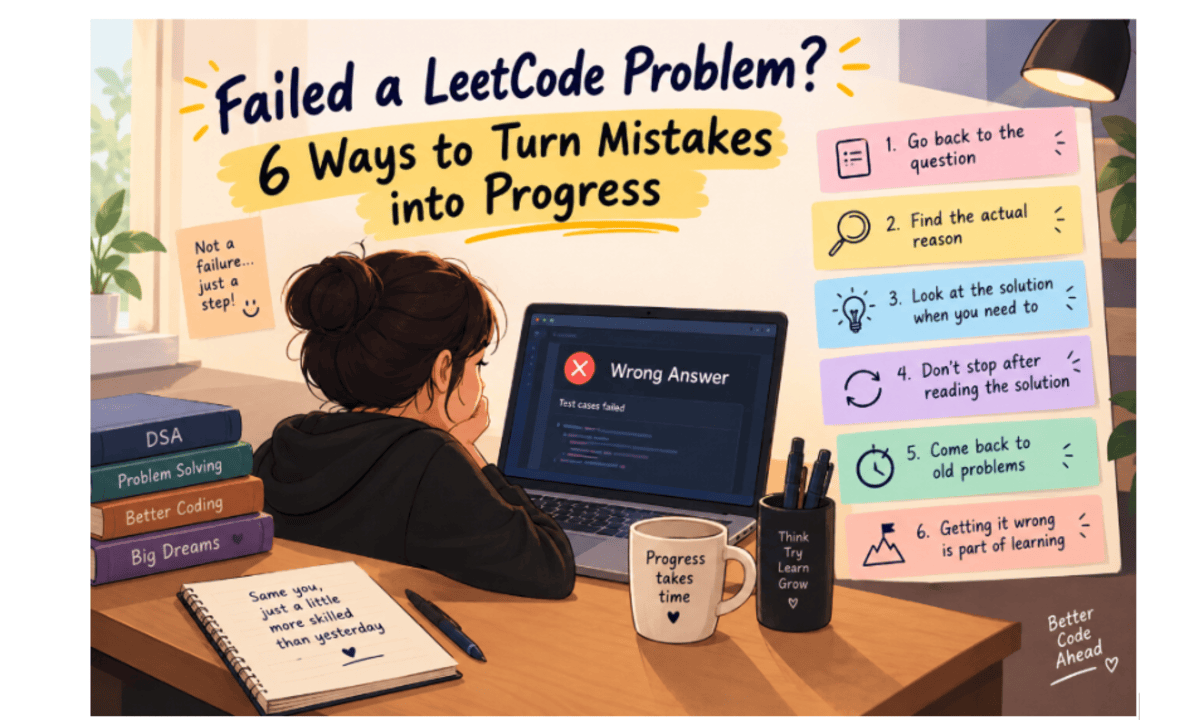
Learning from failed LeetCode problems is an important step toward becoming a better programmer. If you want to learn failed LeetCode solutions and improve your coding skills, start by understanding why your submissions fail. You read a problem, write your code, test it a few times, and then suddenly see a “Wrong Answer” message. Instead of feeling frustrated, use each failed attempt as an opportunity to identify mistakes and strengthen your problem-solving skills.
How to Learn from Failed LeetCode Problems
To learn failed LeetCode solutions effectively, identify the reason behind each incorrect submission, understand the correct approach, and practise solving the problem again without looking at the editorial.
When you learn failed LeetCode problems, you begin to recognize patterns in your mistakes. You may discover that your code fails because of incorrect logic, missing edge cases, or inefficient algorithms. Understanding these patterns helps you approach similar coding challenges with greater confidence and improve your problem-solving skills over time.
1. First, go back to the question
When we’re stuck on a problem, we tend to keep staring at the code. Sometimes the better thing to do is go back to the question itself.
When you learn failed LeetCode problems through careful analysis, you become better at understanding problem requirements and identifying errors before submitting your code.
Read it again slowly.
What exactly is it asking you to find? What are the conditions? Is there something you assumed without actually checking?
Then take a really simple example and solve it yourself on paper. Now compare that answer with what your code is doing.
This can sometimes make the mistake obvious.
When you learn from failed LeetCode attempts, carefully rereading the question helps you identify misunderstood requirements and avoid repeating the same errors.
2. Don’t just say “my code is wrong”
Try to find the actual reason. Maybe you understood the question incorrectly. Maybe your logic works for the example but fails for another input. Maybe you forgot about duplicate values or an empty array. Or maybe your approach is simply too slow.
Knowing this difference matters.
If you just look at the correct code every time, you may solve that one problem, but you won’t necessarily know what to do when a similar problem appears later.
To learn failed LeetCode problems effectively, identify the reason behind each incorrect submission and understand how to avoid the same mistake in future coding challenges.
3. And yes, look at the solution when you need to
There is nothing wrong with checking the editorial. If you have tried several times and genuinely don’t know what to do next, spending another hour staring at the same code may not help much.
If you want to learn failed LeetCode solutions, focus on understanding why the correct approach works instead of simply memorizing the code.
Read the solution and try to understand What problem is it solving?
What was your approach doing unnecessarily?
Those are the things worth remembering.
4. Don’t stop after reading the solution
Another effective way to learn failed LeetCode solutions is to practise writing the code again without looking at the editorial. This approach helps you check whether you understand the algorithm or simply remember the answer. Regular practice strengthens your coding logic and prepares you to solve unfamiliar problems independently.
If you want to learn failed LeetCode solutions, practise solving the same problem again without checking the editorial.
This is where I think many people lose the benefit of the whole exercise. They read the solution, think, “Ohhh, I get it now,” and move on to the next problem.
Then a few days later, they see a similar question and have no idea where to start.
So after reading the solution, close it. Try writing the code yourself. You may not remember everything. That’s fine. Just keep a small list of mistakes somewhere.
For example:
– Forgot an edge case
– Used a slow approach
– Got confused with recursion
– Didn’t know when to use a hash map
– Understood the solution but couldn’t come up with it myself
After a few weeks, look at the list. You might notice that you keep making the same kind of mistake.
That’s actually useful information.
Now you know what you need to work on instead of randomly solving problem after problem.
5. Come back to old problems
If you want to learn from failed LeetCode attempts, revisit difficult questions after a few days and solve them from scratch. Compare your new approach with your earlier attempt and note what has improved. This habit helps you identify knowledge gaps and turn previous failures into meaningful learning experiences.
I wouldn’t consider a problem completely learned just because you understood its solution once. Try it again after a few days.
Don’t look at your old code. Just start from the question and see what you remember.
One effective way to learn failed LeetCode problems is to solve them again after a few days without looking at the original solution.
One problem that you properly understand can sometimes teach you more than five problems that you solved by following an editorial.
So don’t only count solved problems. Count the things you understand now that you didn’t understand before. That’s a better measure of progress.
6. Getting it wrong is part of learning
You’re going to get problems wrong. Quite a lot of them, probably. Some will be easy once you see the answer. Some will take several attempts. And some will probably make you wonder why you decided to learn coding in the first place.
That’s normal.
And come back to the problem later. Over time, you’ll notice that the things that once confused you start becoming familiar.
That’s really what LeetCode practice is about — not getting everything right, but slowly getting better at figuring things out.
The best way to learn from failed LeetCode problems is to analyse each mistake, practise the correct approach, and apply that knowledge to future coding challenges.
References:
[1] 5 Mistakes You Will Make as a LeetCode Beginner & How to Fix Them, Tanishq Chaudhary, 10 April 2022
( Online )
Available:
[2] How to Learn from Your Mistakes and Improve with Every Failed Solution, Algocademy ( Online )
Available:
https://algocademy.com/blog/how-to-learn-from-your-mistakes-and-improve-with-every-failed-solution/
Frequently Asked Questions
1. Why do I keep failing LeetCode problems?
You may struggle with LeetCode problems because of weak problem-solving skills, misunderstood requirements, incorrect logic, or difficulty identifying suitable algorithms. Review your mistakes after every submission to identify patterns and improve.
2. How can I learn from LeetCode mistakes?
Read the problem carefully, identify why your solution failed, test different inputs, and review the editorial when necessary. Then close the solution and implement the correct approach independently.
3. Is it normal to fail LeetCode problems as a beginner?
Yes, failing LeetCode problems is completely normal for beginners. Coding challenges require practice, logical thinking, and familiarity with algorithms. Consistent effort helps you improve over time.
4. Should I look at the solution if I cannot solve a LeetCode problem?
Yes, reviewing the solution is helpful after you have made a genuine attempt. Try to understand the underlying logic, identify what you missed, and implement the solution yourself without copying it.
5. How long should I spend on one LeetCode problem?
Beginners can spend around 20–45 minutes attempting an easy or medium problem before considering a hint or editorial. Adjust this time according to the problem’s difficulty and your current skill level.
6. What should I do after getting a wrong answer on LeetCode?
Check the failing test case, compare the expected and actual outputs, and inspect your logic. Pay attention to boundary conditions, duplicate values, empty inputs, and other edge cases.
7. How can I improve my LeetCode problem-solving skills?
Practise consistently, learn fundamental data structures and algorithms, analyse failed submissions, and revisit previous problems. Focus on understanding patterns rather than memorizing solutions.
8. Should I solve LeetCode problems every day?
Daily practice can help you build consistency and strengthen problem-solving skills. Even one carefully analysed problem per day can be valuable when you focus on understanding the approach.
9. How many LeetCode problems should a beginner solve?
Beginners can start with one or two problems daily, depending on their available time and difficulty level. Understanding each problem is more important than reaching a specific number of solved questions.
10. Why does my LeetCode solution fail even when the logic seems correct?
Your solution may overlook edge cases, violate input constraints, contain implementation errors, or use an inefficient algorithm. Test your code with different inputs and review the failing test case carefully.
11. What is the best way to debug a failed LeetCode submission?
Reproduce the failure, inspect intermediate values, test small examples, and compare your output with the expected result. Work through the algorithm step by step to locate the error.
12. Should I memorize LeetCode solutions?
No, memorizing solutions alone is not an effective long-term strategy. Focus on understanding why an algorithm works and when to apply it to similar problems.
13. How often should I revisit failed LeetCode problems?
Revisit a problem after two or three days, then again after a week or two. Attempt it without looking at your previous code to check whether you genuinely understand the solution.
14. What are the most common LeetCode mistakes beginners make?
Common mistakes include misunderstanding the question, ignoring edge cases, choosing inefficient algorithms, relying too heavily on editorials, and moving on without reviewing failed attempts.
15. How can I identify patterns in LeetCode problems?
Group problems by topic, such as arrays, strings, hash maps, two pointers, binary search, and dynamic programming. Compare their requirements to recognize when a particular technique is useful.
Citations & References
[1] 5 Mistakes You Will Make as a LeetCode Beginner & How to Fix Them, Tanishq Chaudhary, 10 April 2022
( Online )
Available:
https://chaudharycodes.medium.com/5-mistakes-you-will-make-as-a-leetcode-beginner-how-to-fix-them-e28b9ec6c947
[2] How to Learn from Your Mistakes and Improve with Every Failed Solution, Algocademy ( Online )
Available:
https://algocademy.com/blog/how-to-learn-from-your-mistakes-and-improve-with-every-failed-solution/
Streamline Your Hiring with Eve Placement
Engage, assess, and recruit top talent through tailored AI hiring challenges that go beyond resumes. Ready to hire better? Contact our research team for a custom consultation.