
Introduction
Seven internship skills are now essential for students in 2026. The standard required for applying for a competitive internship has risen. While a good GPA and a well-organized résumé are still important, they are not anymore the things that set a shortlisted candidate apart from the others.
In 2026, people who are going through internship applications are looking for something more specific—they want evidence that a candidate is able to carry out useful work using the tools that the modern workplace currently relies on, especially AI.
You can see the extent of this change in the data. According to the National Association of Colleges and Employers (NACE), 13.3 per cent of job advertisements at the entry level now require AI skills, and more than 10 per cent specifically mention asking for them by name.
On the part of employers, about 60 per cent state that they are currently giving current interns AI-related tasks, this is not a trend that will happen in the future but one that is already taking place.
At the same time, almost 70 per cent of employers say that they now make their hiring decisions on the basis of demonstrated skills rather than relying solely on GPA, and the proportion of employers screening candidates by means of their GPA has dropped from 73 per cent in 2019 to 42 per cent at present. It is increasingly the case that skills, not credentials, which get a student an interview.
The article examines seven internship skills, comprising a combination of technical, AI-related, and lasting human skills, which are regularly mentioned by employers as being the ones they want from the 2026 class of interns, and it explains the reason why each skill is important.
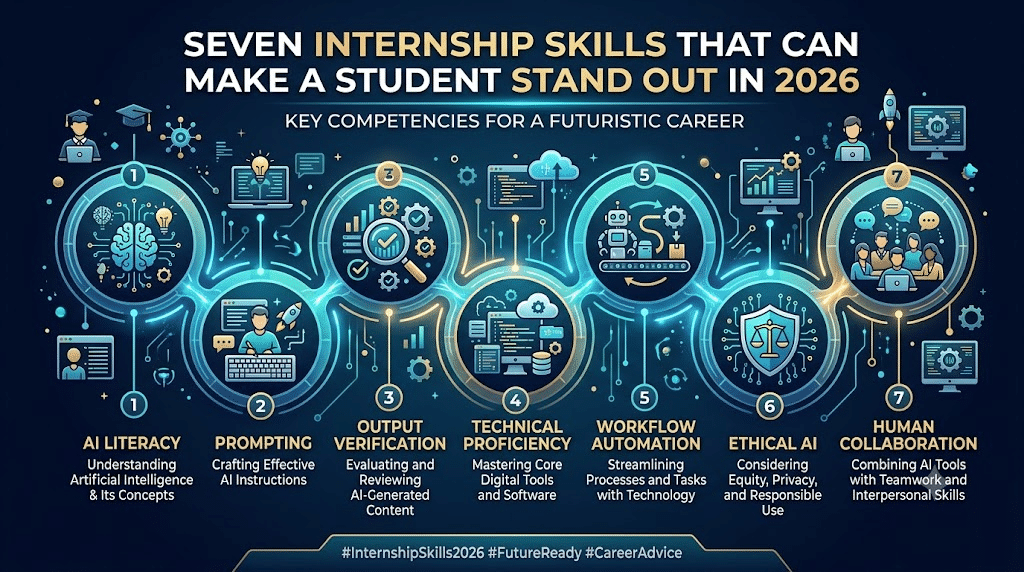
- Change to: Internship Skills 2026: Practical AI Literacy
The capability that is being asked for most frequently in current internship advertisements is not advanced knowledge of machine learning, it is instead a practical, everyday familiarity with AI tools.
Surveys carried out by employers and labour market data indicate that AI literacy, prompt engineering, AI-assisted research, and the interpretation of data using AI are now among the most desired skills in almost every department, not just in technical positions.
In particular, more than half of the AI-related job postings monitored by the labour market analytics company Lightcast are now in areas that are entirely outside traditional IT roles, which means that internships in marketing, operations, and finance are asking for these skills just as often as those in engineering.
This implies that for students AI literacy is no longer something optional but has become a basic requirement, just as knowledge of spreadsheet software did a decade ago.
On the positive side, most employers do not expect interns to construct models from scratch; instead they are looking for people who can use AI tools competently and who know when to trust or question the output.
2. Seven Internship Skills: Prompt Design & AI Research
It is now considered a separate and teachable ability rather than something that has to be guessed at to be able to write a clear and well-structured prompt, and this prompt can then be improved according to the outcome.
Employers are beginning to place more value on employees who can communicate effectively with AI tools in order to carry out tasks more quickly and produce higher-quality results; the skills of writing clear prompts, refining the content generated by the AI, and assessing the responses have in fact become real skills that are valued in the workplace.
This is also true in the case of AI-assisted research, where AI tools can be used to quickly synthesise background information, compare different sources, or summarise dense material before a human reaches their final decision.
Students can develop this ability outside of a formal internship by using AI tools frequently when doing their coursework, on projects, or for their own personal research and by noticing which kinds of prompts always lead to useful results.
3. Internship Skills: Assessing & Correcting AI Output
It is ironic that the ability employers place highest importance on is not the production of AI content but rather the critical assessment of it.
Since AI tools have become sophisticated enough to generate output that sounds plausible but at times inaccurate or misaligned, the true value now resides in having candidates who can detect errors, verify the outputs against the original material, and improve the drafts before they are given to a client or manager.
It is precisely in this area that AI is able to distinguish between interns who add value and those who merely pass on what a chatbot has produced.
This ability is closely linked to critical thinking and knowledge of the subject area, a student cannot spot an incorrect figure in an AI-produced financial summary unless they first know what a sensible figure should be. It is exactly this combination of fluency with AI and a solid understanding of the subject matter that employers are aiming to identify.
4. Internship Skills 2026: Basic Programming & Technical Proficiency
It is not necessary for someone to study computer science in order to gain benefits from having a basic knowledge of coding.
Simply being able to read code, write a simple script, or have a general understanding of how software and automation tools work makes it much easier to work with technical teams and shows employers that the candidate can learn new tools rapidly.
This is especially the case in non-technical internships, since students there may be asked to help set up simple automations that link different platforms rather than writing production code.
Students might build it step by step by, for example, creating a short online course, starting a coding club, or carrying out a small personal project in order to acquire the working vocabulary which makes technical collaboration easier, without having to become an engineer.
5. Seven Internships Skills: Workflow Automation & Process Thinking
Employers are nowadays not only interested in interns who can think in terms of workflows, that is, those who can identify a repetitive and time-consuming process and then find a way to streamline or automate it but are also looking for such individuals.
Today, workflow automation and optimization are considered among the most useful applied AI skills in business, operations, customer service, and analytics positions.
This kind of requirement is not concerned with any particular tool but rather reflects a certain mindset: one that notices inefficiencies and is willing to suggest a solution.
This ability is also most obvious to a manager; an intern who automates a routine reporting task or improves a data-entry process makes a tangible and measurable contribution, just the type of experience that can later be used as a standout point on a resume or as an answer in an interview.
6. Internship Skills: Responsible & Ethical AI Use
As AI is incorporated more and more into everyday work processes, employers are placing increasing importance on judgment specifically on knowing when it is appropriate to use AI, understanding the fundamentals of data privacy, being able to identify bias in AI-generated outputs, and adhering to the organisation’s AI governance guidelines.
Employees who understand responsible AI practices such as data privacy, awareness of bias, and making ethical decisions are becoming more valuable as companies put their AI policies in place.
Employers are looking for people who can steer and question AI tools rather than simply accepting their outputs, and they see AI as a decision-support tool not a shortcut.
What this implies for students is that they should be able to explain not only how to use an AI tool but also when it is appropriate not to do so for instance, by identifying situations that involve sensitive data or require a judgment call that ought not to be left to a chatbot.
7.Seven Internship Skills: Communication, Collaboration & Problem-Solving
Despite the surge in AI skills, the basic abilities have not vanished on the contrary, they have in fact become more valuable since AI is unable to replicate them. Apart from technical skills, employers always highlight communication, emotional intelligence, critical thinking, and problem-solving as the ‘durable skills’ which set candidates apart in the long term.
This is supported by NACE’s research: when considering résumés, employers look for concrete evidence of a candidate’s abilities in teamwork, problem-solving, and communication, not merely a list of the tools the candidate has used.
In an environment saturated with AI, these abilities are even more important than less, since a person still has to turn the output of an AI tool into a decision, a conversation with a client, or a team plan.
A student who can explain their reasoning clearly, works well in a team, and is able to adapt when a plan changes will always perform better than another student who is technically skilled but hard to work with.
Putting It Together
These seven skills never occur by themselves, and it is rare for employers to expect an intern to enter the role as an expert in all of them.
What the 2026 hiring data shows consistently is that employers are giving rewards for combinations: they value AI literacy coupled with judgment, technical competence go hand in hand with communication, and initiative together with the ability to see a task through to completion.
When thinking about how to prepare for an internship, a helpful approach for students is to ask themselves not ‘which single skill do I need’ but ‘which of these seven can I show with a real example’ for instance, a class project, a personal automation, or a volunteer initiative since employers are increasingly looking at evidence of applied skills rather than relying solely on credentials.
The fact is that the students who stand out in 2026 are not necessarily the most technically advanced; instead, they are those who can clearly demonstrate that they have already begun to carry out the kind of AI-augmented, judgment-driven work which is actually required in today’s internships.
Q. What are the seven internship skills employers value most in 2026?
Employers highlight AI literacy, prompt design, AI output assessment, basic programming, workflow automation, ethical AI use, and durable skills like communication and problem‑solving.
Q. Why are internship skills more important than GPA in 2026?
Hiring data shows employers now prioritize demonstrated skills over GPA, with 70% making decisions based on skills rather than grades.
Q. How can students develop practical AI literacy before an internship?
Students can practice using AI tools in coursework, projects, or personal research to build everyday familiarity.
Q. What is prompt engineering and why is it an internship skill?
Prompt engineering is writing clear instructions for AI tools. It helps interns produce faster, higher‑quality results.
Q. Why is assessing AI output considered a critical internship skill?
Because AI can generate plausible but inaccurate content, interns must verify and correct outputs to add real value.
Q. Do interns need advanced coding knowledge in 2026?
No. Basic programming or scripting knowledge is enough to collaborate with technical teams and set up simple automations.
Q. How does workflow automation help interns stand out?
Automating repetitive tasks shows initiative and creates measurable impact, which managers value highly.
Q. What does responsible AI use mean for interns?
It means knowing when to use AI, respecting data privacy, spotting bias, and following company AI policies.
Q. Are communication and teamwork still important internship skills in 2026?
Yes. Durable skills like communication, collaboration, and problem‑solving are irreplaceable and often more valuable than technical skills.
Q. How can students showcase internship skills in applications?
By giving real examples — class projects, personal automations, or volunteer initiatives — instead of just listing tools.
References
[1] University of Florida Career Connections Center, “Breaking down the data: 2026 NACE Job Outlook & Spring Update,” Jun. 30, 2026. [Online]. Available: https://careerhub.ufl.edu/blog/2026/06/30/breaking-down-the-data-2026-nace-job-outlook-spring-update/
[2] InternBoard, “AI skills for fresh graduates: What employers want in 2026,” May 5, 2026. [Online]. Available: https://internboard.com/ai-and-future-skills/ai-skills-for-fresh-graduates-what-employers-want-in-2026/
[3] National Association of Colleges and Employers, “Trends & predictions: Job market,” NACE, 2026. [Online]. Available: https://www.naceweb.org/job-market/trends-and-predictions/
[4] Campus, “AI skills employers want in 2026: Top 5 to learn,” Jul. 21, 2026. [Online]. Available: https://campus.edu/blog/artificial-intelligence/ai-skills-employers-want-2026
[5] Campus, “AI skills employers want in 2026: Top 5 to learn” (citing Lightcast labor-market data), Jul. 21, 2026. [Online]. Available: https://campus.edu/blog/artificial-intelligence/ai-skills-employers-want-2026
[6] Trending Media Buzz, “Why AI job skills look different in 2026 than they did a few years ago,” Jul. 7, 2026. [Online]. Available: https://www.trendingmediabuzz.com/ai-learning-platforms/future-of-ai-job-skills-2026/
[7] The Interview Guys, “10 must-have AI skills for your 2026 resume (that most candidates don’t have),” Jun. 25, 2026. [Online]. Available: https://blog.theinterviewguys.com/ai-skills-for-your-2026/
[8] Absolute Internship, “Top AI skills employers are looking for in interns right now,” Apr. 10, 2026. [Online]. Available:
[9] AI Tool Insight, “AI skills employers want in 2026: What companies look for,” Dec. 26, 2025. [Online]. Available: https://aitoolinsight.com/ai-skills-employers-2026/
[10] ScholarshipOwl, “How to use AI for internships and job searching in 2026,” Jun. 22, 2026. [Online]. Available: https://scholarshipowl.com/blog/career-and-job-search/how-to-use-ai-for-internships-and-job-searching-in-2026/