
How to Apply for Jobs at Global Capability Centres (GCC jobs) in India
Published: Oct 7, 2026
Key Points
- Securing GCC jobs in India requires navigating structured application steps from resume ATS optimization to multi-round technical evaluations.
- Global Capability Centres represent a major strategic shift, handling advanced R&D, AI/ML, and cloud transformation rather than simple back-office functions.
- Recruitment for fresh graduates primarily occurs between August and November, while mid-career positions operate on a rolling basis with Q1-Q2 hiring surges.
- ATS-optimized resumes that quantify technical achievements and showcase verified certifications significantly increase application screening success rates.
- Internal employee referrals and active networking on platforms like LinkedIn remain among the most reliable pathways to secure interviews.
- Structured compensation models offer accelerated financial and career growth, with median salaries ranging from entry-level packages to executive-tier remuneration.
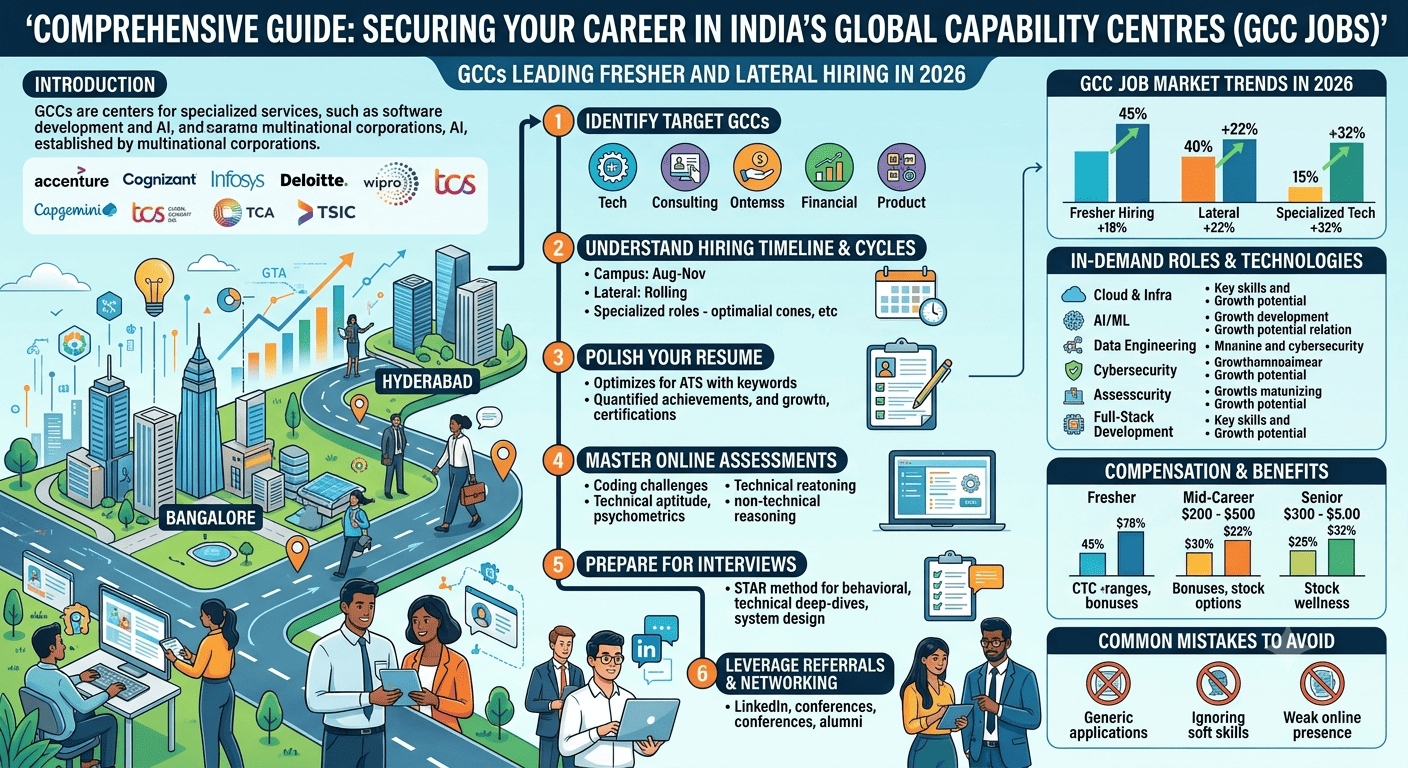
A Comprehensive Guide to Securing Your Career in India’s Fastest Growing Employment Hub
Global Capability Centres (GCCs) Continue to Lead in Fresher and Lateral Hiring in 2026
Introduction
India’s employment landscape is undergoing a significant transformation. Global Capability Centres (GCCs)—centers established by multinational corporations to provide specialized services like software development, data analytics, business process management, and research & development—have emerged as the largest employers of fresh talent and experienced professionals alike.
In 2026, GCCs continue to dominate India’s hiring ecosystem, offering competitive compensation packages, international exposure, and career growth opportunities that rival global tech giants. Whether you’re a fresh graduate or an experienced professional, understanding how to navigate the GCC jobs application process can significantly improve your chances of landing your dream role.
What Are Global Capability Centres?
Global Capability Centres represent a strategic shift in how multinational organizations structure their operations. Rather than centralizing all functions at headquarters, companies establish dedicated centers in talent-rich regions like India to drive innovation, reduce operational costs, and access specialized expertise.
Key characteristics of GCCs include:
• Strategic service delivery centers offering software development, cloud solutions, and digital transformation
• Centers for excellence in AI, machine learning, data science, and emerging technologies
• Business process management and shared services operations
• Research & development hubs focusing on product innovation and IP development
Major multinational corporations like Accenture, Cognizant, Infosys, Deloitte, Capgemini, Wipro, and TCS have established expansive GCC operations across India, particularly in cities like Bangalore, Hyderabad, Mumbai, Pune, and Delhi.
GCC Job Market Trends in 2026
Understanding the current hiring landscape is crucial for job seekers. Here’s what the data reveals about GCC hiring patterns:
-
Fresher Hiring: Accounting for 45% of GCC workforce expansion, entry-level hiring saw an 18% year-over-year growth, primarily focusing on roles like software developers and analysts.
-
Lateral Movement: Experienced professionals represent 40% of total hiring volume with a 22% year-over-year increase, mainly filling positions for senior engineers and architects.
-
Specialized Tech Roles: Representing 15% of the overall hiring focus, specialized roles experienced the highest year-over-year surge at 32%, targeting expertise in AI/ML, Cloud, and Data Science.
The data demonstrates that GCCs are not just maintaining their hiring momentum but accelerating their expansion, particularly in emerging technology domains and leadership positions.
Step-by-Step Guide to Applying for GCC Jobs
Step 1: Identify Your Target GCC Organizations
Begin by researching GCC organizations that align with your career goals, technical interests, and location preferences.
Each GCC has distinct strengths:
• Tech-focused GCCs: Accenture, Cognizant, Infosys—excel in cloud, AI/ML, and digital transformation
• Consulting-driven GCCs: Deloitte, PwC, KPMG—focus on business strategy and enterprise solutions
• Financial services GCCs: JPMorgan Chase, Goldman Sachs—emphasize fintech and quantitative roles
• Product-oriented GCCs: Google, Microsoft, Amazon—prioritize product engineering and data science
Step 2: Understand the Hiring Timeline and Recruitment Cycles
GCCs follow structured hiring calendars. Understanding these timelines dramatically improves your application success:
• Campus Recruitment: August-November (for June graduation batch); applications open 6-8 months in advance
• Mid-career hiring: Rolling basis throughout the year, with surges in Q1-Q2 (January-June)
• Executive positions: Continuous recruitment via executive search firms; internal referrals highly valued
• Specialized tech roles: Project-based hiring; monitor announcements for new center expansions
Pro tip: Set up job alerts 2-3 months before the hiring season begins and maintain connections with recruiters year-round.
Step 3: Polish Your Resume for GCC Screening
Most GCCs employ Applicant Tracking Systems (ATS) to filter resumes. Optimizing your CV is essential for passing the initial screening.
Resume optimization strategies:
• Use industry keywords: Match job descriptions exactly. Include terms like ‘cloud architecture,’ ‘microservices,’ ‘agile methodology,’ ‘data pipeline,’ ‘full-stack development’
• Quantify achievements: Rather than ‘improved system performance,’ write ‘reduced API response time by 45%, improving user satisfaction by 35%’
• Highlight certifications: AWS, GCP, Azure, Kubernetes, Salesforce certifications carry significant weight
• Include metrics: GitHub repositories, published research, patents, or open-source contributions
• Format consistency: Use clear headings, bullet points, and consistent date formats to ensure ATS compatibility
Step 4: Master the Online Assessment Phase
Most GCC candidates must clear online assessments after resume screening. These evaluations differ based on the role:
Technical roles typically include:
• Coding challenges (HackerRank, CodeSignal, LeetCode-style): 60-90 minutes; focuses on algorithms and data structures
• Technical aptitude tests: Problem-solving, system design thinking, and domain-specific knowledge
• Psychometric assessments: Evaluate soft skills, cognitive abilities, and cultural fit
Non-technical roles include:
• Verbal reasoning and reading comprehension
• Quantitative skills and data interpretation
• Case study analysis and business problem-solving
Step 5: Prepare for Technical and Behavioral Interviews
Interviews at GCCs typically follow a structured format spanning 45-60 minutes per round, often conducted by senior engineers or hiring managers.
Technical interview preparation:
• Deep dive into your projects: Be ready to explain your exact contributions, challenges faced, and solutions implemented
• System design: For senior roles, practice designing scalable systems (e.g., a recommendation engine, distributed cache)
• Code walkthrough: Prepare to review existing code and identify improvements or potential issues
• Technology stack questions: Demonstrate understanding of trade-offs between different tools and frameworks
Behavioral interview framework (STAR method):
• Situation: Describe the context of a challenge or project you worked on
• Task: Explain your specific responsibility within that situation
• Action: Detail the concrete steps you took to address the challenge
• Result: Quantify the positive outcome and learning gained
Step 6: Leverage Referrals and Internal Connections
Employee referrals remain one of the most effective pathways into GCCs. Many organizations prioritize referral candidates and offer referral bonuses ranging from ₹25,000 to ₹2,00,000 depending on the role level.
Networking strategies:
• Connect on LinkedIn with employees at your target GCC; personalize your message highlighting common interests
• Attend industry conferences and GCC recruitment drives; these often lead to direct conversations with hiring managers
• Participate in technical webinars and hackathons sponsored by GCCs; stand-out performances can result in direct invitations to interview
• Join alumni networks and college placement cells; many employees maintain active mentorship roles
In-Demand Roles and Emerging Technologies
To maximize your competitiveness, align your skills with GCC hiring priorities:
-
Cloud & Infrastructure: Mastering core skills like AWS, Azure, GCP, Kubernetes, and DevOps can advance your career into high-level positions such as Cloud Architect or Principal Engineer.
-
AI & Machine Learning: Proficiency in Python, TensorFlow, PyTorch, MLOps, and Natural Language Processing (NLP) opens pathways to senior leadership roles like ML Lead or AI Research Scientist.
-
Data Engineering: Expertise in technical tools like Apache Spark, Hadoop, SQL, and building ETL pipelines creates opportunities to step up as a Data Architecture Lead.
-
Cybersecurity: Acquiring key credentials and skills in CISSP, CEH, SOC operations, and threat analysis sets up a growth trajectory toward Security Architect and CISO roles.
-
Full-Stack Development: Building strong capabilities in JavaScript, React, Java, and microservices architecture equips professionals to progress into roles like Technical Lead or Engineering Manager.
Career progression at GCCs typically follows this trajectory: Associate/Entry-level (0-2 years) → Senior role (3-5 years) → Lead/Architect (5-8 years) → Manager (8+ years). The median salary progression ranges from ₹5-7 lakhs for freshers to ₹40+ lakhs for technical leads and architects.
Common Mistakes to Avoid
1. Generic Applications: Customizing your resume and cover letter for each GCC and role significantly improves your chances. Avoid blanket applications.
2. Ignoring Soft Skills: While technical expertise is crucial, GCCs equally value communication, problem-solving mindset, adaptability, and team collaboration.
3. Weak Online Presence: LinkedIn and GitHub profiles are scrutinized. Ensure your profiles are complete, updated, and showcase your work professionally.
4. Poor Communication During Interviews: Mumbling, unclear explanations, or inability to articulate your thought process can harm your chances even if your technical knowledge is sound.
5. Lack of Research About the Company: Not knowing the GCC’s focus areas, recent projects, or company culture reflects poorly during interviews.
6. Overlooking Internships and Contract Roles: Many GCCs hire interns and contractors, which can serve as pathways to permanent positions.
Compensation and Benefits at GCCs
GCCs offer competitive compensation packages that have evolved to match global standards. Here’s what you can typically expect:
Fresher Packages:
• Average CTC: ₹6-10 lakhs per annum
• Includes base salary, performance bonus (10-20%), health insurance, and relocation assistance
Mid-Career Professionals (3-5 years experience):
• Average CTC: ₹18-30 lakhs per annum
• Stock options (for listed companies), performance bonus (15-40%), medical benefits, and professional development allowances
Senior Professionals & Architects (5+ years experience):
• Average CTC: ₹40-80 lakhs per annum
• Significant stock options, performance-based bonuses (30-50%), executive benefits, and flexible work arrangements
Additional benefits typically include:
• Comprehensive health insurance (often covering family members)
• Flexible working hours and work-from-home options (post-pandemic trend)
• Professional development and certification reimbursement
• International assignment opportunities
• Wellness programs including gym memberships and mental health support
Conclusion
Global Capability Centres represent a transformative opportunity for career growth in India’s tech ecosystem. Whether you’re a fresh graduate seeking your first role or an experienced professional pursuing leadership positions, GCCs offer structured career paths, competitive compensation, and exposure to cutting-edge technologies.
Success in the GCC job market requires a multi-faceted approach: strategically positioning your skills, mastering the technical and behavioral interview process, leveraging your network, and demonstrating genuine passion for solving complex problems. By following the structured steps outlined in this guide—from identifying target organizations to preparing for interviews—you significantly enhance your chances of securing a rewarding position.
The GCC hiring boom of 2026 presents an unprecedented opportunity.
The keyword is now: don’t delay. Start building your profile today, engage with your network, and position yourself to be discovered by the GCCs that will shape the future of global technology. Your next career milestone awaits.
Frequently Asked Questions
1: What are the primary roles driving GCC jobs growth during the active 2026 recruitment cycle?
Software development, data analytics, cloud architecture, and specialized AI/ML engineering account for the vast majority of GCC jobs demand across multinational centers.
2: When is the peak season for fresh graduates seeking GCC jobs through campus recruitment?
Campus recruitment for GCC jobs typically runs from August to November, with applications opening 6 to 8 months in advance for graduating batches.
3: How do employee referrals impact GCC jobs candidates during hiring campaigns?
Referrals prioritize GCC jobs applicants during resume screening and significantly streamline the interview process across top multinational centers.
4: What technical skills are most critical when targeting GCC jobs in today’s market?
In-demand competencies for GCC jobs include AWS/Azure cloud platforms, Python, MLOps, full-stack microservices, and big data engineering.
5: Do Applicant Tracking Systems filter resumes submitted for GCC jobs?
Yes, most organizations use ATS tools to screen GCC jobs applicants based on target keywords, technical metrics, and certifications required for the role.
6: How does India hiring for mid-career GCC jobs differ from campus placement drives?
Lateral India hiring for experienced GCC jobs professionals occurs on a rolling basis throughout the year, with notable surges in Q1 and Q2.
7: What is the typical interview structure when applying for GCC jobs?
Candidates targeting GCC jobs undergo resume screening, online coding tests, and structured 45-to-60-minute technical rounds during evaluations.
8: What average compensation packages do entry-level GCC jobs offer?
Fresh graduates securing GCC jobs receive an average CTC between ₹6–10 lakhs per annum, including performance bonuses and health benefits.
9: Why is India hiring expanding so rapidly across top GCC jobs hubs?
Multinational corporations leverage India hiring to recruit top technical talent for high-impact GCC jobs, driving digital innovation, R&D, and product development.
10: How should candidates prepare for behavioral interview rounds for GCC jobs?
Applicants pursuing GCC jobs should use the STAR method during interviews to clearly demonstrate past technical accomplishments and problem-solving skills.
Citations & References
[1] Nasscom, “India’s Technology Services Sector,” Tech Workforce Report 2026, New Delhi, 2026. .[Online].
Available:
https://nasscom.in/
[2] J. K. Sharma and R. Patel, “Global Capability Centres in India: Strategic Employment Hub,” Journal of Global Business Strategy, vol. 15, no. 2, pp. 45–67, Mar. 2026..[Online].
Available:
https://gitarattan.edu.in/j-gibs/
[3] LinkedIn Talent Solutions, “India Talent Acquisition Report 2026,” LinkedIn Economic Graph Research, Bangalore, 2026..[Online].
Available:
https://economicgraph.linkedin.com/
[4] McKinsey & Company, “Hiring in the Digital Age: Global Capability Centers Reshaping India’s Tech Workforce,” Consulting Insights, pp. 1–24, Jun. 2026..[Online].
Available:
https://www.mckinsey.com/featured-insights
[5] A. Desai, “Career Development in GCCs: From Entry-Level to Executive Leadership,” Human Resource Management Review, vol. 28, no. 4, pp. 312–335, Aug. 2026..[Online].
Available:
https://www.sciencedirect.com/journal/human-resource-management-review
[6] Deloitte Global, “The Future of Work in Global Capability Centres,” Deloitte Insights, New Delhi, 2026..[Online].
Available:
https://www2.deloitte.com/us/en/insights.html
[7] World Economic Forum, “Skills Report: Technology Sector Trends in India,” Geneva, 2026..[Online].
Available:
https://www.weforum.org/
[8] EvePlacement. [Online].
Available:
https://eveplacement.com/
Streamline Your Hiring with Eve Placement
Engage, assess, and recruit top talent through tailored AI hiring challenges that go beyond resumes. Ready to hire better? Contact our research team for a custom consultation.