Why AI Is Changing What Interns Actually Do in 2026
Published: Oct 7, 2026
Key Points
- The rapid automation of traditional entry-level tasks by AI, which is shrinking the number of available roles for new graduates
- The confusion and uncertainty among the Class of 2026 regarding how to navigate a job market that is shifting from basic execution to AI-augmented workflows
- The skills gap, where candidates lack the specific AI-related competencies that employers are now demanding for entry-level positions
- The need for students and recent graduates to understand the latest trends in internships and co-ops, which are becoming increasingly critical for securing employment in an AI-driven economy
- Copied
Table of Contents
Introduction to how AI internships are redefining entry-level work
For many years the internship had a routine pattern to it: you were asked to get the coffee, format slide decks, shadow a manager, and, if you were lucky, was given a small and low-risk project by the end of the week. In 2026, however, that routine has changed. In various industries internship advertisements now ask candidates to build AI agents, automate regular workflows, and assist in redesigning the way their teams work. The intern in 2026 is therefore not simply a passive observer of the workplace but rather an active participant in altering it.
The change did not take place slowly. Instead, it sped up considerably in the last eighteen months as generative AI tools went from being a novelty to being expected. As found in Handshake’s Class of 2026 study, over 10% of the active internship vacancies on its site now include AI-related keywords, and the proportion of full-time entry-level job listings that refer to AI has more than doubled on an annual basis to reach 4.2%. The National Association of Colleges and Employers (NACE) has also observed the same trend: 13.3% of entry-level job advertisements now require AI skills, and more than 10% specifically ask for them by name. The signal sent by employers is clear — AI fluency is no longer a desirable extra on a resume; it is now a basic requirement.
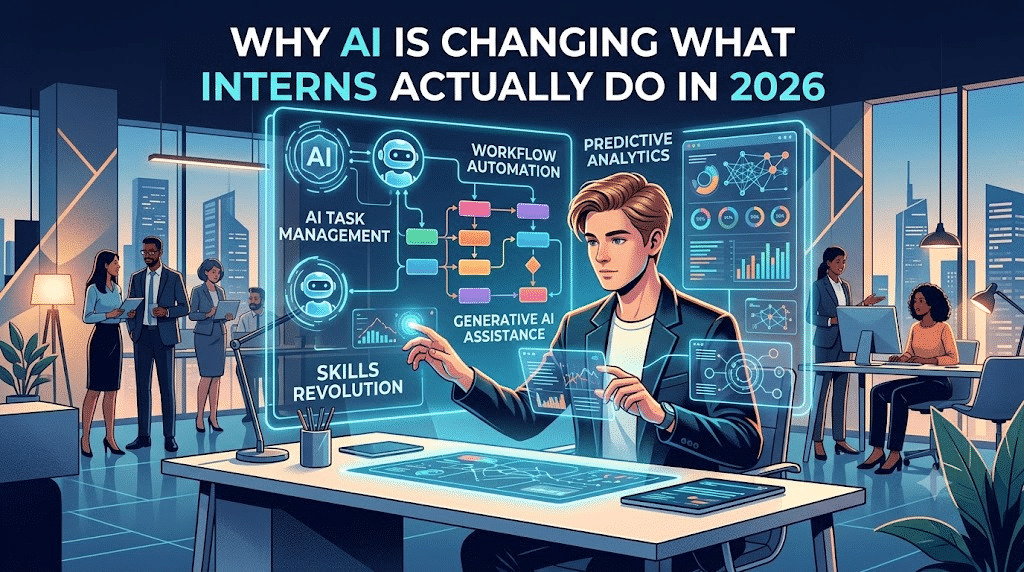
From Task Executors to Workflow Builders
The most noticeable change concerns the type of work given to interns. In the past, junior positions had been partly designed as a training exercise, involving repetitive and clearly defined tasks such as data entry, note-taking and document formatting, in order to teach new employees the mechanics of running a business while at the same time keeping the risks low. AI tools can now carry out many of these tasks more quickly and with greater consistency than a new intern could. Because of this, part of that “grunt work” has effectively vanished from the intern position and has instead been substituted by more important duties.
The summer 2026 intern group was reported on in a way that showed students being given the responsibility of designing the highly automated workflows which previously had been considered basic training exercises. A frequently mentioned example is that an intern working at an agentic human-resources company spent most of her internship creating and keeping an eye on an AI agent that searched the company’s data and prepared marketing materials — in this case, the AI was carrying out the work, not just a tool that she used alongside. Likewise, such trends can be seen in internships in finance, engineering, and marketing, with the responsibilities listed now including the construction of agent pipelines, writing evaluation harnesses to verify that a model’s output is in fact improving, and integrating large language models into internal tools via platforms such as n8n, Zapier, and Make.com
It represents a significant reversal of the usual intern-employer relationship. Instead of learning the company’s current processes, many interns are now being asked to question them and reconstruct those processes with the help of AI. For example, a rising senior at Liberty Mutual could spend the summer using AI to analyse data and produce visualisations of trends in actuarial work which used to take weeks of manual review. The intern is not only carrying out the task more quickly; they are often the person who decides on what the job should be like in the future.
Why Employers Are Making This Trade
The fact that early-career employees are given the responsibility of redesigning workflows using AI is no coincidence but a deliberate decision. There are several factors coming together to make this attractive to employers:
1. Among the interns, there are often the ones who are most familiar with AI. According to Handshake’s study of the Class of 2026 being the first group whose entire time at college was guided by generative AI—it has been found that 85% of the graduating seniors currently use AI tools, compared to about half two years ago, and over one-third of them use these tools every day. Since they have already gained experience, the interns are able to prompt, make improvements to, and debug AI outputs more easily than employees who joined the workforce before these tools were available.
The demand for skills in artificial intelligence is rising at a faster rate than the supply of qualified individuals can meet. According to NACE’s 2026 Job Outlook Spring Update, AI is increasingly being expected of people at the beginning of their careers, and this is affecting both the criteria used when hiring and the everyday content of entry-level positions. Job listings that include AI in their titles draw in a much larger number of applicants—Handshake discovered that internship postings which mention AI receive nearly five times as many applications as those that do not mention AI, even when the applicant pools are of a similar qualification.
3. Since AI-savvy interns are inexpensive and enthusiastic workers who can help introduce new ways of working, it is possible to test an unproven automation idea on a live production process without taking much risk. Instead, the idea can be tested over the course of a ten- or twelve-week internship project, with well-defined limits and under close supervision, thus allowing the team to find out whether an AI agent can actually carry out a task before introducing it on a larger scale.
4. Incentives relating to retention and conversion. The NACE 2026 Internship & Co-op Report links effective internship programs with long-term hiring return on investment, and it is becoming more common for companies to convert interns who have shown that they can work independently using AI tools into full-time employees. For instance, Liberty Mutual converted 79% of its rising-senior interns into permanent positions, a number of these interns having spent the summer using AI to carry out tasks which previously would have required a more senior analyst.
The Skills Gap Interns Are Being Asked to Close
At the same time as demand for interns who are skilled in AI is increasing, most students claim that they are not receiving systematic training to meet this change. In Handshake’s survey, only 28% of incoming graduates said that their school had ‘meaningfully integrated’ AI into their courses, and 58% stated that they will need stronger AI skills than those they currently possess in order to succeed in their careers. To put it simply, many interns have to learn how to build agents and automate workflows on the job, in real time, since their official education has not kept up.
At an institutional level, steps are now being taken to bridge this gap, for instance, Purdue University will be requiring all incoming freshmen to have an ‘AI working competency’ beginning in the fall of 2026, but the students currently involved in internships are having to make this transition without the benefit of a structured curriculum. It is therefore the internship that serves as the main source of training for a skill which employers nowadays regard as almost essential: this is true for nearly all members of the Class of 2026 and is rapidly increasing among the younger groups as well.
The particular skills that employers most frequently mention in job postings related to AI tend to fall into a number of broad categories: constructing and assessing retrieval or agent pipelines, linking large language models to internal data and tools through the use of APIs, carrying out prompt engineering for business applications, and checking that the output generated by AI is accurate before it is given to a customer or client. It is worth noting that in several of these job advertisements it is made clear that they do not expect candidates to already be familiar with every tool; instead, they are looking for the ability to solve problems quickly, a quality that corresponds exactly to the speed at which the underlying AI tools themselves are evolving.
The Trade-Offs Nobody Is Advertising
This change is not entirely beneficial for interns, and the report on the 2026 group has been honest about the disadvantages.
There’s a structural irony here: each workflow that an intern manages to automate this summer could result in a training task being removed that would have been used to teach next year’s interns the basic aspects of the job. If activities such as data entry, producing the first draft, and carrying out basic research all get automated, then some people are concerned that the industry is, in effect, getting rid of the rungs at the bottom of the career ladder while at the same time introducing new responsibilities specific to AI at the top.
Second, it is not true that all ‘AI internships’ involve the creation of agents; some interns have stated that they spend a significant part of their internship reviewing and correcting AI-generated code or documents, identifying basic errors that a more experienced employee would be able to fix in a shorter amount of time. This has been put rather bluntly into words as being like a ‘AI slop janitor’ — a modern and less glamorous version of the traditional filing work.
Third, student opinions are truly divided. Although employers are mostly optimistic more than half of hiring managers think that generative AI will lead to the creation of jobs. Only about one quarter of graduating seniors share this optimistic view, and almost half of the pessimistic seniors say that AI’s effect on the job market has been a factor in their outlook. Overall, the number of job advertisements for early-career positions is down by about 2% compared with the previous year and 12% lower than the levels seen before the pandemic, even though the number of advertisements specifically related to AI is increasing. Interns are therefore being asked to develop the tools which may make it harder for some of their peers to secure entry-level positions.
References
[1] Handshake, “Class of 2026 graduation report,” Handshake Research, 2026. [Online]. Available: https://joinhandshake.com/research/economic-research/class-of-2026-ai-outlook/
[2] National Association of Colleges and Employers, “2026 Internship & Co-op Report + Dashboard,” NACE Research Reports, 2026. [Online]. Available: https://naceweb.org/research/reports/2026/2026-nace-internship-and-co-op-report-and-dashboard
[3] “The surreal summer intern class of 2026: How today’s interns are automating tomorrow’s entry-level jobs,” Job Advisor, Aug. 2026. [Online]. Available: https://www.jobadvisor.link/2026/08/the-surreal-summer-intern-class-of-2026.html
[4] Internshala, “AI agent development internships,” Internshala Internship Listings, 2026. [Online]. Available: https://internshala.com/internships/ai-agent-development-internship/
[5] Internshala, “Artificial intelligence (AI) internships,” Internshala Internship Listings, 2026. [Online]. Available: https://internshala.com/internships/artificial-intelligence-ai-internship/
[6] Handshake, “Workforce outlook: Class of 2026 in the AI economy,” Handshake Network Trends, 2026. [Online]. Available: https://joinhandshake.com/network-trends/class-of-2026-outlook/
[7] National Association of Colleges and Employers, “Trends & predictions: Job market,” NACE, 2026. [Online]. Available: https://www.naceweb.org/job-market/trends-and-predictions/
[8] C. Flaherty, “AI career skills move beyond computer science,” Inside Higher Ed, Aug. 19, 2026. [Online]. Available: https://www.insidehighered.com/news/student-success/life-after-college/2026/08/19/ai-career-skills-move-beyond-computer-science
[9] R. Friedman, “Entry-level jobs calling for AI skills nearly doubled from a year ago, says report,” CNBC, Apr. 29, 2026. [Online]. Available: https://www.cnbc.com/2026/04/29/entry-level-jobs-calling-for-ai-skills-nearly-doubled-from-a-year-ago-report.html
[10] Handshake, “AI and the workforce ahead: What the Class of 2026 tells us,” Handshake Network Trends, 2026. [Online]. Available: https://joinhandshake.com/themes/handshake/dist/assets/downloads/network-trends/%5BHNT%2026%5D%20Class%20of%202026.pdf
Streamline Your Hiring with Eve Placement
Engage, assess, and recruit top talent through tailored AI hiring challenges that go beyond resumes. Ready to hire better? Contact our research team for a custom consultation.