
India Macro Fundamentals FII – The Case That Will Bring it Back in Force
Published: Jul 15, 2026
Key Points
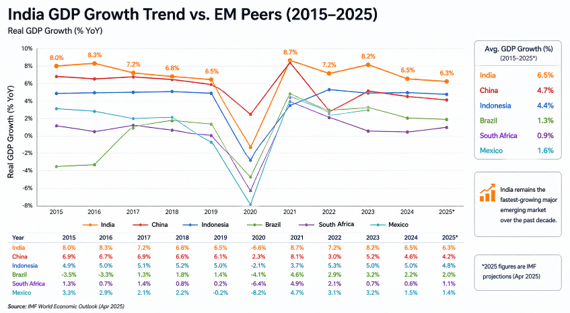
- India macro fundamentals FII capital is highly likely to return as a structural allocation rather than a short-term tactical trade, driven by a highly consistent annual GDP growth rate between 6.5% and 7.2%.
- India's service exports surplus has risen to near $160 billion, transforming the structural balance of the current account and shielding the rupee from historical volatility.
- The inclusion of Indian Government Bonds in the JP Morgan GBI-EM index acts as a passive, non-discretionary trigger expected to pull in up to $25 billion in non-sentimental inflows.
- The Reserve Bank of India’s aggressive accumulation of foreign exchange reserves above $600 billion provides a massive buffer that mitigates currency risk for foreign allocators.
- While temporary capital shifts to a cheaper Chinese market occur, India’s corporate earnings growth of 15% to 18% over consecutive years continues to justify its premium valuations.
- The eventual return of global institutional liquidity is a matter of sequencing waiting on global rate pivots, stable currency margins, and corporate earnings confirmation.
An investor-focused analysis of India’s structural growth story and what it means for foreign institutional capital
Introduction
There is a certain irony in the fact that the most persistent bearish argument on India — that it is always expensive — has, over the past decade, proven to be the most expensive view to hold. To truly understand this resilient equity rally, global allocators must look beyond short-term valuations to the underlying India macro fundamentals FII structural alignment. The MSCI India index has compounded at rates that have left EM peers standing still, and yet every rally has been greeted with the same refrain: stretched valuations, unsustainable multiples, and the inevitable correction that is always, somehow, just around the corner.
Foreign institutional investors have pulled money out on cue during global risk-off episodes — dollar strengthening, Fed hawkishness, China re-rating bets — and each time, re-entry has cost them dearly. The question for 2025 and beyond is not whether FIIs will return to India. They will. The question is on what terms, and whether those managing institutional capital in London, Singapore, and New York are looking at the right variables when they try to time it.
A Growth Rate That Has Stopped Being a Consensus Surprise
India’s GDP growth story has, at this point, moved past the phase where it surprises anyone. What has changed is its consistency. In the four years following the pandemic-era disruption, India’s real GDP growth has averaged somewhere between 6.5% and 7.2% annually — a band that most comparable economies would structure entire policy frameworks around trying to achieve. The IMF, World Bank, and the Asian Development Bank have all, at various points, positioned India as the fastest-growing large economy on the planet, and the structural drivers behind that claim are not short-cycle phenomenon.
Private capital formation has been picking up steadily since 2022 after years of balance-sheet repair in Indian corporates. The investment-to-GDP ratio, which had fallen to alarming lows during the credit crisis years, has staged a gradual recovery. Public infrastructure spending — roads, railways, ports, logistics corridors — has acted as the demand engine, and private capex has begun to follow with the lag that economic textbooks predict but rarely see executed this cleanly.
The Production-Linked Incentive schemes across fourteen sectors have not solved everything, but they have created measurable capacity additions in electronics, pharmaceuticals, and specialty chemicals that are beginning to show up in export data. None of this is revolutionary analysis. But what tends to escape FII models built around shorter time horizons is that India’s macro fundamentals are not priced in a single quarter. They price in over cycles. The compounding effect of a 6.5–7% GDP grower with expanding formal sector employment and deepening domestic financial markets is not a trade; it is a structural allocation question.
The Current Account Narrative Has Quietly Improved
India’s current account deficit has historically been the variable that triggers the most violent FII exits. The 2013 Taper Tantrum saw the rupee collapse partly because India’s CAD had ballooned above 4.5% of GDP — a figure that made the country acutely vulnerable to any reversal in dollar liquidity. That experience left a scar on the institutional memory of global EM investors, and the CAD remains a first-order concern whenever dollar strength returns to the table.
What has changed meaningfully is the structural composition of India’s external account. Services exports — software, IT-enabled services, business process management, and increasingly, global capability centers — have become a structural offset to the merchandise trade deficit. India’s services surplus has grown from roughly $70 billion in 2018 to something approaching $160 billion by 2024, and the trajectory on digital services exports is not showing signs of saturation. Remittance inflows, consistently the world’s largest in absolute terms, add another layer of resilience that the headline CAD number does not capture.
The result is a current account position that sits typically in the 1–2% of GDP deficit range during normal commodity cycles, with the capacity to deteriorate when oil spikes but the structural wherewithal to recover faster than the 2012–2013 episode would suggest. FII attraction, historically, correlates strongly with external account stability — and on this metric, India looks meaningfully different from where it sat a decade ago.
Three Real-World Signals That Sophisticated FIIs Are Already Reading
The first signal worth watching is the inclusion trajectory. India’s weight in the MSCI Emerging Markets Index has risen substantially, and the inclusion of Indian Government Bonds in the JP Morgan GBI-EM Global index from June 2024 onward is not a symbolic gesture. It is a passive flow trigger. Index inclusion forces allocation from funds that benchmark against these indices — a structural, non-discretionary demand that does not respond to short-term sentiment. Goldman Sachs estimated the JP Morgan bond index inclusion alone could drive $20–25 billion in passive inflows over 12–18 months. That is not noise.
The second signal is the IPO and primary market data, which functions as an on-the-ground barometer of where domestic and institutional capital is actually comfortable deploying. India’s primary markets have seen some of the most heavily oversubscribed offerings in the world over the last two years — and the quality of the pipeline, from D-Mart’s expansion to Zomato’s eventual path to profitability to the HDFC Bank merger absorbing smoothly into market cap, reflects a domestic institutional ecosystem that is maturing in ways that global capital markets rarely see in a single decade.
The third signal is the dollar-rupee stability relative to history. The RBI’s reserve management — which has kept forex reserves comfortably above $600 billion for sustained periods — has created a credible buffer against the kind of currency volatility that historically sent FIIs for the exits. When global investors model India allocations today, they are doing so with a currency risk profile that is structurally less alarming than 2013, 2018, or even the 2020 early pandemic period.
What FIIs Are Actually Waiting For
The honest answer to why foreign institutional capital has not returned in force is not that India’s macro fundamentals are unconvincing. The story is compelling, and most serious EM allocators know it. The hesitation is a combination of valuation discipline, tactical dollar dynamics, and the competing narrative of China’s re-rating cycle — which, each time it appears, seems to absorb the marginal EM dollar that might otherwise find its way to Mumbai.
The China factor deserves a clear-eyed treatment. Every time Beijing signals stimulus — whether through property market support, infrastructure spending, or PBOC rate cuts — a cohort of EM funds shifts allocation eastward. The logic is straightforward: China’s discount to historical multiples becomes compelling relative to India’s premium.
What this misses is that the structural risks in China — demographic headwinds, property sector debt overhangs, regulatory unpredictability — are not cyclically resolved by a rate cut. India’s premium to China, in that context, is not entirely irrational. It reflects a different risk-adjusted return profile, not just hype.
What would catalyze FII return in force is a combination of rupee stability, a Fed pivot that weakens the dollar meaningfully, and earnings delivery from Indian corporates that continues to justify the multiple. The Indian corporate earnings cycle has been remarkably robust — Nifty 50 earnings growth in the 15–18% range for multiple consecutive years is not the norm for any large market — and if that trajectory holds, the premium becomes defensible even by the standards of the most valuation-conscious allocators.
Conclusion
India’s macro fundamentals make the most coherent case they have made in twenty years for sustained FII attraction. The combination of durable GDP growth, an improved current account structure, index inclusion driving passive flows, and a central bank that has managed currency volatility with far greater sophistication than its EM peers — this is not a trading thesis. It is an allocation thesis. The FIIs who built positions during the 2022–2023 correction and held through the noise have seen what happens when the fundamentals eventually assert themselves over short-term sentiment.
Key Takeaway for Founders & Investors
If you are building a business or managing institutional capital with an India exposure, the macro backdrop is genuinely your friend right now — which is precisely when most people are distracted by short-term noise. The structural FII return to India is not a question of if; it is a question of sequencing. Dollar weakness, a stabilizing global rate environment, and one or two quarters of earnings confirmation are the triggers. Position before consensus arrives at the same conclusion, because by the time the allocation tide fully turns, the entry point will look, in hindsight, as obvious and as painful to have missed as every other India rally before it.
Frequently Asked Questions
1: Why are global investors re-evaluating India macro fundamentals FII opportunities right now?
Global allocators are looking past near-term currency swings to study long-term stability. A clear understanding of India macro fundamentals FII dynamics shows that domestic structural growth is highly resilient, changing the way foreign capital assesses entry pricing. Therefore, keeping track of India macro fundamentals FII is key to identifying secular market shifts.
2: How does the external trade balance influence GDP current account FII attraction trends?
Historically, a widening deficit scared away global funds. Today, the strength of the software and service exports directly improves the GDP current account FII attraction relationship by shielding the country’s balance of payments from sudden commodity shocks. This resilience has fundamentally altered how emerging markets view GDP current account FII attraction as a primary stability indicator.
3: What makes the current India macro fundamentals FII outlook different from the 2013 Taper Tantrum?
In 2013, a high external deficit left the financial system exposed. The modern India macro fundamentals FII framework is supported by a massive $600+ billion foreign exchange reserve buffer and robust domestic liquidity, creating a highly stable investment environment. This is why analysts point to India macro fundamentals FII strength as a primary shock absorber.
4: Why is services export growth vital for GDP current account FII attraction?
Services exports have near-doubled to around $160 billion, which dramatically minimizes external structural deficits. This structural safety net directly boosts GDP current account FII attraction by neutralizing merchandise trade imbalances. For macro funds, stable service export delivery remains a cornerstone of GDP current account FII attraction models.
5: Will passive index tracking force an increase in India macro fundamentals FII inflows?
Yes, passive tracking is non-discretionary. The inclusion of Indian government debt in major global indexes ensures that India macro fundamentals FII allocations must rise automatically, completely independent of active manager sentiment. This benchmark shift establishes a permanent floor for India macro fundamentals FII flows.
6: How does corporate earnings growth affect GDP current account FII attraction over time?
Consistent corporate earnings growth of 15% to 18% provides a fundamental justification for high entry valuations. This strong corporate performance is a key driver for GDP current account FII attraction, keeping foreign capital anchored even during global market shifts. No other emerging market matches this earnings-backed GDP current account FII attraction profile right now.
7: How do domestic markets protect the broader India macro fundamentals FII narrative?
Deepening domestic mutual fund inflows mean Indian markets are no longer solely dependent on foreign hot money. This domestic maturity stabilizes the India macro fundamentals FII environment, making the entire ecosystem far less volatile during global risk-off phases and proving the structural strength of India macro fundamentals FII indices.
8: Does the comparison with China affect GDP current account FII attraction?
While short-term capital sometimes rotates to cheaper Chinese equities, India’s superior structural growth profile maintains its premium. This long-term premium directly sustains GDP current account FII attraction over multi-year economic cycles, confirming that cyclical stimulus in peer nations does not derail local GDP current account FII attraction metrics.
9: What specific triggers will spark a massive wave of India macro fundamentals FII inflows?
A combination of stable domestic currency performance, a pivot in Federal Reserve interest rate policies, and continued corporate earnings delivery will solidify the next cycle of India macro fundamentals FII capital deployment. Investors waiting for these catalysts are monitoring India macro fundamentals FII signals closely.
10: How does currency risk management play into GDP current account FII attraction?
Active currency management by the RBI minimizes exchange-rate depreciation risks. For foreign investors, a predictable currency directly enhances GDP current account FII attraction by protecting absolute, dollar-denominated returns. Consequently, currency stability remains central to the long-term GDP current account FII attraction thesis.
Citations & References
[1] International Monetary Fund (2024). World Economic Outlook — Steady but Slow: Resilience amid Divergence. IMF Publications. [Online].
Available:
https://www.imf.org/en/Publications/WEO
[2] JP Morgan Asset Management (2024). India GBI-EM Index Inclusion — Flow Impact Analysis. JP Morgan Research.
[3] Reserve Bank of India (2024). Annual Report 2023–24: External Sector and Monetary Policy. RBI Publications. [Online].
Available:
https://www.rbi.org.in
[4] Goldman Sachs Global Investment Research (2024). India — The Weight of Inclusion. GS Equity Research Note.
[5] MSCI (2024). MSCI Emerging Markets Index Factsheet — India Weight Trajectory. [Online].
Available:
https://www.msci.com
[6] Asian Development Bank (2024). Asian Development Outlook — India Country Chapter. ADB Publications. [Online].
Available:
https://www.adb.org
[7] Ministry of Finance, Government of India (2024). Economic Survey 2023–24. Department of Economic Affairs. [Online].
Available:
https://www.indiabudget.gov.in
[8] EvePlacement. [Online].
Available:
https://eveplacement.com/
Streamline Your Hiring with Eve Placement
Engage, assess, and recruit top talent through tailored AI hiring challenges that go beyond resumes. Ready to hire better? Contact our research team for a custom consultation.