
5 Reasons why India is the last growth engine of Global Economic Growth
Published: Jul 14, 2026
Key Points
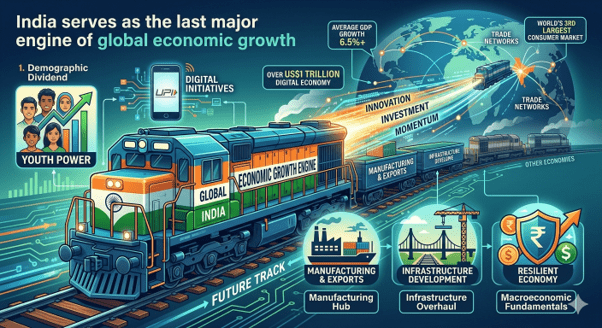
- A young median age of 29 ensures a productive workforce and a high-consumption economy.
- Tools like UPI have created the world’s most efficient public digital infrastructure.
- Global supply chains are increasingly shifting to India to mitigate risks elsewhere.
- Heavy investment in physical infrastructure is slashing the cost of doing business.
- A proactive shift toward green energy ensures that future growth is resilient and modern.
Introduction
While many of the world’s major economies today are faced with issues like aging populations, high debt, or stagnant productivity, India has emerged as a resilient economy. Frequently described as the final major growth engine of the global economy, India is no longer just “the next big thing”—it is the current powerhouse.
Here are five key reasons why India is sustaining this vital momentum in GDP and driving global prosperity.
1. The Demographic Dividend
Unlike the aging and shrinking populations of West and East Asia, India possesses one of the world’s youngest workforces. With a median age of around 29, the nation has a large pool of workers, consumers, entrepreneurs, and innovators. The demographic dividend provides a dual advantage i.e. it offers a steady supply of labour for global manufacturing and a growing middle class that creates a considerable domestic demand, thus somewhat shielding the economy from external shocks.
2. Digital Infrastructure and the “Tech Leap.”
The story of economic growth in India has always been unique and different from how the rest of the economies of the world have shaped up. The India Stack—a unified software platform including Aadhaar and the Unified Payments Interface (UPI)—has revolutionized financial inclusion. By making digital payments as convenient as sending a text, India has formalized its economy at a fast pace, fostering a startup ecosystem that is now the world’s third-largest.
3. A Strategic Shift in Manufacturing
The “China Plus One” strategy adopted by global corporations has proven to be beneficial for India. Through the Production Linked Incentive (PLI) schemes, the government has successfully lured in global giants like Apple and Samsung and convinced them to move their assembly lines to Indian soil. This shift from a service-heavy economy to a manufacturing hub is diversifying the country’s growth base and creating millions of jobs. Also it is important to have a sound manufacturing sector to sustain growth over long periods of time.
4.Infrastructure Overhaul
The physical landscape of India is changing at a record pace. Massive investments in the “Gati Shakti” national master plan have lead to the construction of world-class highways, modernized railway corridors, and dozens of new airports. By lowering logistics costs—traditionally a bottleneck for Indian trade— and prices eventually, the country is becoming significantly more competitive on the global stage.
5. Energy Transition and Sustainability
India is positioning itself as a leader in the green energy revolution. With ambitious targets for solar power and green hydrogen, the country is delinking its growth from heavy carbon emissions. This transition not only addresses climate change but also reduces the economic burden of energy imports, ensuring that long-term growth is both sustainable and fiscally sound.
Conclusion
India’s rise is not a matter of chance but a result of structural reforms, technological adoption, and favorable demographics. As other engines of the world economy slow down, India’s consistent 6–7% growth rate provides the necessary fuel to keep the global machinery moving. While challenges like wealth inequality and bureaucratic hurdles remain, the sheer scale of India’s GDP momentum makes it the indispensable growth engine for the coming decades.
Frequently Asked Questions
1: Why is India considered a vital global economic growth engine?
As major global economies face severe slowdowns, India’s consistent 6–7% expansion rate acts as a highly resilient growth engine to keep the global machinery moving.
2: How does the demographic dividend support India’s GDP momentum?
With a median age of 29, India’s exceptionally young workforce drives massive manufacturing productivity and consumer demand, directly sustaining this vital GDP momentum.
3: What is the “India Stack” and how has it helped the economy?
It is a unified digital software platform, including Aadhaar and UPI, that has fast-tracked financial inclusion and modernized the transaction ecosystem without relying on traditional legacy systems.
4: How does the “China Plus One” strategy boost the country’s manufacturing sector?
By diversifying global supply chains, international corporations are moving major assembly lines to India, providing a powerful physical anchor for local industries.
5: What is the focus of the Gati Shakti national infrastructure initiative?
Gati Shakti is a massive logistics overhaul. By modernizing highways and airports, it acts as a crucial growth engine that lowers trade costs.
6: Why is the transition to green energy a priority for India’s long-term expansion?
By investing heavily in solar and green hydrogen, India decouples economic progress from carbon emissions, ensuring that future progress remains clean and sustainable.
7: Can a strong domestic consumer market shield this global growth engine?
Yes, a massive and rising middle class creates strong internal demand, effectively shielding this crucial growth engine from sudden external economic shocks.
8: What specific growth rate is keeping the nation’s GDP momentum stable?
India is maintaining a highly resilient economic expansion rate of 6% to 7%, which successfully feeds and stabilizes its ongoing GDP momentum.
9: How do government PLI schemes attract foreign corporations?
Production Linked Incentive (PLI) schemes offer direct financial incentives to global giants, converting the domestic manufacturing sector into a high-powered hub.
10: What challenges could slow down India’s ongoing GDP momentum?
Even though India is expanding rapidly, structural issues like wealth inequality and bureaucratic hurdles must be actively managed to protect future GDP momentum.
Citations & References
[1]“PIB Headquarters,” Pib.gov.in, 2017. [Online].
Available:
https://www.pib.gov.in/PressNoteDetails.aspx?ModuleId=3&NoteId=154840®=3&lang=2
[2]“India Stack | Data,” Indiastack.org, 2025. [Online].
Available:
https://indiastack.org/data.html
[3]W. B. Group, “India Remains Among the Fastest-Growing Economies Even As Growth Slows Amid Middle East Conflict; Outlook Vulnerable to Risks and Uncertainty,” World Bank, Apr. 09, 2026. [Online].
Available:
https://www.worldbank.org/en/news/press-release/2026/04/09/india-remains-among-the-fastest-growing-economies
[4] EvePlacement. [Online].
Available:
https://eveplacement.com/
Streamline Your Hiring with Eve Placement
Engage, assess, and recruit top talent through tailored AI hiring challenges that go beyond resumes. Ready to hire better? Contact our research team for a custom consultation.