
Bricks, Beams & Bytes: How Heritage Restoration Is Breathing New Life into Old Bones
Published: Jul 7, 2026
Key Points
- Heritage restoration plays a crucial role in preserving cultural identity while generating trillions of dollars globally through historical tourism.
- Repurposing old structures for modern utility provides significant economic advantages by transforming abandoned spaces into commercial or public hubs.
- Modern technological interventions like 3D laser scanning and AI structural analysis allow architects to upgrade ancient buildings safely.
- Preserving and renovating older structures releases significantly less carbon dioxide compared to the environmental cost of demolition and rebuilding.
- Successful conservation projects require a strict adherence to original materials, community involvement, and thorough documentation.
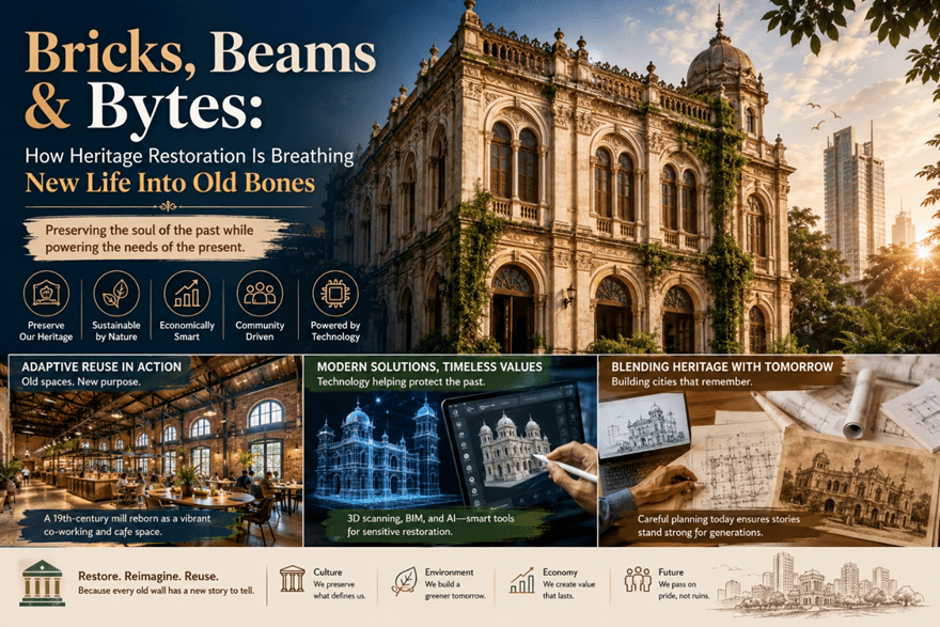
Preserving the soul of the past while powering the needs of the present.
Introduction
Go walking down any old neighbourhood in Mumbai, Kolkata, or Hyderabad, and you will come across a decrepit haveli, an old Victorian railway terminal covered in years of dirt, or an ornate palace from the time of the Nizam, all of which have been overtaken by bougainvillea. They contain many years of culture, tradition, and history. But around the globe, there has been a paradigm shift in the way things are being talked about, from destruction and reconstruction to renovation, reinvention, and reuse.
What Is Heritage Restoration – And Why Does It Matter?
Heritage restoration involves restoring historic buildings and structures with utmost care to maintain their architecture and heritage value. Restoration is not like renovation; it requires careful attention to details such as replacing a damaged sandstone cornice with a similarly hued piece of quarried stone or removing the layers of poor-quality paint to reveal hand-painted frescoes underneath.
This makes heritage preservation crucial. As per the Archaeological Survey of India, there are over 3,600 centrally protected monuments in India and several more are protected by state governments. The contribution of heritage tourism in generating revenues for the world’s economies is estimated to be over $8 trillion annually by UNESCO. This is because historical buildings have their own story to tell.
The Rise of Adaptive Reuse
This is where restoration of heritage becomes exciting. It involves repurposing heritage buildings for something completely different – but still maintaining all their cultural significance. For instance, an old colonial-era warehouse can be converted into a boutique hotel; a 19th-century flour mill can become a co-working space, while a deserted railway station can transform into a weekend market.
There are some great examples of this practice in India. The Bhau Daji Lad Museum in Mumbai, which dates to 1872, has been successfully restored and functions as an active museum till date. In Ahmedabad, which is known as the first World Heritage City of India, several pol buildings have been repurposed into heritage homestays and design studios.
Internationally, there are many such projects that highlight the economic benefits of adaptive reuse. Examples include the Tate Modern in London, where an old power station has been converted into an art gallery, while the High Line in New York is one of the best examples of an abandoned railway line transformed into a beautiful, elevated park.
Modernizing Without Compromising: The Balancing Act
The fundamental problem when working on heritage sites is: how to make plumbing and safety systems for the internet available in the walls dating back 150 years ago? Without demolishing what you are trying to restore, that is. This concept is known as “honest intervention,” which means designing new features in such a way that they would stand out from historical walls so that future generations can see the difference.
This process is increasingly helped with advanced technologies like 3D laser scanning, which lets architects capture the state of all parts of a building in detail at the very early stage. With BIM, engineers can digitally recreate the entire complex and design their interventions using that model. Even structural analysis powered by artificial intelligence is utilized to reveal weaknesses and defects invisible to a naked eye.
Apart from cultural responsibility, sustainability is one more motive behind the preservation of heritage buildings. Numerous research has proven that renovation results in the release of 2.4 times less CO2 than demolition and reconstruction.
Key Principles Every Restoration Project Must Follow
1: Respect the original fabric –
Repair rather than replace wherever possible.
2: Document everything –
Photograph and record before, during, and after the restoration.
3: Use compatible materials –
Avoid modern substitutes that may damage historic masonry.
4: Involve the community –
Residents and historians are irreplaceable sources of knowledge.
5: Ensure accessibility –
Modern safety standards must be met, sensitively integrated.
The Road Ahead: Challenges and Opportunities
There are some challenges to restoring the heritage sites in India. These include unclear ownership rights, lack of funds, insufficient professional conservation architects, and most importantly, bureaucracy. The Heritage Conservation Committees in many cities lack staff members and adequate budget allocations.
However, the efforts to restore and maintain heritage sites in India are gaining momentum. The HRIDAY initiative by the Indian government for heritage urban areas has been allocated several thousand crores of rupees. The private sector is increasingly investing in restoring heritage sites for reasons such as the heritage hotel industry, cultural tourism, and the attraction of character spaces that younger generations seek.
Old Walls, New Stories
Heritage restoration and adaptation are not backward-looking ventures. Instead, they are visionary and pragmatic approaches to urban construction that respect history while meeting modern needs. Each door left standing, each bracket preserved, each heritage building repurposed as a place of life and activity is an act of cultural survival.
The walls know their history. It is up to us to listen, restore, and adapt, or ignore and destroy.
Frequently Asked Questions
1: What is heritage restoration?
It involves carefully conserving historic structures to protect their original architecture.
2: Why use adaptive reuse?
It allows historic buildings to serve modern purposes efficiently.
3: Is heritage restoration sustainable?
Yes, it releases far less carbon dioxide than reconstruction.
4: What defines adaptive reuse?
It means repurposing old spaces while maintaining cultural value.
5: How does heritage restoration help?
It drives significant tourism and economic revenue worldwide.
6: Who funds adaptive reuse?
Both private investors and government initiatives fund these projects.
7: Does heritage restoration use tech?
Yes, techniques like 3D laser scanning are widely used.
8: What is an adaptive reuse example?
The Tate Modern power station conversion is a prime example.
9: Why value heritage restoration?
It preserves historical stories and architectural identity for the future.
10: Is adaptive reuse profitable?
Yes, it creates highly attractive character spaces for modern industries.
Citations & References
[1] Archaeological Survey of India, “Centrally Protected Monuments,” 2025. [Online].
Available:
https://asi.nic.in/
[2] UNESCO, “Heritage Tourism and Culture,” 2025. [Online].
Available:
https://whc.unesco.org/
[3] Ministry of Housing and Urban Affairs, “HRIDAY Scheme Overview,” 2025. [Online].
Available:
https://www.mohua.gov.in/
[4] Bhau Daji Lad Mumbai City Museum, “Museum History,” 2025. [Online].
Available:
https://www.bdlmuseum.org/
[5] INTACH, “Built Heritage in India,” 2025. [Online].
Available:
http://www.intach.org/
[6] EvePlacement. [Online].
Available:
https://eveplacement.com/
Streamline Your Hiring with Eve Placement
Engage, assess, and recruit top talent through tailored AI hiring challenges that go beyond resumes. Ready to hire better? Contact our research team for a custom consultation.