
9 Innovative Ways How Pest Management AI is Transforming Modern Farming
Published: Jun 27, 2026
Key Points
- Modern agriculture is shifting toward precision data, and pest management AI is leading this change by replacing slow, manual field scouting with instant automated detection.
- Intelligent drones inspect massive hectares of farmland in minutes, providing high-resolution imagery that catches infestations before they spread.
- By calculating exact infestation rates, smart technology drastically minimizes chemical pesticide application, saving soil and water health.
- AI-driven sensors continuously track real-time changes in soil moisture and temperature to warn farmers of impending insect threats.
- Autonomous agricultural robots can pinpoint, isolate, and spot-treat infected plants without requiring manual human labor.
- Combining cloud computing with machine learning makes advanced crop monitoring scalable and affordable for small-scale farms.
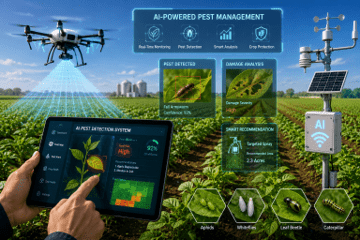
Introduction
Agriculture has always been among the key sectors essential to human existence. However, modern farmers have to deal with many difficulties affecting crop yield negatively. The use of pesticides remains a major challenge since pest attacks contribute substantially to crop destruction. Integrating pest management AI into standard agricultural practices offers a powerful solution to these ecological and financial struggles.
In recent years, great achievements have been made due to the rapid development of artificial intelligence. Modern agriculture is becoming much smarter thanks to pest management solutions based on AI technologies. Machine learning algorithms, computer vision, drone technology, and different types of sensors allow detecting pest infestation much faster compared to conventional approaches.
1. Early Pests Detection with the Assistance of AI Imaging Technology
The other way that artificial intelligence can help in pest management is by detecting early pest invasion into the crops. The technology uses cameras, drones, and satellite images to continually check for signs of pest invasions that can easily be seen well before they start causing damage. Artificial intelligence uses computer imaging technologies to check whether the leaf colour, pattern, and texture are consistent with normality. If any anomaly is found, it is immediately noted to ensure proper handling of the situation.
2. Field Inspection with the Help of Intelligent Drones
AI-powered drones are commonly used by modern farmers to conduct efficient field inspections in a matter of minutes. Drones take high-quality photos and collect all the necessary information on a large number of hectares. Unlike human inspections, drone inspections help to identify pest-infested areas and provide comprehensive reports instantly, saving money and time. Drones help implement advanced techniques of protecting crops from pesticides because they make sure that pesticides are applied only in the areas of concern.
3. Minimal Chemical Pesticide Usage
The conventional method of agricultural practices makes extensive use of pesticides, which may have adverse effects on soil quality and the quality of water and even be dangerous for humans. The artificial intelligence technology of pest control allows for adopting a precise approach to managing pests since the computer will be able to determine infestation rates and how many pesticides would be necessary to deal with the problem.
4. Instant Analysis of Crops’ Health State
With the help of artificial intelligence technologies, farmers will be able to analyse the state of crops in real-time thanks to advanced sensors and other intelligent devices that transmit information about soil moisture, temperature, air moisture, and presence of pests and then give appropriate recommendations regarding further actions to take right away.
5. Methods of Analysis for Prediction of Pests’ Attack
The ability to analyse is another strong side of artificial intelligence in pest control. It can predict future pests’ attacks based on data analysis of weather conditions, historical data, and others. For instance, there are some insects that start their activity when the temperature and humidity reach certain levels. Based on the gathered data, the system will make predictions about possible attacks and inform the farmer about that.
6. Increase the Yield of Crops and Their Quality
A healthy yield of crops is essential in efficient agriculture, which implies successful pest control through the use of artificial intelligence in pest control results in better agricultural productivity. Identification and pest control in a timely manner minimise damages inflicted upon crops; hence, the yield will be better. Not only will it benefit the farmer, but it will also improve the customers’ experience due to high-quality crops available.
7. Agricultural Robots With AI
Another interesting development in the area of AI that can revolutionise the agricultural industry is agricultural robotics. These robots are installed with AI-based camera and sensor technology that can identify pests and help eradicate infected plants. Some of the advanced robots are able to spray the right amount of pesticide in the affected regions without any human intervention at all. AI-based technology will help in addressing problems related to labour shortages in agriculture.
8. Promoting Eco-Friendly Farming
There is a great need in the agricultural industry today to adopt environmentally friendly agricultural processes. Overuse of pesticides and inefficient pest control strategies have been causing damage to the ecosystem and affecting the soil quality. Pest management AI systems provide an environmentally friendly approach to managing agricultural crops by adopting an efficient resource management strategy.
9. Potential of AI in Crop Protection
It seems like the potential of AI technology in agriculture is quite high. Various intelligent systems capable of detecting numerous diseases, insect infestations, and nutritional deficiencies are continually developed by experts in the field. Further improvement of farming efficiency will come through the combination of cloud computing, analytical capabilities, and IoT technologies. In the coming years, even small-scale farmers might be able to afford an affordable solution powered by AI technology.
Conclusion
The field of artificial intelligence is revolutionising agriculture by making the farming process intelligent, quick, and efficient. Artificial intelligence is being used in pest management to help farmers reduce crop loss and increase productivity using advanced monitoring techniques, predictions, drones and robotic technologies. Modern crop protection technologies used in agriculture and supported by AI are improving the production of agricultural produce while promoting sustainability in agriculture.
Moreover, the use of AI in agriculture helps protect the environment as well as foster economic development, revolutionising the reduction of excessive pesticide usage and precision farming. While there are challenges like expensive installation costs and access to technology, it cannot be denied that the use of AI in agriculture holds great significance.
Frequently Asked Questions
1: What is the main benefit of deploying pest management AI in modern fields?
The main benefit of deploying pest management AI is its ability to catch insect infestations early using computer vision, allowing farmers to act before widespread crop damage occurs.
2: How do drones assist a pest management AI framework during daily operations?
Drones act as the eyes of a pest management AI framework, flying over hectares of land to take high-resolution photos and instantly flag problematic, infested zones.
3: Can a pest management AI tool help scale down chemical use?
Yes, a pest management AI tool ensures that chemical treatments are only applied to verified problem areas rather than blanketing an entire field blindly.
4: How does a pest management AI handle predictive analytics?
A pest management AI analyzes historical data patterns alongside real-time weather, humidity, and temperature metrics to forecast when specific insect species will hatch or attack.
5: Are robotic systems integrated into pest management AI architectures?
Yes, specialized agricultural robots function alongside pest management AI software to automatically spot-treat fields or physically extract damaged vegetation without human intervention.
6: Why is a pest management AI safer for regional ecosystems?
A pest management AI reduces chemical runoff into local water tables and prevents soil degradation by significantly narrowing down insecticide applications.
7: Is pest management AI accessible for smaller family farms?
While early setups can be expensive, the cloud integration of pest management AI services is rapidly lowering costs, making it accessible for smaller farms soon.
8: Does pest management AI look at things other than insects?
Yes, the core image recognition models in pest management AI are trained to look at leaf discoloration, structural patterns, and signs of nutrient deficiencies.
9: How do automated sensors feed data back to a pest management AI?
IoT sensors embedded in the soil continuously transmit moisture and atmospheric data directly into the pest management AI backend for real-time risk assessment.
10: What role does a pest management AI play in global food security?
By curbing massive crop losses through early warnings, a pest management AI stabilizes food supply yields while increasing the physical quality of the harvested produce.
Citations & References
[1] S. Ramesh and D. Vydeki, “Recognition and Classification of Paddy Leaf Diseases Using Optimised Deep Neural Network”, Artificial Intelligence in Agriculture, vol. 4, pp. 52–56, 2020. [Online].
Available:
https://doi.org/10.1016/j.aiia.2020.04.002
[2] J. Kamilaris and F. X. Prenafeta-Boldú, “Deep Learning in Agriculture: A Survey,” Computers and Electronics in Agriculture, vol. 147, pp. 70–90, 2018. [Online].
Available:
https://doi.org/10.1016/j.compag.2018.02.016
[3] Food and Agriculture Organization (FAO), Integrated Pest Management and Sustainable Agriculture, Rome, Italy, 2020. [Online].
Available:
https://openknowledge.fao.org/
[4] EvePlacement. [Online].
Available:
https://eveplacement.com/
Streamline Your Hiring with Eve Placement
Engage, assess, and recruit top talent through tailored AI hiring challenges that go beyond resumes. Ready to hire better? Contact our research team for a custom consultation.