
WHY THE MOST FULFILLED PEOPLE OF 2026 ARE TRAVELLING LESS, STAYING LONGER, AND EMBRACING DELIBERATE LIVING
Published: Jun 27, 2026
Key Points
- Rushing through places isn’t the same as actually experiencing them – and a lot of people are finally admitting that.
- Mindful travel isn’t a wellness trend – it’s just what happens when you stop treating trips like performance.
- Once you slow down travel, something unexpected happens – the rest of your life slows down too.
- Deliberate Living is defined not by a minimalist aesthetic or rigid 5:00 AM routines, but by the conscious practice of choosing things purely because they matter to you.
- The hyper-mobile "more is more" travel boom of 2022–2024 officially reached its expiration date when travelers realized their rapid itineraries left them with plenty of photos but almost no genuine memories.
- By 2026, the digital nomad community has structurally shifted toward sustainability, with remote workers staying in hub cities like Tbilisi or Medellín for months at a time to establish local routines.
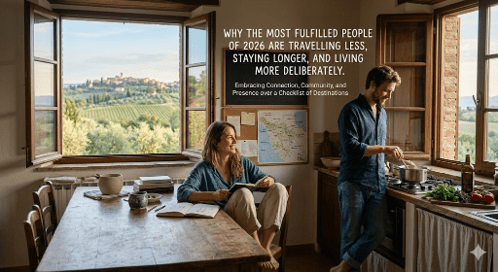
INTRODUCTION
Between the fourth layover and the ninth “authentic local experience” that somehow looked exactly like the last, people started asking a question they hadn’t really let themselves ask before: is this really fun? A growing movement toward deliberate living is changing how we answer that question.
Not all of travel. Travel’s still wonderful. But the kind of travel that was like collecting countries the way people used to collect stamps?. The ones who look really happy aren’t the ones with the most passport stamps. They’re the ones who lingered long enough to be able to call the corner table at a café no one else knew about their favorite.
That’s intentional living — and it’s quietly becoming the lifestyle choice of a generation tired of performing happiness instead of actually feeling it.
THE “MORE IS MORE” ERA HAD A EXPIRY DATE
There was a window — roughly 2022 to 2024 — when everyone was moving fast and calling it living. Post-pandemic energy. Pent-up wanderlust. The cultural pressure to make up for lost time. Absolutely understandable. But then the hangover set in.
People came back from two-week trips covering five countries and found that the memories were mostly just photos. You wrote about being in a place without ever being there. The highlight reel was right there. Strangely enough, the real thing didn’t.
Many Gen Z travelers started to quietly confess this to each other — in comment sections, in group chats, on late-night podcasts. The constant movement was not fulfilling its promise. It was so exhausting that it was almost embarrassing to say out loud, because weren’t you supposed to be grateful? Weren’t you supposed to be living your best life?
Sometimes the most honest thing you can do is admit the thing everyone agreed was amazing isn’t actually working for you.
WHAT HAPPENS WHEN YOU ACTUALLY STAY SOMEWHERE
You spend three days in a place, and you’re a tourist. Three weeks in one place and something real different happens.
One afternoon you get rained in, and instead of rushing to reschedule you simply sit with a book and let the afternoon drift away. You learn one street so well that you don’t need maps for it. They are little things. They just don’t do good Instagram content. But they stick around, in a way that blasting through six cities in ten days never does.
This is where mindful travel comes in – not as a brand, not as a retreat package, just as a quieter way of moving through the world. Being in one place long enough that it starts to change you. A place, valuable if flawed. Coming home knowing you actually took something in, not just survived the itinerary.By 2026, the digital nomad scene pretty clearly reflects this shift.
The people doing it sustainably are not hopping beaches every week anymore. They choose a city — Tbilisi, Medellín, Chiang Mai, Porto — and stay for a month or two. Finding a gym. Learning the public transportation. Maybe getting a library card. And oddly enough, this more grounded version of nomadic life seems to produce far less of the burnout that plagued the “always moving” crowd a few years ago.
IT SPILLS INTO EVERYTHING ELSE TOO
The thing about slowing travel down is that it rarely stops at travel.
When you stop stuffing every moment of your life with stimulation and busyness, you begin to notice what you actually enjoy when no one’s looking and nothing is being recorded. Some people find they like long walks with no destination. Others find themselves rediscovering cooking, or reading, or dinner conversations that last way too long and cover absolutely nothing productive.
Relationships also begin to feel different. When you are there, not there in body but mentally planning the next thing, but actually present. The people around you notice this. And you notice them in ways you probably haven’t for a while.
Deliberate living isn’t a minimalist apartment and a morning routine and cold plunges at 5am. It’s not an aesthetic. It’s just the practise of paying attention to your own life – choosing things because they matter to you rather than because they look good or fill a gap in the schedule.
Which, when you say it like that, sounds almost embarrassingly simple.
CONCLUSION
No one is saying don’t travel. Really – some of the most formative experiences a person can have are being in a place that’s totally unfamiliar and figuring it out.
But there’s a difference between travel that transforms you and travel that just keeps you busy. The first kind usually involves dropping down slowly enough to let a place actually touch down. The second type generates a lot of content and very little memory.
The most fulfilled people today are not living small, boring lives. They’re living as the elect. They’re somewhere in particular, paying attention, and they find that depth in a place, in a relationship, in an ordinary afternoon delivers something breadth and speed never quite managed.
Living intentionally is not a trend. It might just be what it actually feels like to be present for your own life.
Frequently Asked Questions
1: How does deliberate living change the way we experience mindful travel?
Embracing deliberate living allows you to substitute stressful itineraries with slow exploration, shifting focus from ticking off tourist attractions to building deep connections.
2: Why is intentional pacing becoming the preferred approach to travel?
People are turning to a slower pace because modern journeys prove that staying in one place brings more joy than performing for social media.
3: Can you practice mindful travel without committing to a new lifestyle?
While mindful travel can be done on single trips, it rejects the post-pandemic rush that left travelers exhausted and superficial.
4: How do digital nomads combine mindful travel and deliberate living to avoid burnout?
Sustained nomads protect their energy through mindful travel, choosing to settle in one city for months to build a routine rooted in intentionality.
5: Does deliberate living require rigid routines, or is it just about presence?
True deliberate living isn’t an aesthetic or a cold plunge routine; it is simply about bringing full presence into your ordinary daily life.
6: What is the main difference between standard tourism and mindful travel?
Standard tourism prioritizes speed, whereas mindful travel encourages slow exploration and ensures you stay long enough to let the environment change you.
7: How do deliberate living and mindful travel improve our personal relationships?
Both deliberate living and mindful travel force you to be mentally present rather than planning your next move, allowing you to connect deeply with the people around you.
8: Why do modern trends prioritize depth over high-speed itineraries?
True intentionality emphasizes that a deep connection to an ordinary afternoon delivers more satisfaction, making it the ultimate form of mindful travel.
9: What destinations are best suited for slow stays and deliberate living?
Cities like Tbilisi and Porto are ideal for extended stays, allowing remote workers to unpack, join local spaces, and practice sustainable deliberate living.
10: Is choosing deliberate living considered a step backward?
Not at all; prioritizing deliberate living is a powerful, conscious decision to actively participate in your own life rather than rushing through it.
Citations & References
[1] Skift Research, “The Future of Travel 2025: Slow Travel and the Experience Economy,” Skift, New York, Tech. Rep., 2025. [Online].
Available:
https://skift.com
[2] Global Wellness Institute, “Wellness Tourism 2024–2026: Trends and Forecasts,” GWI, Miami, Tech. Rep., 2024. [Online].
Available:
https://globalwellnessinstitute.org
[3] T. Baer, “Digital Nomad Report 2025: How Long-Stay Travel Is Replacing Location Hopping,” Nomad List Insights, Tech. Rep., 2025. [Online].
Available:
https://nomadlist.com
[4] American Psychological Association, “Stress and Lifestyle: Annual Report on Well-Being in Young Adults,” APA, Washington D.C., Tech. Rep., 2025. [Online].
Available:
https://apa.org
[5] EvePlacement. [Online].
Available:
https://eveplacement.com/
Streamline Your Hiring with Eve Placement
Engage, assess, and recruit top talent through tailored AI hiring challenges that go beyond resumes. Ready to hire better? Contact our research team for a custom consultation.