Slow Living in 2026: Why Millions Are Choosing Presence Intention and Imperfection Over Productivity
Published: Jun 24, 2026
Key Points
- Shifting to Slow Living in 2026 serves as a vital psychological defense against a decade of digital optimization fatigue and non-stop hustle.
- Our findings showed that presence is not only a sensation but a biological need.
- The creation process involves shifting from "alertness" under the influence of dopamine to rest through the parasympathetic nervous system.
- Neuroplasticity takes place during these brief intervals of silence, and deliberate rest emerges as a biological necessity for brain development.
- By 2026, humanity will have transcended mere measurement through industrial output.
- Our new economy measures "Well-being Capital", valuing quality over the rapid delivery of services.
- Unavailability becomes a marker of autonomy and freedom over one’s schedule.
Introduction
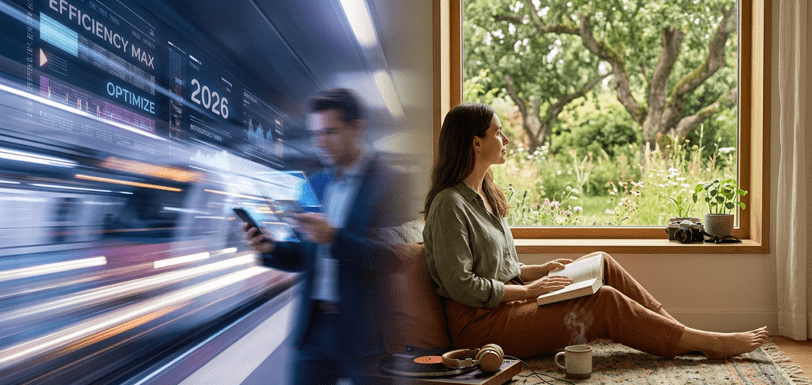
The emergence of the concept of “Slow Living” as a trend in 2026 is a very significant response to a decade’s worth of continuous hyper-productivity. This discovery has caused a significant social revolution called “Slow Living.” Instead of trying to achieve hyper-productivity, millions of people have now chosen “Presence over Productivity” for the sake of maintaining their psychological health.
As the population becomes aware that the always-on approach cannot continue forever, the Intentional Life philosophy has evolved from an individual concept to a necessity. Slow Living does not just mean doing things more slowly; instead, it means reasserting control over one’s schedule and attention. The idea of crafting an Intentional Life allows people to place value on what matters rather than merely producing at all costs.
The Neurobiology of Stillness
In terms of science, the shift towards slowing down is a physiological adaptation to defend against “Optimization Fatigue.” For decades now, the human brain has experienced continuous high-frequency dopamine waves through incessant digital notifications.
It will be seen that in the year 2026, scientists are putting forward the idea of the importance of activating the parasympathetic nervous system, and this is done by getting out of the “hustle.” This means that individuals can have the luxury of enjoying the rewards of deep work and concentrating on one task at a time.
The Rise of Well-being Capital
From an economic standpoint, the 2020 decade sees the fall of “Throughput Economics” and the rise of “Well-being Capital”. In this paradigm, the capability to be “unproductive” is no longer considered an indication of a flawed character but an essential investment towards human sustainability for the future.
With the old 9-to-5 system disintegrating into something more fluid, the epitome of status becomes the luxury of having leisure time. This economic perspective indicates that one’s worth is determined not by how fast they deliver results, but by the presence and significance of their contributions.
Digital Sovereignty and Trust
Socially, the shift is most apparent in our digital exodus. For instance, we are shifting from large, loud social media spaces to smaller networks called “Private Trust Networks” which are limited by our biological ability to forge connections.
These “Digital Campfires” offer true intimacy without the need for flawless algorithms. By opting for extended form essays and in-depth podcasting rather than 15 seconds of video, the world community sends a message about their preference for substance over sensationalism. In effect, they have retaken control over crafting their lives through truth rather than distraction.
Slow-Green Sustainability
A considerable overlap exists between individual tempo and environmental wellbeing. Intentional living will inevitably lead to the creation of “intentional friction” in the consumer process, resulting in practices like fixing, slow cooking, and investing in local circular economies.
Environmental psychologists suggest that by moving slowly, we decrease our extractivist tendencies towards nature. When we stop being in a hurry to get to the next acquisition, we start appreciating quality and craftsmanship, ensuring that our personal choices match the planetary needs for climate change.
The Aesthetic of Imperfection
The final shift that occurred as we reached 2026 involved the shift from perfectionist aesthetics created through AI to the aesthetics of messiness.
The popularity of these hobbies has increased due to their ability to recognize the untidiness in our lives. It is interesting that this aesthetic philosophy has become popular as it shows a strong act of defiance towards a life that demands perfection. The world is being made a place of compassion where messiness is viewed positively.
Conclusion
Considering the difficulties faced due to the year 2026, it is quite evident that the mixture of all these sciences together helps prove that the revolution is not a regression but an evolution. Through our choice for Slow Living, it becomes possible for us to keep the power relationship between mankind and technology intact so that neither of the two dominates and they exist harmoniously. Through Slow Living, it is our intention to bring about the concept of Intentional Living wherein we stop competing with the machine and embrace life as a whole.
Frequently Asked Questions
1: What major shift occurred regarding productivity in 2026?
Millions globally began prioritizing human presence over continuous hyper-productivity to protect their mental health.
2: How does a slower lifestyle benefit our physical neurobiology?
It actively triggers the parasympathetic nervous system, allowing the human brain to rest and recover from digital notification fatigue.
3: What is meant by the term “Well-being Capital”?
It is an economic shift where an individual’s worth is measured by their health, presence, and life balance rather than pure output speed.
4: How does choosing Slow Living impact our day-to-day relationship with technology?
Adopting Slow Living helps restore a balanced power dynamic, ensuring technology serves human needs rather than dominating our time.
5: Why are people moving away from massive public social media networks?
Users are seeking deeper, more authentic intimacy through smaller spaces known as Private Trust Networks.
6: What connection exists between consumer habits and global sustainability?
Slowing down creates purposeful friction in shopping habits, which reduces waste and lowers our extractivist tendencies toward nature.
7: How does building an Intentional Life change our daily focus?
Designing an Intentional Life empowers you to value what truly matters instead of focusing on mindless production.
8: Why is the aesthetic of imperfection becoming popular against AI?
It acts as a healthy rebellion against sterile, AI-generated perfection by celebrating the beauty of real human messiness.
9: Is the lifestyle shift discussed in the text a backward step for society?
No, scientists and economists view it as a necessary evolution to ensure long-term human sustainability.
10: Does this lifestyle mean avoiding modern technology altogether?
Not at all; it simply requires mindfulness so that technology stays a helpful tool instead of causing continuous distraction.
Citations & References
[1] G. AI, “Slow Living in 2026: A Multidisciplinary Inquiry,” Gemini Documents, May 2026.
[2] Center for Humane Technology, “The systemic effects of hyper-connectivity and the dopamine loop,” 2026. [Online].
Available:
https://www.humanetech.com/
[3] Wellbeing Economy Alliance (WEAll), “Moving beyond throughput: The rise of well-being capital,” Global Economic Policy Reports, 2026. [Online].
Available:
https://weall.org/
[4] Berkman Klein Center for Internet & Society, “Digital Sovereignty: The transition to private trust networks and digital campfires,” Harvard University Research Series, Feb. 2026. [Online].
Available:
https://cyber.harvard.edu/
[5] American Psychological Association, “Environmental Psychology: Intentional living and global sustainability,” APA Science Directorate, 2026.
[6] EvePlacement. [Online].
Available:
https://eveplacement.com/
Streamline Your Hiring with Eve Placement
Engage, assess, and recruit top talent through tailored AI hiring challenges that go beyond resumes. Ready to hire better? Contact our research team for a custom consultation.