
Sound Therapy and Brain Tuning Through Music: Can Sound Improve Intelligence?
Published: Jun 21, 2026
Key Points
- Sound therapy is increasingly being studied for its potential to support cognitive performance, focus, and emotional well-being through controlled auditory stimulation.
- Research shows that music activates multiple brain regions involved in memory, attention, language, and emotional processing.
- Structured musical experiences may strengthen neural pathways associated with learning, information retention, and mental engagement.
- Music-based rehabilitation methods are being used to support recovery from neurological conditions by improving memory recall, coordination, and communication skills.
- Psychological benefits such as reduced stress, improved mood, and enhanced emotional resilience may contribute to better concentration and learning outcomes.
- Although findings are promising, scientists continue to investigate whether these effects translate into measurable improvements in intelligence over the long term.
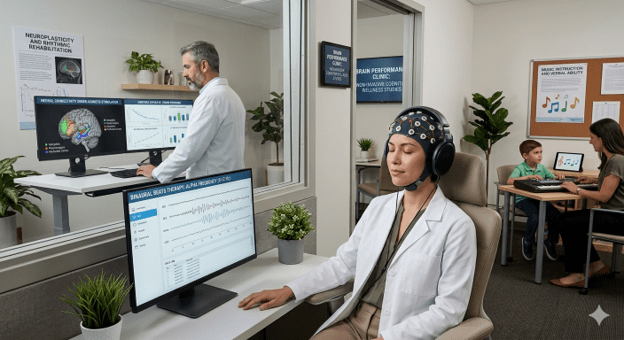
Introduction
Increasingly, the use of sound therapy and brain therapy is being studied for its impact on cognitive well-being and mental performance. Experiments and studies are underway to determine the potential benefits of sound therapy for improving focus, emotional regulation, and neurological function through carefully controlled acoustical stimulation.
Meanwhile, brain therapy methods using sounds and frequencies to affect memory, attention, and stress reduction are being researched. Given the recent trend of non-invasive cognitive enhancement, the role of sound therapy and brain therapy is becoming an important topic of discussion in neuroscience, psychology, and mental wellness studies.
The Brain-Music Connection
Music has long been linked to emotional expression and relaxation, but recent studies in neuroscience indicate that music can also impact brain activity and cognitive processing. Listening to music engages several areas of the brain at once – areas that are associated with memory, emotion, language, and attention.
Research has demonstrated that neural connectivity can be stimulated by rhythmic patterns and musical structures, thanks to the use of brain imaging technologies. This is why music can often help to enhance concentration, mood management, and mental engagement. The researchers also propose that repeated exposure to musical stimulation that is structured could reinforce neural connections related to learning and information processing.
Effect of sound therapy on mental abilities
Sound therapy is the conscious application of sound frequencies, music, or rhythmic vibrations in the service of mental and physical health. There are a variety of different types of sound therapy, such as binaural beats, meditative music, classical music, and relaxation techniques.
Some sound frequencies have been shown to help lower stress and improve attention span. Minimizing stress is especially relevant because prolonged stress has an adverse impact on memory and cognitive function. Sound-based interventions can indirectly facilitate better learning and concentration by inducing relaxation and mental clarity.
There are also some studies that indicate a positive correlation between music instruction in childhood and verbal abilities and executive functioning. The results have enhanced the increasing research interest in music-based cognitive therapies and education.
Neuroplasticity and brain therapy
Brain therapies based on music are closely related to the concept of neuroplasticity – the brain’s ability to reorganise and adapt through experience. Exposure to sound can stimulate patterns of neural activation, promoting emotional regulation and cognitive flexibility.
Music therapy has grown to be a prominent part of rehabilitation for people who have neurological illnesses like stroke, dementia, and traumatic brain injuries. Here, the emphasis is typically on the use of rhythm and melody in order to activate memory recall, motor coordination, and speech recovery.
Regular exposure to music has been known to enhance communication between brain areas, which could lead to greater mental adaptability with continued exposure.
The Psychological Benefits of Music
Music not only has an impact on intelligence and cognition, but also on psychology. Soothing or meaningful music can help to enhance the mood, decrease anxiety, and build emotional resilience. The indirect benefits are psychological stability, which is closely related to concentration and learning efficiency.
Sometimes in education and at work, background music is provided to boost productivity and concentration. But the benefit of music is subject to individual tastes, task difficulty, and listening experience. With the rise in popularity of applications that promote mindfulness and digital wellness platforms, people are becoming more interested in sound-based mental health practices.
Limitations and scientific debate
Although there are promising results, the ability to directly boost intelligence through music is still a matter of debate. There are some researchers who suggest that the enhancements related to music are more related to motivation, emotional involvement, and practice, rather than to actual intelligence.
Also, the cognitive effects of music are not the same across all types of music. The impact of sound on the brain may vary depending on the type of music, the volume, the length of play, and neurological differences. Further long-term studies are thus required for more definite scientific conclusions about music and brain intelligence enhancement.
Conclusion
Brain and sound therapy remain subjects of interest as innovative techniques to help with cognitive and emotional health. Scientists are studying the brain’s reaction to rhythm, frequencies, and emotion via music and sound.
Although there is still some controversy about the direct link between music and intelligence, sound therapy and brain therapy do show great promise of enhanced concentration, relaxation, and mental well-being in the controlled and natural environments.
Frequently Asked Questions
1: What is sound therapy?
Sound therapy involves the intentional use of music, frequencies, rhythmic patterns, or vibrations to promote mental, emotional, and physical well-being. Researchers are exploring its potential effects on focus, relaxation, and cognitive performance.
2: How does music affect the brain?
Music engages several neural networks at the same time, including those associated with memory, attention, language, and emotions. This widespread activation may help improve mental engagement and information processing.
3: Can sound therapy improve concentration?
Studies suggest that sound therapy may help some individuals maintain focus by encouraging relaxation and reducing mental distractions. The effectiveness often depends on the type of audio used and personal preferences.
4: What is the role of neuroplasticity in music-based interventions?
Neuroplasticity refers to the brain’s ability to adapt and reorganize throughout life. Repeated exposure to structured auditory experiences may support the formation and strengthening of neural connections.
5: How is music used in neurological rehabilitation?
Healthcare professionals may incorporate rhythm and melody into rehabilitation programs to assist with speech recovery, movement coordination, and memory exercises for individuals recovering from neurological conditions.
6: Can childhood music education support cognitive development?
Some research has linked musical training during childhood with stronger verbal skills, executive functioning, and academic performance. However, scientists continue to examine the factors responsible for these outcomes.
7: What is brain stimulation in the context of music research?
brain stimulation refers to the activation of neural activity through external inputs such as rhythm, melody, and frequency patterns. Researchers study how these auditory elements influence communication between different brain regions.
8: Does music help reduce stress and anxiety?
Many people experience lower stress levels and improved emotional balance when listening to calming or meaningful music. Reduced stress can create a more favorable environment for learning and concentration.
9: Can brain stimulation from music increase intelligence?
While brain stimulation through music may support attention, engagement, and emotional regulation, current evidence does not conclusively prove that it directly increases overall intelligence.
10: What does current research say about future applications?
Scientists are continuing to investigate sound therapy and brain stimulation as non-invasive approaches that may support mental wellness, cognitive health, and rehabilitation. More long-term studies are needed to establish definitive conclusions.
Citations & References
[1] C. Toader, C. P. Tataru, I. A. Florian, R. A. Covache-Busuioc, B. G. Bratu, L. A. Glavan, et al., “Cognitive crescendo: How music shapes the brain’s structure and function,” Brain Sciences, vol. 13, no. 10, Art. no. 1390, 2023. [Online]. Available:
https://doi.org/10.3390/brainsci13101390
[2] N. Kraus, Of Sound Mind: How Our Brain Constructs a Meaningful Sonic World. Cambridge, MA, USA: MIT Press, 2021. [Online]. Available:
https://mitpress.mit.edu/9780262045865/of-sound-mind/
[3] W. G. Chen, J. R. Iversen, M. H. Kao, P. Loui, A. D. Patel, R. J. Zatorre, and E. Edwards, “Music and brain circuitry: Strategies for strengthening evidence-based research for music-based interventions,” Journal of Neuroscience, vol. 42, no. 45, pp. 8498–8507, 2022. [Online]. Available:
https://doi.org/10.1523/JNEUROSCI.1135-22.2022
[4] L. Bellier, A. Llorens, D. Marciano, A. Gunduz, G. Schalk, P. Brunner, and R. T. Knight, “Music can be reconstructed from human auditory cortex activity using nonlinear decoding models,” PLoS Biology, vol. 21, no. 8, Art. no. e3002176, 2023. [Online]. Available:
https://doi.org/10.1371/journal.pbio.3002176
[5] EvePlacement. [Online]. Available:
https://eveplacement.com/
Streamline Your Hiring with Eve Placement
Engage, assess, and recruit top talent through tailored AI hiring challenges that go beyond resumes. Ready to hire better? Contact our research team for a custom consultation.