
How Star–Planet Interactions Influence Planetary Habitability
Published: Jun 17, 2026
Key Points
- Star–Planet Interactions dictate a planet's atmospheric stability, climate, and long-term temperature, making them a fundamental driver of planetary environments.
- The stability and activity level of a host star determine whether a planet receives steady energy or destructive radiation that strips away its atmosphere.
- A planet's magnetic field acts as a critical shield, protecting the surface from being eroded by harmful stellar winds and solar flares.
- Gravitational forces and tidal locking between a star and a planet can cause extreme temperature variations that heavily restrict the zones where life can survive.
- Advanced technologies like the James Webb Space Telescope and AI simulations are allowing scientists to precisely analyze distant atmospheres and predict the long-term habitability of exoplanets.
Introduction
The legacy of life on other planets will depend greatly on the nature of the planetary-star system links. A study of star-planet interaction has shown scientists that the star has an impact on the temperature, atmosphere, climate, and long-term stability of planets. Such factors can have a direct impact on planetary habitability — the potential of a particular planet to host life.
Thanks to the advanced simulations and modern telescopes, they are now able to look at how the behavior of stars affects planetary environments in other solar systems. Knowing these interactions better will be vital for future attempts to find potentially habitable planets.
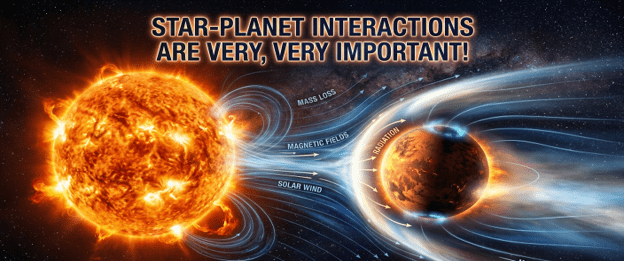
Star–Planet Interactions are very, very important!
The physical characteristics of a star have a tight grip on the environment of a planet. The stars continuously influence the planets and their atmospheres through radiation, magnetic activity, gravity, and solar winds. The more stable the star, the more favorable the conditions will be because it is able to supply energy to the system for extended periods of time.
For highly active stars, however, planets may soon be subjected to strong radiation that can destroy the atmosphere and upset the climate on those worlds. This is one reason that astronomers carefully examine star–planet interactions to find out if planets can have a climate capable of supporting life.
Radiation and Atmospheric Stability
Planetary habitability is greatly affected by stellar radiation. Planets very close to a star will be hot, with heavy ultraviolet radiation causing atmospheric gases to be stripped away over time. A lack of a stable atmosphere makes the maintenance of liquid water and biological processes difficult.
A planet that is too distant could become a frozen environment in which life cannot survive. Scientists thus tend to concentrate on the “habitable zone,” where liquid water is possible. Now, using modern observation instrumentation and data analysis systems, they can assess these areas in a more precise manner.
The relationships between magnetic fields and stellar activity
The magnetic fields on planets are vital insulators against harmful activities from the stars. A solar flare release, together with charged particles (called “stellar wind”), is a characteristic feature of many stars and can erode a planet’s atmosphere slowly over time. The magnetic field is very strong and protects the surface against radiation by deflecting these particles.
One of the limiting factors of life, despite the constant activity of the Sun, has to do with Earth’s magnetic field. One of the first approaches used by scientists during the investigation of exoplanets is to study the intensity of the star, along with magnetic protection, for estimates of potential habitability of the system.
Gravitational Effects and Climate Conditions
Star-planet gravitational resonances can have large effects on planetary climates. Tidal effects in some systems include a change in the rotation of a planet and a change in the internal heating of a planet. Some planets develop into tidally locked ones, with one side always facing the star and the other side always being dark.
This can cause extreme variations in temperatures between different parts of the Earth’s surface. But for some tidally locked planets, researchers think it is possible to have some parts of the globe where temperatures are not quite so extreme. The results illustrate how a star–planet system can either enhance or inhibit the planet’s potential for life.
Future Research and Exploration
The study of exoplanets and their stars doesn’t get more detailed than this, as scientists push new technology towards the study of exoplanets and host stars. The James Webb Space Telescope is helping to study distant planets’ atmosphere chemistry, temperature, and composition.
Computer simulations and AI research are also assisting scientists in predicting the evolution of planetary systems over billions of years. As other aliens are found in the future, it could offer us a better understanding of how conditions are created that can support life in space and deliver new insights into Earth-like environments.
Conclusion
How planets are formed, and the relationship between planets and stars, are central themes in planetary habitability. The various factors that affect a planet’s ability to sustain conditions conducive to life are known as radiation, magnetic activity, gravitational forces, and atmospheric stability.
Researchers are slowly starting to understand the development and persistence of worlds that can support life by observing interactions between stars and planets. Knowledge of star–planet interactions helps scientists understand how habitable worlds form and live. As astrometry progresses, this research could deprive humanity of the ability to find planets that could harbor life in other stellar systems.
Frequently Asked Questions
1: What are star–planet interactions?
These are the complex physical processes and links—including radiation, magnetic fields, gravity, and solar winds—that occur between a host star and its surrounding planets.
2: Why do astronomers study how stars behave?
Astronomers study stellar behavior because the activity levels of a star have a direct grip on a planet’s climate, atmosphere, and ultimate potential to host life.
3: What is planetary habitability?
It is the measure of a particular planet’s potential to develop and sustain an environment that is hospitable to biological processes and life.
4: How does stellar radiation affect a planet’s atmosphere?
Heavy ultraviolet radiation from a nearby star can heat a planet’s environment to extreme levels and strip away essential atmospheric gases over time.
5: What is the “habitable zone” in a solar system?
The habitable zone is the specific orbital region around a star where temperatures are moderate enough to allow liquid water to exist on a planet’s surface.
6: Why is a magnetic field important for a planet’s atmosphere?
A strong magnetic field acts as a vital insulator, deflecting charged particles from stellar winds and protecting the atmosphere from being slowly eroded.
7: What happens when a planet becomes tidally locked?
Tidal locking causes one side of the planet to permanently face its host star in scorching daylight, while the other side remains in perpetual, freezing darkness.
8: Can life exist on a tidally locked planet?
Researchers analyzing planetary habitability believe it might be possible for life to exist in specific transitional zones on the planet’s surface where temperatures are not quite so extreme.
9: How is the James Webb Space Telescope helping astrobiologists?
The telescope allows scientists to look deeply into distant solar systems to analyze how ongoing star–planet interactions shape the chemical composition, temperature, and atmospheric makeup of exoplanets.
10: What role do modern computer simulations play in space exploration?
Advanced simulations and AI tools assist scientists in modeling star–planet interactions to predict how these complex systems will evolve and change over billions of years.
Citations & References
[1] A. Loeb, The Habitable Universe: From the Dark Ages to Complex Life. Cambridge, MA, USA: Harvard University Press, 2016. Available:
Harvard University Press
[2] NASA, “Exoplanet Exploration and Habitability,” NASA Science Division, 2024. Available:
https://science.nasa.gov/exoplanets/
[3] European Space Agency, “Star–Planet Interactions and Exoplanet Atmospheres,” ESA Reports, 2023. Available:
https://www.esa.int/?utm_source=chatgpt.com
[4] Nature Astronomy, “Magnetic Fields and Planetary Habitability,” Nature Astronomy Journal, 2024. Available:
Nature Astronomy
[5] Smithsonian Astrophysical Observatory, “The Search for Habitable Worlds,” 2023. [Online]. Available:
https://www.cfa.harvard.edu/?utm_source=chatgpt.com
[5] Eve placement. [Online]. Available:
https://eveplacement.com/
Streamline Your Hiring with Eve Placement
Engage, assess, and recruit top talent through tailored AI hiring challenges that go beyond resumes. Ready to hire better? Contact our research team for a custom consultation.