
The $12 Billion Opportunity: India’s Race to Lead the Global Agri-Blockchain Market
Published: Jun 17, 2026
Key Points
- India is rapidly adopting digital technology to transform its traditional, middleman-heavy farming sector into a leader of the Agri-blockchain market.
- Implementing secure, unalterable digital records allows companies to track food products seamlessly from the farm straight to the consumer.
- Enhanced supply chain transparency directly answers the strict quality and origin demands required to succeed in modern global food trade.
- Significant infrastructure hurdles remain, including low awareness among rural farmers, limited internet access, and high technical costs.
- Despite early-stage challenges, the momentum behind agricultural blockchain systems offers a multi-billion dollar economic opportunity for the nation.
Introduction
The agriculture sector in India is rapidly transforming with the use of digital technology. Before, farming was predominantly based on traditional systems, paperwork and middlemen. Now new technologies are slowly coming in the sector and one of the biggest discussion today is around agri-blockchain market.
Blockchain is no longer just for cryptocurrency… Now it is being trialled in farming, food supply chains, storage and export systems. This sector is thought by many experts to be a multi-billion dollar opportunity in the next few years, particularly as the worldwide food trade increasingly depends on transparency and tracking systems.
Why Blockchain is Coming to Agriculture?
Trust and record management has always been a big problem of agriculture. There are a long chain of farmers, traders, transporters, exporters and buyers.Sometimes product quality, pricing details, or delivery records become difficult to verify properly.
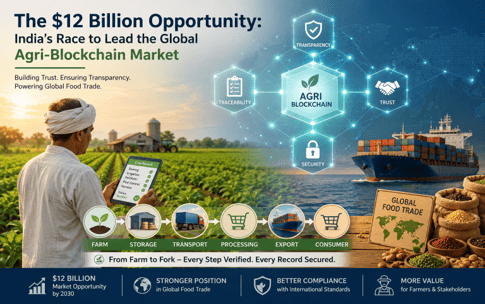
Blockchain is a way to create secure digital records that are difficult to alter. This helps companies track the food products from the farm to the market more clearly
For example, buyers may learn where a crop was grown, how it was shipped and whether safety standards were met along the way.
India’s Growing Interest in the Agri-Blockchain Market
India is one of the largest agricultural producers in the world so it has a huge potential in the agri-blockchain space. Government programs, agri-tech startups and private companies are already trialing blockchain systems in farming and food supply chains.
The technology is being tested to track crops, maintain warehouse records, verify exports and manage payments. Some companies also are working to reduce fraud and increase transparency in food exports with blockchain-based platforms.
Impact on Global Food Trade
The global food trade is becoming more demanding in terms of product quality and safety records. Many countries now require proof of origin of food products, storage conditions and transportation details before importing them.
Blockchain systems can help to deliver this information faster and more accurately. Digital records can make the verification process easier for exporters and importers, instead of just paperwork.
This may also help Indian agrarian products to be more competitive in international markets where transparency is gaining ground.
Challenges Still Remain
Despite increasing interest, blockchain in agriculture is still in its infancy. Such technology is unknown to many farmers, especially in the rural areas where there is little awareness of digital technology.
Challenges also include internet access, technical costs and training. For small farmers, without the right support, advanced systems can be hard to use.
Conclusion
India’s vast agricultural sector combined with its developing digital infrastructure offers promising opportunities for growth in the agri-blockchain market. With transparency and product traceability gaining importance in global food trade, blockchain technology could become more integral to farming and exports. Though there are still hurdles to overcome, there is already a growing momentum of interest in this segment within the agri-industry.
Frequently Asked Questions
1. What is driving the digital transformation in Indian agriculture?
The shift is primarily driven by the need to upgrade traditional farming practices, eliminate inefficient paperwork, and reduce reliance on predatory middlemen. Modern tech solutions aim to streamline the entire supply chain from seed to market.
2. How does cryptographic ledger tech actually function in farming?
It creates a secure, decentralized log of every transaction and movement a crop makes. Once data regarding a harvest or shipment is entered into the system, it becomes virtually impossible to alter, ensuring total data integrity.
3. In what ways can tracing a crop benefit everyday consumers?
Traced supply chains allow buyers to verify the exact origin of their food, check the conditions under which it was stored, and confirm whether the product meets specific organic or safety certifications.
4. What specific export advantages does India gain from these new platforms?
International buyers are increasingly demanding strict proof of origin and quality records before allowing imports. Adopting automated tracking systems makes verification much faster and more accurate for Indian exporters.
5. Why is the current momentum shifting toward decentralized agricultural networks?
This digital ledger ecosystem in farming is expanding because global logistics networks require unprecedented transparency, turning decentralized verification into a multi-billion dollar economic opportunity in the Agri-blockchain market.
6. What are the primary roadblocks for rural farmers adopting this technology?
The biggest hurdles are a widespread lack of digital literacy in rural communities, high initial technical setup costs, and a lack of reliable internet infrastructure in remote farming villages.
7. Who is currently driving the testing and implementation of these systems?
A combination of government welfare initiatives, progressive agri-tech startups, and large private enterprises are currently collaborating to trial digital supply chain solutions.
8. How does digital record-keeping impact international commerce and the global food trade?
It replaces slow, manual paperwork with instant digital verification, helping domestic agrarian products remain highly competitive across the global food trade.
9. Can smallholder farmers use these advanced tracking systems to enter the Agri-blockchain market without training?
No, small farmers require dedicated community support, subsidized access to hardware, and specialized training programs to successfully utilize advanced tracking platforms in the Agri-blockchain market.
10. What is the long-term economic outlook for technology in this sector?
Despite early infrastructure challenges, the momentum is growing rapidly across the Agri-blockchain market, and digital integration is expected to become an essential, permanent component of international food logistics and cross-border distribution.
Citations & References
[1] Food and Agriculture Organisation (FAO), “Digital Agriculture,” FAO.org. [Online]. Available:
https://www.fao.org/digital-agriculture/en/
[2] IBM, “IBM Food Trust – Blockchain in Food Supply Chains,” IBM Products. [Online]. Available:
https://www.ibm.com/products/supply-chain-intelligence-suite/food-trust
[3] Ministry of Agriculture & Farmers Welfare, Government of India, Official Website of Ministry of Agriculture & Farmers Welfare. [Online]. Available:
https://www.agriwelfare.gov.in/
[4] Eve Placement. [Online]. Available:
https://eveplacement.com/
Streamline Your Hiring with Eve Placement
Engage, assess, and recruit top talent through tailored AI hiring challenges that go beyond resumes. Ready to hire better? Contact our research team for a custom consultation.