
AI Environmental Guards: Using Eco-Tech to Track Local Pollution
Published: May 24, 2026
Key Points
- Eco-Tech empowers local communities by shifting the control of pollution data away from centralized authorities directly into the hands of everyday citizens.
- Advanced smart sensors now provide the public with real-time tracking of air, water, and soil conditions through accessible mobile dashboards.
- Artificial intelligence goes beyond simple monitoring to predict future environmental risks and uncover hidden industrial emission patterns.
- Open access to transparent environmental data helps city planners make better policy choices and improves public health outcomes.
- The integration of satellite imagery, drones, and connected devices represents the next major milestone for global environmental conservation.
Introduction
The environmental challenges that exist in their surroundings have become a more significant concern for people around the world. Local environmental issues require public attention to identify their existence because they remain hidden until they develop into major environmental problems. Eco-Tech has started to create its first important impacts in this area.
Pollution monitoring and understanding pollution through Artificial intelligence, sensors, and data analytics has reached a new level of development. People now have access to real-time environmental data because they no longer need to depend on government reports or periodic inspections. The technologies function as “AI environmental guards” because they continuously monitor and document environmental conditions.
The increasing adoption of Eco-Tech technology enables organizations to gather information, but it also serves as a force that generates actual Social Impact through its support of community development efforts, executive decision-making, and organizational initiatives.
How AI-Powered Eco-Tech Monitors Pollution
Smart Sensors and Real-Time Data
The Eco-Tech solutions of today depend on smart sensor networks, which track environmental conditions through their continuous data collection. The sensors detect pollutants that exist in air, water, and soil environments and transmit their findings to artificial intelligence systems for processing.
The city has air-quality sensors that monitor particulate matter, carbon monoxide, and nitrogen dioxide levels throughout its area. The AI system uses pattern analysis to identify pollution hotspots, which results in authorities and residents receiving alerts about dangerous pollution levels.
Eco-Tech dashboards in urban areas enable citizens to monitor their local pollution levels through mobile devices, which assist them in making better health choices throughout their day.
AI Pattern Detection
The main strength of Eco-Tech systems comes from their ability to analyze substantial data sets through artificial intelligence technology. Artificial intelligence goes beyond pollution tracking because it enables the prediction of future risks based on existing data patterns.
AI systems can identify emission patterns that occur during specific hours when factories release their pollutants into the environment. Environmental agencies use this predictive ability to develop response strategies that protect ecosystems from lasting harm.
The implementation of technological monitoring systems establishes environmental responsibility while creating positive Social Impact results for the communities that experience environmental damage.
Real-World Applications of Eco-Tech
Eco-Tech solutions currently operate in environmental monitoring projects throughout the world. The most common applications of technology use three specific functions which include Urban Air Monitoring, Water Quality Tracking, Industrial Emission Detection and Waste Management Analytics.
-
Cities use sensor networks to monitor air quality and issue pollution alerts during periods of elevated pollution.
-
AI systems track chemical pollutants and waste disposal activities in rivers and lakes.
-
The smart monitoring systems of factories detect when their operations produce pollution at levels that exceed established limits.
-
AI technology enables waste management organizations to monitor illegal dumping locations and anticipate future waste disposal trends.
-
The Eco-Tech innovations reveal their capacity to transform environmental measurements into practical solutions.
-
Communities receive essential knowledge which empowers them to demand both cleaner environments and more effective environmental regulations.
Why Eco-Tech Creates Social Impact
Empowering Communities
Eco-Tech provides its most significant strength by making environmental data accessible to all people. The authorities and research institutions used to control all aspects of pollution monitoring in previous times.
Currently, community organizations and educational institutions have the ability to set up inexpensive sensors which use public environmental data. The transparent system enables citizens to take part in environmental protection work because they have complete access to information.
Supporting Better Policy Decisions
Eco-Tech provides beneficial information which helps government officials and city planners make better decisions. The accurate pollution data enables authorities to determine environmental hazards while they create effective environmental protection policies.
AI-based insights provide the foundation for implementing two measures which include traffic restrictions during polluted periods and stronger industrial control measures. The policies establish Social Impact because they lead to better health outcomes for people and greater environmental sustainability.
The Future of AI Environmental Monitoring
The upcoming Eco-Tech generation will utilize artificial intelligence and satellite images and Internet of Things devices to create their systems. The combination of these three tools will enable the development of a complete system for environmental monitoring.
The AI systems will automatically identify oil spills through satellite images and drones will detect illegal dumping in distant locations. The new advancements will improve environmental conservation efforts while creating broader worldwide social benefits.
The growing availability of affordable technology will enable even the smallest communities to access Eco-Tech tools for environmental protection and monitoring purposes.
Conclusion
Environmental protection work now includes scientists and policymakers. Eco-Tech provides communities with advanced monitoring tools which they can use to track pollution and identify polluters. AI environmental monitoring technology provides immediate data, future predictions, and increased system visibility.
The project establishes an essential connection which enables community members to use technological resources for their own Social Impact initiatives that benefit both human and environmental needs. Eco-Tech has the potential to become one of the most effective tools which assist communities in achieving their environmental goals as the world experiences increasing ecological difficulties.
Frequently Asked Questions
1. What exactly are AI environmental guards?
They are automated digital systems that combine physical monitoring hardware with smart software algorithms to continuously track, analyze, and document ecological conditions without requiring human intervention.
2. How do smart sensors detect local pollution?
These compact devices are placed in public areas to measure specific chemical concentrations, microscopic dust particles, and toxic gases in the air, water, or soil, immediately uploading the numbers to cloud networks.
3. Can everyday citizens access this data?
Yes, modern platforms stream this information directly to public mobile applications and interactive online maps, allowing residents to view live air quality index levels in their immediate neighborhoods.
4. Why is artificial intelligence needed if we already have sensors?
While sensors only collect raw numbers, intelligent software looks at the bigger picture, recognizing complex historical patterns to predict when and where spikes in contamination are likely to happen next.
5. How does predictive tracking hold factories accountable?
The software can pinpoint the exact hours and weather conditions during which industrial facilities release unauthorized emissions, giving communities concrete evidence to present to regulators.
6. In what ways does open data improve public health?
When families have clear visibility into neighborhood air and water quality, they can make informed daily decisions, such as altering outdoor exercise routes or keeping vulnerable individuals indoors during high-risk hours.
7. How does data transparency influence city planning?
Accurate, localized metrics allow municipal governments to design smarter zoning laws, implement temporary traffic diversions during high-emission periods, and locate green spaces where they are needed most.
8. What role do drones and satellites play in this network?
Aerial and orbital imaging tools fill the gaps that ground-level stations cannot reach, allowing automated programs to scan vast forests for illegal dumping or spot ocean oil spills early.
9. Are these monitoring tools affordable for smaller neighborhoods?
Yes, the manufacturing cost of connected hardware has dropped significantly, allowing grassroots groups and schools to deploy effective baseline tracking systems on modest budgets.
10. What is the ultimate goal of these technical innovations?
The objective is to democratize ecological data, transforming abstract scientific metrics into clear, actionable insights that empower humanity to build a cleaner, safer, and more sustainable world.
Citations & References
[1] Ecotoxicology and Environmental Safety, vol. 284, p. 116932, Oct. 2024, doi: 10.1016/j.ecoenv.2024.116932. [Online]. Available:
https://www.sciencedirect.com/science/article/pii/S0147651324009321
[2] “Transforming Environmental Monitoring with AI-Driven Edge Analytics,” XenonStack Blog, Apr. 22, 2025. [Online]. Available:
https://www.xenonstack.com/blog/environmental-monitoring-with-edge-ai
[3] “How artificial intelligence is helping tackle environmental challenges,” United Nations Environment Programme (UNEP), Nov. 7, 2022. [Online]. Available:
https://www.unep.org/news-and-stories/story/how-artificial-intelligence-helping-tackle-environmental-challenges
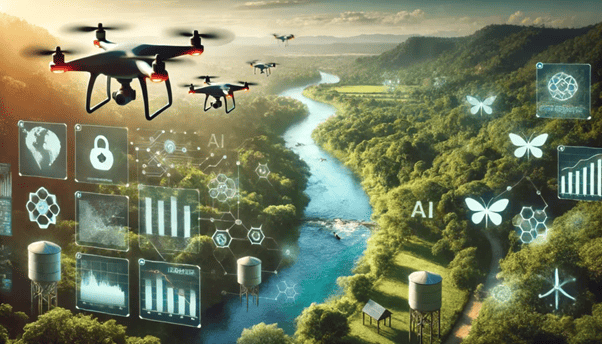
[4] AI-powered drones and sensors monitoring a forest and a river, highlighting AI’s role in environmental protection, DVO Team, Jun. 2024. [Digital Image]. Available:
https://dvoteam.com/wp-content/uploads/2024/06/An-image-of-AI-powered-drones-and-sensors-monitoring-a-forest-and-a-river-highlighting-AIs-role-in-environmental-protection-1024×585.webp
Streamline Your Hiring with Eve Placement
Engage, assess, and recruit top talent through tailored AI hiring challenges that go beyond resumes. Ready to hire better? Contact our research team for a custom consultation.