
AI for Eco Warriors: Automatically Tracking Your Carbon Footprints with Climate Tech
Published: May 20, 2026
Key Points
- AI-driven Climate Tech removes the manual burden of calculating carbon footprints by seamlessly pulling real-time data from everyday activities like GPS and digital purchases.
- Developers must use Green AI practices to ensure that the computational energy required to run these tracking systems does not worsen the climate problem.
- AI-driven platforms provide highly personalized, data-backed recommendations instead of generic environmental advice to effectively change user behavior.
- Incorporating community rewards and gamification principles helps bridge the gap between having environmental knowledge and taking actual action.
- The widespread success of automated carbon tracking relies on solving ethical challenges regarding data privacy and unequal access to smart devices.
Key Strategy Points
- AI-driven Climate Tech removes the manual burden of calculating carbon footprints by seamlessly pulling real-time data from everyday activities like GPS and digital purchases.
- Developers must use Green AI practices to ensure that the computational energy required to run these tracking systems does not worsen the climate problem.
- AI-driven platforms provide highly personalized, data-backed recommendations instead of generic environmental advice to effectively change user behavior.
- Incorporating community rewards and gamification principles helps bridge the gap between having environmental knowledge and taking actual action.
- The widespread success of automated carbon tracking relies on solving ethical challenges regarding data privacy and unequal access to smart devices.
Introduction
Over the course of the last few years, we have moved from talking about climate change to actually living through it. Today, we all wish to be more aware of our carbon footprint and our effect on the environment. However, measuring one’s carbon footprint can prove to be a huge challenge. This is because it is very difficult to measure the impact one has on climate change. A variety of climate technologies are making changes to our lives on a daily basis. The integration of artificial intelligence into various sustainability and carbon monitoring software has allowed for automated emissions tracking, customisation of data in accordance with our specific situations and appropriate action-taking regarding our carbon footprint.Emergence of Climate Tech into Daily Life
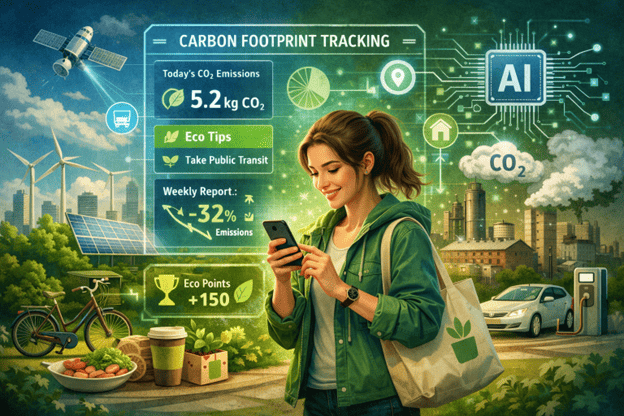
Climate change technology refers to technology aimed at targeting and addressing climate change through technology innovations at both a larger level (such as energy grids) and a smaller level (such as with an individual person). While news articles may feature solutions like renewable energy grids and carbon capture systems, there are smaller, more direct changes occurring at the individual user level. Apps today will connect to your daily activity (commuting, shopping, using your utilities, eating, etc.) to calculate your carbon footprint based on real-time conditions. In essence, instead of requiring a user to keep careful and watchful notes of their daily activities in terms of carbon output, AI pulls data from many different sources (GPS, sales records, smart device activity, etc.) to enable a real-time tracking mechanism that occurs seamlessly and without any burden or significant effort on the part of the user.AI Simplifies Carbon Tracking
AI is critical in converting raw data into valuable information. A conventional carbon footprint calculator will typically utilise static assumptions, but an AI-powered carbon tracker has the ability to change as your actions change. Now this is where green AI will come into play: While traditional AI models can require a significant amount of computational energy to operate, green AI promotes sustainability and efficiency for all things related to the environmental footprint of using AI. It focuses on reducing the carbon footprint of operating AI systems themselves, ensuring that the solution does not turn into a contributor to the existing problem.Personalised Insights That Drive Change
One benefit of AI-based tracking solutions is their ability to personalise insights for users. Users do not receive the same advice for all their actions. Instead of offering people general information about reducing plastic or driving less, carbon-tracking products will provide them with specific recommendations based on both historical data and current patterns. For instance, Based on previous trips you took, your recommended travel route has lower greenhouse gases. Your use of this X product has a Y footprint on the climate. By adopting these simple practices every day, you can reduce your carbon footprint and save energy. Due to user affinity with their actions and their impact on the environment, there will be a drive for a change in habitual behaviour.Transitioning from Knowledge to Action
While having knowledge on an issue is important, it’s often not enough to motivate someone to act upon that knowledge – one of the biggest challenges in confronting climate change technology is to convert the knowledge we have into meaningful action. One way of doing this could involve using green AI technology to suggest more sustainable options for consumers when they receive information about environmental issues. Along with traditional approaches, various existing platforms employ gamification principles to support sustainability by providing users with points or rewards for making sustainability choices within the platform’s community. The participation and gamified nature of the activities will give a sense of responsibility towards the community amongst the participants, which will make them adopt sustainable behaviours.Challenges and Ethical Considerations
Carbon tracking with green AI has its own set of problems. One major issue is data privacy. These systems need a lot of info, like where you live, what you buy, and how much energy you use. You should be open about how you collect and use this data. Give users choices to control who sees their info and agree to share it. Also, users must know what data is being collected and how it will be used. Make sure users can see what information is being gathered.Make sure users can see what information is being gathered.
Let users choose what data they want to share.
Be transparent about data collection and use practices.
Users should feel safe sharing their information.
Clear data practices can make users feel more comfortable using these systems. Moreover, despite green AI aiming for low energy consumption, large-scale AI deployment can still release considerable amounts of CO2. Developers must find a balance between function and form. Another constraint is accessibility. Not everyone has smart devices and access to digital platforms, which may cause a wider gap between those who can actively track their emissions and those who can’t.
The Role of Artificial Intelligence in Climate Action
Going forward, climate tech is likely to become more commonplace in everyday life. As the world continues to embrace wearable technology, IoT (Internet of Things), smart cities and carbon tracking – could become a module of existence. Picture houses that alter energy use and accentuate the habits of their inhabitants, or cities that ease traffic to cut down on emissions. These innovations, along with green AI, can eliminate the need for constant user involvement in creating an ecosystem.Conclusion
Artificial-intelligence systems that record carbon emissions represent measurable progress for worldwide sustainability efforts. When the analytical capacity of artificial intelligence merges with climate technology objectives, people shift from passive observers to active partners in climate initiatives. Those tools observe the rules of green artificial intelligence – the same technology advances ecological aims. As climate technology driven by artificial intelligence spreads through daily routines, sustainable behaviour begins to feel automatic. Further development and careful use of such systems will supply individuals and communities with the necessary means to confront immediate climate threats plus every person will gain the authority to promote a durable future.Frequently Asked Questions
1: How does automated carbon tracking gather data without manual input?
The system links directly with your day-to-day digital footprint, pulling background data seamlessly from your connected smart devices, GPS travel routes, and digital purchase history.
2: Can static calculators provide the same insights as a modern AI system?
No, conventional calculators rely on rigid, fixed assumptions about consumer habits, whereas intelligent models dynamically adapt to your changing behaviors and real-time conditions.
3: Why is the energy consumption of large software models an issue?
Running massive data computations requires substantial electricity; if the infrastructure powering these tracking tools is inefficient, the software can accidentally release significant emissions while trying to solve the problem.
4: What makes modern Climate Tech different from older environmental software?
Newer Climate Tech applications actively automate data collection behind the scenes, removing the friction of manual data entry for the everyday user.
5: How do personalized recommendations differ from standard eco-friendly tips?
Instead of giving generic advice like “drive less,” the system looks at your actual travel history and suggests specific alternatives, such as a localized route change or a lower-emission delivery option.
6: What role does Green AI play in this tracking process?
By design, Green AI optimizes the algorithms running the software, ensuring that processing your personal data uses minimal electricity and leaves a tiny carbon footprint.
7: What data privacy risks are associated with automated tracking apps?
Because these applications track highly sensitive personal details—including your precise real-time location, utility consumption, and shopping history—they require strict data protections to keep user info safe.
8: How can creators ensure a Green AI application remains ethically sound?
Developers focusing on Green AI must establish clear, transparent data-collection rules, offer explicit opt-in options, and give users full control over what details they want to share or keep private.
9: What is the accessibility gap in modern Climate Tech?
These advanced monitoring systems rely heavily on modern hardware, meaning individuals without access to up-to-date Climate Tech infrastructure are often excluded from participating.
10: How will smart cities integrate into automated sustainability efforts?
Future urban centers will utilize connected networks to optimize municipal traffic flows and automatically regulate building energy use based on real-time population habits.
Citations & References
[1] S. Rolnick et al., “Tackling Climate Change with Machine Learning,” arXiv preprint arXiv:1906.05433, 2019. [Online]. Available: https://arxiv.org/abs/1906.05433
[2] R. Schwartz, J. Dodge, N. A. Smith, and O. Etzioni, “Green AI,” Communications of the ACM, vol. 63, no. 12, pp. 54–63, 2020. [Online]. Available:
https://dl.acm.org/doi/10.1145/3381831
[3] International Energy Agency (IEA), “Digitalisation and Energy,” 2017. [Online]. Available:
https://www.iea.org/reports/digitalisation-and-energy
[4] Global e-Sustainability Initiative (GeSI), “Artificial Intelligence for Climate Action,” 2019. [Online]. Available:
https://gesi.org/research/artificial-intelligence-for-climate-action
[5] United Nations Environment Programme (UNEP), “Emissions Gap Report,” 2023. [Online]. Available:
https://www.unep.org/resources/emissions-gap-report-2023
[6] OpenAI, “AI-powered carbon footprint tracking illustration,” DALL·E Image Generator, Mar. 20, 2026. [Online]. Available:
https://openai.com/dall-e
Streamline Your Hiring with Eve Placement
Engage, assess, and recruit top talent through tailored AI hiring challenges that go beyond resumes. Ready to hire better? Contact our research team for a custom consultation.