
The Soaring Price of Virtual Real Estate in the Metaverse in 2026: A New Digital Gold Rush
Published: May 20, 2026
Key Points
- The metaverse has transformed virtual spaces into highly lucrative digital real estate backed by real-world financial investments.
- The rapid surge in digital land prices is primarily driven by artificial scarcity, major corporate brand entry, and speculative investing.
- Technologies like blockchain and Non-Fungible Tokens play a critical role by ensuring secure, verifiable ownership of digital property.
- Despite massive profit potential, the market remains highly unpredictable due to steep price volatility and a complete lack of formal regulatory laws.
- As the boundary between the virtual and physical world blurs, investors must navigate serious platform dependencies before spending capital.
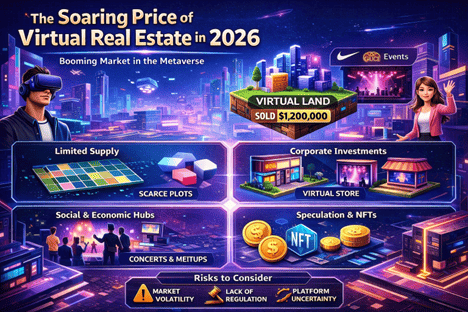
Key Strategy Points
- The metaverse has transformed virtual spaces into highly lucrative digital real estate backed by real-world financial investments.
- The rapid surge in digital land prices is primarily driven by artificial scarcity, major corporate brand entry, and speculative investing.
- Technologies like blockchain and Non-Fungible Tokens play a critical role by ensuring secure, verifiable ownership of digital property.
- Despite massive profit potential, the market remains highly unpredictable due to steep price volatility and a complete lack of formal regulatory laws.
- As the boundary between the virtual and physical world blurs, investors must navigate serious platform dependencies before spending capital.
Introduction
In the year 2026, the idea of owning land is not about physical places anymore. As someone who is looking into digital trends, I have seen how the metaverse is becoming a real thing. It is like a parallel world where people are putting actual money into virtual spaces. What is really surprising is how fast the prices of these plots, which are also called virtual assets, are going up.
Understanding Real Estate
Virtual real estate is like pieces of land in the metaverse. The metaverse is a world where people interact with each other using avatars. There are websites like Decentraland and The Sandbox that let people buy, sell, and build on land. People use these spaces to host events, set up online stores, or even build digital homes. At first, virtual real estate seemed like an idea to many people.Some virtual land that was bought for a few dollars is now worth thousands or even millions of dollars. Virtual real estate is one of the talked-about digital assets right now because of its huge increase in value. The metaverse and virtual real estate are changing how we think about owning land and the metaverse is a part of this change.The metaverse is making virtual real estate more popular. People are excited about real estate and the metaverse. The metaverse and virtual real estate are here to stay.
Why Are Prices Going Up Fast?
I have been looking into this. I found a few big reasons why prices are increasing so quickly. The main reasons are:
1. Limited Digital Land:
Digital land is like land. Most metaverse platforms only have a limited number of virtual plots. That makes the price go up.2. Brand and Corporate Interest:
Big companies like Nike, Gucci, and Adidas are now in the metaverse. They are buying land to sell their products. This makes the metaverse more credible. It attracts more people who want to invest.3. Social and Economic Opportunities:
People are doing all sorts of things in these spaces. They are having concerts, art shows, and even job fairs. This gives assets a real use, which makes them more valuable.4. Speculative Investment:
A lot of people are buying real estate because they think it will be worth more money later. This is, like investing in stocks or cryptocurrency. People are hoping that the value of digital land will go up over time.The Role of Technology
Technology is really important in the real estate business. Things like blockchain and Non-Fungible Tokens are very useful. They make it easy to say who owns a piece of land. They keep everything safe and honest. When we talk about the metaverse, each piece of land is like a Non-Fungible Token that can be bought and sold.Blockchain and Non-Fungible Tokens are what keep the land in the metaverse safe and secure, so people do not have to worry about someone taking their land. Non-Fungible Tokens and blockchain are very good at doing this job.
Challenges and Risks
The growth of real estate is exciting, but it also comes with some risks. I think it’s essential to talk about a few concerns.
1. Market Volatility:
Prices of land can go up and down quickly, making it a risky investment. Virtual land prices change fast. That’s a worry.2. Lack of Regulation:
There are no laws that govern virtual property ownership. This makes it really tough to figure out what is safe and what is not safe when it comes to virtual property ownership. Virtual property ownership is a thing because we do not have any laws that govern virtual property ownership.3. Platform Dependency:
If a metaverse platform becomes less popular, the value of its land could go down a lot. The value of land depends on the platform it’s on.Is It Worth the Investment?
On the one hand, early investors have made significant profits. On the other hand, the market is still evolving and unpredictable. From research, it feels similar to the early days of the internet—full of potential, but also uncertainty.
Conclusion
The price of real estate is going up really high in 2026. This shows us that digital transformation is changing the way we think about owning things and what they’re worth. The metaverse is giving us chances to buy virtual assets, but we need to be careful before we spend our money. As the metaverse gets bigger, it will be interesting to see if virtual land becomes as valuable as the land we walk on. It is just a trend that people are following for now. The virtual world and the real world are getting more connected every day. I think the virtual world and the real world are not so different from each other anymore. They are really close now. The virtual world and the real world are basically the same, in ways now. The virtual world and the real world are not like they used to be. The virtual world and the real world are. They are getting more alike.Frequently Asked Questions
1. What exactly is digital property ownership, and how does it function conceptually?
Digital property ownership refers to possessing exclusive rights to a specific, bounded coordinate space within a decentralized online platform. Instead of physical soil, owners hold a cryptographic entry secured on a shared ledger. This entry serves as definitive proof that you control the space, allowing you to modify it, rent it out, restrict access, or transfer it to another internet user without needing a traditional centralized real estate agent.
2. Which major corporate brands are leading the charge into these alternative environments?
Global retail giants, high-end luxury fashion houses, and athletic apparel leaders have established massive digital footprints. Major names like Nike, Gucci, and Adidas have purchased extensive plots to build interactive showrooms, host product launches, and sell digital clothing items. Their presence turns these online maps into highly commercialized shopping and entertainment districts.
3. How do internet users actually make money from owning digital plots?
Owners generate revenue through several creative channels. You can rent your plot out to event organizers who need a venue for online concerts or corporate conferences. Alternatively, you can build digital storefronts to launch online retail businesses, set up advertising billboards that charge brands based on user traffic, or simply flip the raw land for a profit when regional demand spikes.
4. Is the total amount of land in the metaverse infinite, or is there a hard limit?
While software code can technically expand forever, individual platforms purposely cap the supply of plots to create artificial scarcity. For instance, platforms like Decentraland or The Sandbox have strict limits on the number of plots that will ever exist on their maps. This fixed supply ensures that as more users join the ecosystem, demand goes up while availability remains stagnant, driving up market prices.
5. What are the main technological tools that keep online property transactions secure?
Transactions rely completely on decentralized blockchain networks and smart contracts to ensure total transparency. When a user buys a plot, the transaction is recorded across thousands of independent computers simultaneously. This makes it structurally impossible for a malicious actor to forge property deeds, manipulate ownership records, or steal a piece of land from its legitimate owner.
6. What happens to a property investment if the underlying hosting platform loses popularity?
This is one of the most critical structural risks of the industry. If users lose interest in a specific online application and migrate to a newer alternative, the intrinsic value of that platform’s real estate could plummet to zero. Unlike physical land, which exists independently of human technology, digital properties are completely dependent on the server architecture, user base, and survival of the company hosting them.
7. Are there any formal legal frameworks or government laws protecting digital landlords?
Currently, there is a total lack of regulatory oversight in this market. No sovereign government explicitly recognizes or protects online land deeds under traditional property laws. If a platform experiences a catastrophic smart contract hack, shuts down entirely, or alters its terms of service, owners have virtually no legal recourse or consumer protection systems to recoup their financial losses.
8. Why do people compare this current digital land movement to the early days of the internet?
The comparison stems from the raw potential and extreme uncertainty of the era. In the early 1990s, many critics dismissed dot-com domain names as worthless novelties, yet those early digital markers eventually became the foundational pillars of the modern global economy. Analysts see the current phase of online environments as a similar frontier where early participants take massive risks for potentially historic rewards.
9. How exactly do virtual property spaces interact with physical world economics?
The line between online and offline economies is blurring fast because online land transactions use real monetary value. Cryptocurrencies used to buy plots are pegged directly to fiat currencies like US dollars. Furthermore, physical companies are hiring real architectural firms, software developers, and digital interior designers to build out their spaces, creating genuine employment opportunities in the real world.
10. What crucial safety steps should an individual take before buying digital land?
Prospective buyers must practice extreme financial caution. This includes conducting deep research into the developer team behind the platform, analyzing the historical traffic metrics of the world, and examining the smart contract audit history. Because the market suffers from severe volatility, it is vital to only invest capital that you are completely prepared to lose in the event of a market downturn.
Citations & References
[1] M. Ball, The Metaverse: And How It Will Revolutionize Everything. New York, NY, USA: Liveright Publishing, 2022. Available:
https://www.matthewball.vc/the-metaverse
[2] Decentraland, “Marketplace and Virtual Land,” 2026. Available:
https://decentraland.org
[3] The Sandbox, “Virtual Real Estate Platform Overview,” 2026. Available:
https://www.sandbox.game
[4] S. Nadella, “The Metaverse and Digital Economy,” Microsoft Insights, 2025. Available:
https://www.microsoft.com/en-us/industry/blog
[5] CoinDesk, “Why Virtual Land Prices Are Rising,” 2025. Available:
https://www.coindesk.com
[6] Forbes, “The Business of Virtual Real Estate,” 2025. Available:
https://www.forbes.com
[7] OpenAI, “The Soaring Price of Virtual Real Estate in 2026 (Infographic),” DALL·E, Mar. 20, 2026. Available:
https://openai.com/dall-e
Streamline Your Hiring with Eve Placement
Engage, assess, and recruit top talent through tailored AI hiring challenges that go beyond resumes. Ready to hire better? Contact our research team for a custom consultation.