
AI Hardware and Translation Buds: Talking to International Students Without a Barrier
Published: May 9, 2026
Key Points
- Advanced ear-level devices now provide instantaneous conversion of spoken words to help scholars navigate diverse educational settings.
- These compact tools enable natural dialogue between individuals who do not share a primary tongue, fostering deeper social bonds.
- Modern electronic components allow for rapid processing of speech, which removes the typical delays found in older digital tools.
- Beyond the lecture hall, this technology assists with daily activities like communal living and regional exploration.
- While these instruments offer significant support for inclusivity, they still face technical hurdles regarding environmental noise and linguistic nuances.
Introduction
The current global classroom environment enables students from various countries to unite for educational purposes while engaging in mutual learning and personal development. The existing language variations among students create challenges because it leads to situations where people stop talking and moments which would build relationships get lost.
AI hardware such as translation earbuds establish a new standard for human communication because it operates as a silent bridge between different languages. The smart devices create a better experience because they enable people to hold conversations that flow naturally without feeling scared to speak their minds.
You can now talk without using a common tongue because your words will reach full comprehension by the other person. The concept which you describe has entered our current existence because we now experience it.
What Are AI Translation Buds?
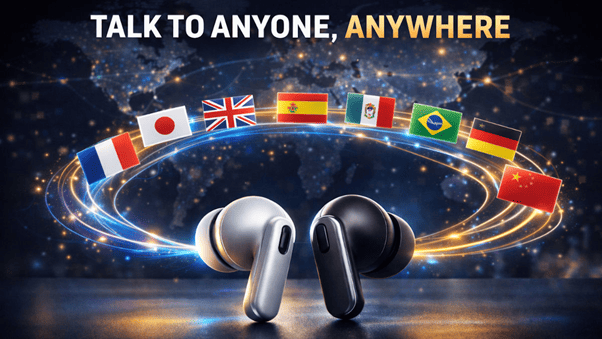
AI translation buds are compact wearable devices powered by advanced AI Hardware. They fit in your ears like regular earbuds but come with the ability to translate spoken language in real time.
How Do They Work?
-
They use speech recognition to understand what is being said
-
AI processes the language instantly
-
The translated version is played back in your ear
The result? Seamless communication without needing to pause, type, or rely on apps.
Breaking Language Barriers on Campus
International students often face challenges when trying to interact with peers, participate in discussions, or even ask for help. AI translation buds powered by modern AI Hardware are changing that experience.
Real-Life Example
A student from Japan studying in India can now:
-
Ask questions in class without hesitation
-
Chat casually with classmates during breaks
-
Participate confidently in group projects
This type of effortless communication builds confidence and fosters genuine friendships.
Why AI Hardware Matters in Everyday Conversations
Not all translation tools are created equal. What makes AI translation buds stand out is the role of advanced AI Hardware in delivering fast and accurate results.
Key Advantages
-
The system translates spoken language without any time delays or awkward pauses.
-
The system allows users to control their environment without needing to view digital displays.
-
The system produces better translation results through its ability to understand the surrounding context.
-
The system allows users to carry it anywhere and use it without restrictions.
Unlike mobile apps, these devices integrate directly into conversations, making communication feel natural instead of forced.
Enhancing Student Life Beyond Academics
AI translation buds are not just useful in classrooms—they improve everyday campus life.
Where They Help Most
-
Social events: Making new friends from different cultures
-
Hostel life: Interacting with roommates from other countries
-
Campus activities: Joining clubs and discussions confidently
-
Travel and exploration: Navigating local areas with ease
With the help of AI Hardware, students no longer feel isolated due to language barriers. Instead, they become active participants in their environment.
Challenges and Considerations
AI translation buds have strong capabilities but they do not provide complete accuracy. The following list presents essential factors that require ongoing assessment.
-
Background noise can affect accuracy.
-
The system cannot achieve complete accuracy with complex phrase translations which create translation difficulties.
-
The need to use technology for learning purposes decreases students’ motivation to learn new languages.
-
The ongoing development of AI hardware systems provides solutions to current technological problems which increase system dependability throughout its operational period.
The Future of Communication with AI Hardware
The translation buds will become more intelligent because AI Hardware technology will continue to develop. Future versions may include:
-
Emotion detection for better context
-
Offline translation capabilities
-
Support for more regional languages.
The ability to communicate across different cultures will reach new heights because of this development.
Conclusion
The AI translation buds function as more than an impressive device because they serve as an effective instrument for promoting inclusivity. The advanced AI Hardware enables organizations to eliminate their main obstacle which prevents global educational access through language barriers.
This technology provides international students with access to social connections and educational experiences which would require months or years to achieve. Now all people have an opportunity to establish connections which go deeper than spoken communication. People require communication improvement tools because our world has reached its highest level of global interconnectedness.
Frequently Asked Questions
1. How do real-time translation earbuds help students in a classroom setting?
They allow students to participate in group projects and ask questions without hesitation or the need to pause for manual translation.
2. Do these devices require a mobile app or typing to function during a conversation?
No, they are designed to provide seamless dialogue playback directly in the ear, making communication feel more natural than using phone-based apps.
3. Can translation earbuds accurately capture speech in a crowded cafeteria?
Background noise remains a challenge and can potentially affect the accuracy of the speech recognition systems.
4. How do these devices improve a student’s social life outside of lectures?
They help international students interact with roommates, join campus clubs, and navigate local travel with greater ease.
5. Are translation earbuds capable of understanding complex technical terms?
Current versions may struggle with complex phrases and linguistic nuances, which can lead to difficulties in translation.
6. What makes earbuds better than traditional translation software?
The integration of specialized internal components allows for faster processing and a hands-free experience that ensures the focus remains entirely on the person speaking.
7. Will using these devices prevent me from learning a new language?
There is a concern that relying heavily on this technology might decrease a student’s natural motivation to learn the local language over a long period.
8. Do translation earbuds support regional dialects and emotional context?
While current models have limitations, future developments are expected to include better support for regional languages and systems for detecting speaker emotion.
9. Can I use these devices if I don’t have a stable internet connection?
While many current features depend on connectivity, future iterations aim to include offline capabilities so users can rely on them in remote areas.
10. How do these tools contribute to global educational inclusivity?
They eliminate the language barrier as a primary obstacle, allowing students from vastly different cultures to connect and share knowledge instantly in a welcoming environment.
Streamline Your Hiring with Eve Placement
Engage, assess, and recruit top talent through tailored AI hiring challenges that go beyond resumes. Ready to hire better? Contact our research team for a custom consultation.