
Campus placements 2026 hiring slowdown
Published: May 6, 2026
Key Points
- The 2026 campus placement cycle continues to face a significant hiring slowdown characterized by reduced intake and disrupted timelines as a lingering effect of the pandemic.
- Recruitment has undergone a permanent shift toward virtual models, utilizing e-tests and video-based assessments to increase operational efficiency and reduce costs.
- Competition for entry-level roles has intensified sharply as fresh graduates must now compete against experienced professionals and unplaced students from previous batches.
- Despite lower hiring volumes, salary benchmarks for high-demand roles at top-tier institutions have remained relatively stable across key industries.
- Industry recovery is expected to normalize within two years, but students must proactively upskill in digital and remote work competencies to remain competitive.
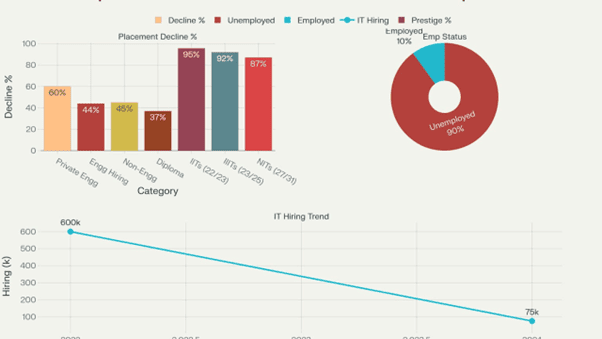
Abstract
Campus placements have long been regarded as a critical institutional responsibility and a key indicator of academic merit and reputation. Institutional rankings in India are often influenced by placement percentages and average compensation packages offered to graduates. However, the hiring slowdown triggered by the COVID-19 pandemic and its prolonged economic consequences has significantly altered the campus recruitment landscape. As India approaches the 2026 placement cycle, institutions and students continue to experience the after-effects of disrupted hiring timelines, reduced intake numbers, and evolving recruitment models. This article examines the campus placement slowdown with a focus on campus hiring trends, fresher job opportunities, recruiter behavior, and long-term normalization prospects, drawing insights from industrial surveys, academic studies, and employer perceptions.
Introduction
Campus placements serve as a structured mechanism through which educational institutions collaborate with industry to facilitate employment for graduating students. Traditionally, strong placement outcomes have been associated with institutional credibility, student enrolment, and alumni trust. However, the hiring ecosystem has undergone a substantial transformation since the pandemic, leading to hiring freezes, revoked offers, delayed onboarding, and uncertainty for fresh graduates.
Although economic activity has gradually resumed, the campus placement environment remains cautious. The slowdown observed during earlier years has extended into the mid-2020s, directly affecting the 2026 graduating batch. This shift necessitates a deeper understanding of recruitment trends, employer strategies, and the preparedness of institutions and students.
Impact of the Pandemic on Campus Hiring
The nationwide lockdown and global economic contraction significantly disrupted recruitment activities across sectors. Many organizations reduced operations, faced supply chain disruptions, and cut down on manpower to manage financial stress. As a result, campus placements were among the worst-hit employment channels.
Several institutions reported revoked job offers and postponed recruitment drives. While top-tier institutions managed to sustain recruiter interest, mid- and lower-tier colleges faced considerable difficulty in onboarding companies. Research indicates that more than 75% of organizations altered their hiring numbers during the pandemic, leading to a decline in fresher job openings [1].
Changing Recruitment Timelines and Hiring Models
One of the most visible changes in campus placements has been the shift in recruitment timelines. Pre-pandemic, campus drives typically occurred between December and February. However, disruptions forced companies to reschedule hiring to later months such as September and November. Survey-based findings suggest that organizations adopted flexible timelines to accommodate uncertainty and operational challenges [2].
Simultaneously, online recruitment emerged as a dominant model. Virtual interviews, e-tests, and video-based assessments became widely accepted due to cost efficiency and flexibility. Employers largely perceived online recruitment as more efficient, although some recruiters expressed a preference for in-person campus engagement once conditions normalize.
Salary Trends and Hiring Volume
Despite reduced hiring volumes, salary structures for freshers have largely remained stable. Studies reveal that compensation packages were only marginally affected in sectors such as manufacturing, food and beverage, and travel, while IT services and multinational corporations continued to offer pre-pandemic salary levels [3].
This trend indicates that while the number of job offers declined, market-driven salary benchmarks were preserved. For the 2026 batch, this suggests fewer opportunities but not necessarily lower pay, particularly for candidates from reputed institutions with in-demand skills.
Increased Competition for Fresher Jobs
Another critical outcome of the hiring slowdown is the sharp increase in competition for available roles. Employers unanimously reported a rise in job applications per position, driven by a combination of laid-off professionals, fresh graduates with revoked offers, and unplaced students from previous batches [2].
This heightened competition has intensified pressure on campus hiring mechanisms, reducing the effectiveness of placements for average-performing institutions. Consequently, students are increasingly seeking off-campus opportunities, internships, and alumni referrals to secure employment.
Industry Outlook and Normalization Timeline
Industry perception suggests cautious optimism regarding recovery. Survey findings indicate that most organizations expect the recruitment landscape to normalize within one to two years, depending on economic recovery rates. While online recruitment is expected to remain prominent, on-campus drives are likely to regain importance as conditions stabilize [2].
Importantly, organizations reported no significant reduction in long-term campus associations, signaling sustained reliance on fresher talent pipelines. This reinforces the relevance of campus placements even amid short-term disruptions.
Implications for Institutions and Students
For institutions, the hiring slowdown highlights the need to diversify recruiter bases, strengthen industry partnerships, and invest in skill-oriented training. Government support and policies promoting entrepreneurship within campuses may also help mitigate placement challenges.
For students, adaptability has become essential. Employers increasingly value digital skills, business awareness, and remote work readiness. Students graduating in 2026 must proactively upskill, leverage alumni networks, and remain flexible in job expectations to navigate the evolving hiring environment.
Conclusion
The campus placements 2026 hiring slowdown reflects a broader transformation in India’s employment ecosystem. While fresher job opportunities have declined in volume, the foundational structure of campus hiring remains intact. Online recruitment, altered timelines, and increased competition characterize the new normal. Although full normalization is expected within the next two years, uncertainty persists. Institutions and students that align early with industry needs, technological shifts, and skill-based hiring practices will be better positioned to succeed in the post-pandemic campus recruitment landscape.
Frequently Asked Questions
1. What is the main cause of the current campus placements 2026 hiring slowdown?
The slowdown is primarily a lingering consequence of the COVID-19 pandemic, which disrupted economic cycles and forced organizations to adopt more cautious recruitment strategies.
2. How has the landscape of campus hiring changed for the 2026 batch?
Campus hiring has shifted toward virtual models and more flexible timelines, with many drives moving from the traditional winter window to later in the year.
3. Are there fewer fresher jobs available compared to the pre-pandemic era?
Yes, research indicates that over 75% of organizations reduced their intake, leading to a noticeable decline in the total volume of fresher jobs.
4. How has virtual recruitment impacted campus hiring efficiency?
Digital tools like video interviews and e-tests have made campus hiring more cost-effective for employers, though many still value the depth of in-person engagement.
5. What is the outlook for fresher jobs in the IT and manufacturing sectors?
While the volume of fresher jobs has decreased, salary structures in these sectors have remained largely stable, particularly for candidates with in-demand technical skills.
6. Why is competition for campus hiring roles increasing so sharply?
The increase in competition is driven by a “backlog” of candidates, including unplaced students from previous years and professionals displaced by layoffs, all targeting the same campus hiring slots.
7. Should students rely solely on campus drives to find fresher jobs?
Given the current slowdown, students are encouraged to look beyond traditional placements by seeking off-campus fresher jobs, internships, and utilizing alumni networks.
8. Will on-campus hiring drives return to their original importance?
Industry reports suggest that while virtual models are here to stay, physical campus hiring events will regain importance as the economic environment stabilizes over the next two years.
9. What skills are essential to secure fresher jobs in this competitive market?
To secure the available fresher jobs, students must prioritize digital literacy, business awareness, and the ability to work effectively in remote or hybrid environments.
10. When is the recruitment market expected to reach full normalization?
Industry experts anticipate that the recruitment landscape will fully normalize within one to two years, depending on the pace of global economic recovery.
Streamline Your Hiring with Eve Placement
Engage, assess, and recruit top talent through tailored AI hiring challenges that go beyond resumes. Ready to hire better? Contact our research team for a custom consultation.