
The Blue-Collar Shield: Why Traders are Insulated from AI
Published: Apr 22, 2026
Key Points
- Skilled trades are shielded from automation because they require hands-on judgment and the ability to adapt to non-routine, unpredictable environments.
- AI and robotics still struggle to match the physical coordination and complex movement necessary for tasks like onsite construction or mechanical repair.
- Automating small-scale or local manual labor is often more expensive than hiring skilled human workers, making large-scale AI adoption in these sectors slower.
- The essential human elements of trade work, such as establishing trust and communicating solutions to clients, remain very difficult for machines to replicate.
- While technology will continue to evolve, the unique mix of physical dexterity and social interaction keeps blue-collar jobs more insulated from AI than white-collar roles.
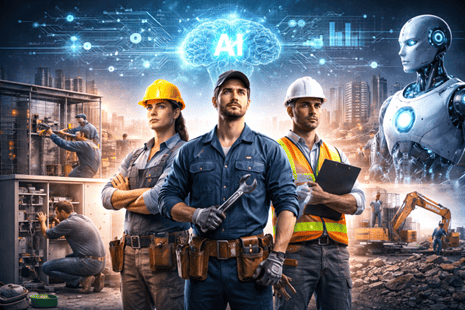
Introduction
The rise of intelligence has sparked a lot of talk about the future of jobs globally. Most of it is about white-collar work. There’s also a growing discussion about how blue-collar jobs are being affected. Looking at it from a picture, especially worldwide, many skilled trades seem to be doing okay. This makes the debate interesting because while automation is increasing everywhere, its impact varies across sectors in the global economy (The Future of Jobs Report 2023).
Hands-on work like that of electricians, plumbers, mechanics and construction workers is required in blue-collar jobs. But these jobs don’t follow a routine. In the same profession, the work can change depending on the situation. That’s why workers rely on experience and judgment rather than just following a process (White collar vs blue collar: How work, culture, and technology shape each sector, 2025).
AI systems do well in environments where tasks are predictable. That’s not the case with trade work. For example, a technician dealing with a machine issue might face something each time. There’s not always a solution. AI still struggles to match in cases where human decision-making is important. The nature of these jobs is often overlooked. Many tasks require movement, coordination and working in unpredictable or variable environments.
Even though robotics has improved, it still struggles in settings like construction sites or repair work, where conditions keep changing. So, replacing workers completely isn’t practical at the moment (Chui, Manyika, & Miremadi, 2016).
There’s also a cost factor involved. Using machines or AI systems for small-scale or local tasks may not make financial sense. Hiring skilled workers is more efficient in some places. Therefore, automation on a large scale is slower than expected in these sectors (Chui, Manyika, & Miremadi, 2016).
Another thing is the human side of these jobs. Trading often involves interaction with people, whether it’s understanding a problem or explaining a solution. The level of communication and trust plays an important role in the work itself. It’s not just about fixing something but also about dealing with people, which machines can’t easily replicate (Manyika & Sneader, 2018).
Overall, blue-collar jobs seem to have some protection, while AI continues to influence industries. This doesn’t mean they will never change. The pace is clearly different. The ongoing global developments in technology have kept the debate active. So far, skilled trades continue to remain relatively insulated from AI in a global context.
Frequently Asked Questions
1. Why is the impact of AI considered a worldwide phenomenon?
The rise of artificial intelligence is a shift felt in every economy, affecting how industries operate on an international scale.
2. How does the work environment of a tradesperson differ from an office?
Skilled trades occur in unpredictable settings, like construction sites, whereas office work often follows a more predictable, digital routine.
3. Is the discussion regarding AI job displacement only about office workers?
No, while much of the conversation focuses on white-collar roles, there is an increasing focus on how automation affects manual labor.
4. Why are robotics not yet common on construction sites?
Current robotics struggle with the coordination and movement required to navigate changing environments and non-routine physical tasks.
5. Does the article suggest that blue-collar jobs are completely immune to change?
Not entirely; while they are currently more insulated, the worldwide development of technology means these sectors will eventually evolve.
6. What role does human judgment play in skilled trades?
Workers rely on years of experience to make real-time decisions, especially when a machine or system faces an issue without a standard solution.
7. How does cost influence the speed of automation?
In many global regions, it is still more financially practical to hire skilled human professionals than to invest in expensive, specialized machinery for local tasks.
8. Can AI replicate the social aspect of being a tradesperson?
It is difficult for machines to mirror the communication and trust required when explaining technical solutions to customers.
9. What keeps the discussion about trade insulation active?
The ongoing debate is fueled by the fact that, despite rapid AI growth, skilled trades continue to remain steady in the face of automation.
10. What is the overall outlook for the global trade workforce?
The global context shows that for now, the unique combination of physical skill and human interaction keeps these jobs relatively secure.
Streamline Your Hiring with Eve Placement
Engage, assess, and recruit top talent through tailored AI hiring challenges that go beyond resumes. Ready to hire better? Contact our research team for a custom consultation.