9 Real Structural Job Challenges Explaining Soft vs Tech Skill Mismatches in Employment
Introduction
Finding a job today is not always about lack of vacancies. Many graduates are unemployed even when companies say they are hiring. This problem is linked to structural employment issues and growing skill imbalance in the job market.
In simple terms, jobs exist, but the right skills don’t always match what employers need. This article explains how soft skills and technical skills mismatch is creating long-term challenges in employment.
What Are Structural Job Challenges
Structural job challenges happen when the workforce skills do not match the requirements of available jobs. This is not a temporary issue.
It usually happens due to:
-
Changes in technology
-
Shifts in industry demand
-
Outdated education systems
-
Slow skill adaptation
unemployment continues even when job openings are present.
Understanding Structural Employment
Structural employment problems are different from normal unemployment.
Here, people are willing to work, but:
-
Their skills are outdated
-
Their education does not fit current roles
-
They lack practical exposure
This can lead to long term unemployment or underemployment, especially among graduates.
What Is Skill Imbalance
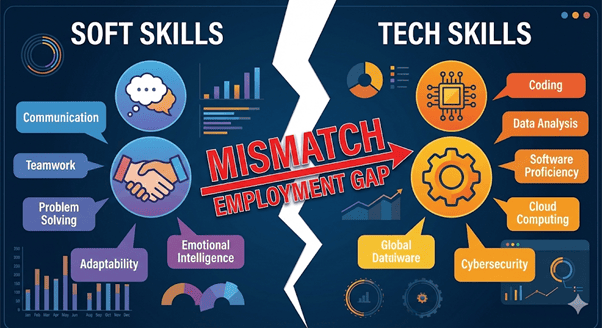
Skill imbalance means a gap between what job seekers know and what companies expect.
It usually appears in two forms:
-
Lack of technical skills
-
Weak soft skills
Both do are actually important, but many candidates focus only on one side.
Technical Skills Mismatch
Technical skills are job-specific abilities like coding, data analysis, or operating tools.
Problems arise when:
-
Curriculum is outdated
-
Students learn theory, not tools
-
Technology changes faster than courses
As a result, companies struggle to find “job-ready” candidates even after hiring fresh graduates.
Soft Skill Gap in the Workforce
Soft skills are equally important but often ignored.
These include:
-
Communication
-
Teamwork
-
Problem-solving
-
Time management
Many technically sound candidates fail interviews or workplace expectations because soft skills are missing.
Why This Mismatch Is Increasing
The soft vs tech skill imbalance is growing due to several reasons.
Some key reasons are:
-
Education focuses more on exams than skills
-
Limited industry exposure for students
-
Rapid digital transformation
-
Poor career guidance
This creates a disconnect between education and employment needs.
Impact on Employment and Companies
Structural employment issues affect both job seekers and employers.
For job seekers:
-
Longer job search time
-
Lower starting salaries
-
Job dissatisfaction
For companies:
-
High training costs
-
Slower productivity
-
Frequent employee turnover
This shows how serious the skill imbalance problem has become.
Role of Education and Training
Education systems play a big role in reducing this mismatch.
Improvements needed include:
-
Industry-aligned curriculum
-
Practical and project-based learning
-
Internship exposure
-
Soft skill training
Without these changes, structural employment issues will continue.
Way Forward
Solving skill imbalance needs effort from all sides.
Some possible steps are:
-
Students focusing on both soft and technical skills
-
Colleges updating course content
-
Companies supporting training programs
-
Better career awareness at early stages
Balanced skills are key to long-term employability.
Conclusion
Structural job challenges are increasing due to clear mismatch between soft skills and technical skills.
Structural employment problems will not solve automatically. Addressing skill imbalance through better education, training, and awareness is necessary to make graduates more employable and reduce long-term unemployment.
References
[1] International Labour Organization, Global Employment Trends. [Online]. Available:
https://www.ilo.org/research-and-publicationshttps://www.ilo.org/global/research/global-reports
[2] World Economic Forum, Future of Jobs Report. [Online]. Available:
https://www.weforum.org/reports
[3] Organisation for Economic Co-operation and Development, Skills Outlook. [Online]. Available:
https://www.oecd.org/en/publications/oecd-skills-outlook_e11c1c2d-en.htmlhttps://www.oecd.org/skills
[4] World Bank Group, World Development Report. [Online]. Available:
https://www.worldbank.org/en/publication/wdr
Frequently Asked Questions
1. Why are graduates struggling to find work despite available openings?
Many face a disconnect where their academic background doesn’t align with the specific demands of modern industries.
2. What causes long-term imbalances in the labor market?
Rapid digital transformation and static education curricula often create a permanent gap in candidate readiness.
3. Are specialized abilities more important than interpersonal ones?
Success requires a balance; being a genius in a specific tool is often negated if one cannot work effectively in a team.
4. How does the current education system contribute to this problem?
Most systems prioritize theoretical knowledge over applied, hands-on experience with modern industry tools.
5. What is the difference between temporary and deep-rooted employment issues?
Deep-rooted issues persist regardless of economic growth because the workforce simply lacks the required profiles.
6. Which interpersonal abilities are most in demand right now?
Communication, adaptability, and critical thinking are currently the most sought-after non-academic traits.
7. Can companies help bridge this gap?
Yes, by offering robust internal training and clearer pathways for entry-level talent to learn on the job.
8. Is the rapid pace of technology a major factor?
Absolutely. Specialized software and methods change faster than most four-year degree programs can update their materials.
9. How do these challenges affect starting salaries?
When candidates don’t arrive “job-ready,” companies often offer lower starting pay to offset the high cost of initial training.
10. What is “underemployment” in this context?
It occurs when a person with high qualifications works in a role that doesn’t utilize their full potential or training.
11. Why do many candidates fail at the interview stage?
Often, they can solve the logic problems but struggle to communicate their thought process or demonstrate cultural fit.
12. Is internship experience mandatory for modern roles?
While not always mandatory, it provides the “practical exposure” that most classroom settings lack.
13. How can a job seeker identify their own gaps?
By comparing their current portfolio against the “required” section of top-tier vacancy listings.
14. Does digital transformation make certain degrees obsolete?
Not necessarily obsolete, but it requires graduates to supplement their degrees with modern certifications.
15. What role does career guidance play?
Effective guidance helps students choose paths that have high demand rather than just following traditional academic routes.
16. How does high turnover affect a business?
It leads to lost productivity and forces the company to stay in a constant, expensive cycle of recruitment.
17. What is “project-based learning”?
It is a method where students solve real-world problems instead of just memorizing facts for an exam.
18. Can older professionals face these same challenges?
Yes, if they do not participate in continuous learning to stay updated with new industry methodologies.
19. Is the problem global or limited to certain regions?
This is a global phenomenon, though it is more severe in regions with rigid, traditional schooling systems.
20. What is the first step to becoming more employable?
Acknowledging that a degree is a foundation, but a mix of varied proficiencies is what actually secures the role.
Penned by Pranjal Sharma
Edited by Aradhiti, Research Analyst
For any feedback mail us at [email protected]
Streamline Your Hiring with Eve Placement’s Custom Assessments
Eve Placement helps you engage, assess, and recruit top talent through tailored hiring challenges that go beyond resumes. From technical quizzes and real-world case studies to psychometric evaluations and audio/video submissions, our platform enables smarter, data-driven hiring decisions. Advanced security features ensure authenticity and eliminate fraud, giving you reliable results. Ready to hire better? Know More.
Mail us at [email protected]