
Entrepreneurship Boot Camps For College Students
In 2026, the traditional path from college to a corporate cubicle is being aggressively challenged by a new educational phenomenon – the entrepreneurship bootcamp. As the global startup economy continues to evolve with rapid AI integration, these intensive, high-impact programs have become the “new fashion” for college students seeking to transcend theoretical learning.
Far more than just a workshop, these bootcamps serve as professional pressure cookers, condensing years of business logic into weeks of hands-on-execution. For the modern student navigating an era of solopreneurship, digital disruption, and economic volatility, these programs provide these essential bridges between an ambitious idea and market – ready venture.
This article happens to highlight –
- Entrepreneurship bootcamps organised for the year 2026
- How are entrepreneurship bootcamps beneficial for the students?
- What are the current problems that are being faced by students who want to be entrepreneurs?
- Why are entrepreneurship bootcamps important in today’s era?
- What is the future of student entrepreneurship?
1. Entrepreneurship bootcamps organised for the year 2026 –
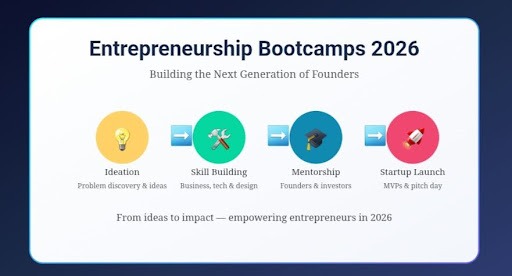
- IIM Shillong Summer School Bootcamps –
A 5-day immersive program scheduled for May 13-17 2025, with potential cycles in 2026. It targets aspiring entrepreneurs in sectors like FineTech, Agritech and IT.
- MIT Innovative Leadership Bootcamps- A highly rigorous program ( virtual ) that teaches the Disciplined entrepreneurship framework to build scalable ventures.
- Blackstone LaunchPad – Provides year-round virtual fellowship opportunities and resources for college students to develop entrepreneurial skills.
- SP Jain Startup Bootcamps – An online course divided into three parts: discovering the idea, building the business plan and creating a funding pitch.
- IDE Bootcamp (India) – Organised by the Ministry of Education and AICTE, these 5-days immersive bootcamps are held across multiple Indian cities – (Hyderabad, Ahmedabad, Kolkata) to nurture student innovators.
2. How are entrepreneurship bootcamps beneficial for students?
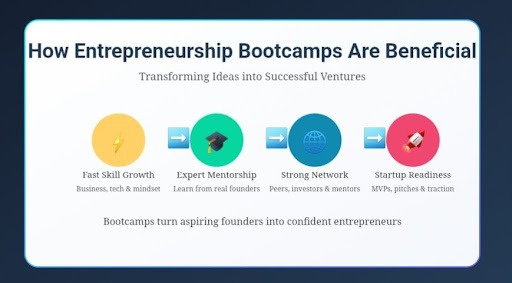
Entrepreneurship bootcamps provide college students with a competitive edge by shifting that focus from theoretical classroom learning to – practical, high-stakes execution.
Career & Academic Advantages –
- Enhanced Employability – Even for students who do not start a business, the critical thinking, leadership and adaptability gained are highly valued by employers in the 2026 job market.
- Portfolio Building – Participants leave with tangible outcomes, such as business plans, functional prototypes, and certifications that showcase their ability to handle real – world challenges.
- Funding Eligibility – Completion of certain bootcamps can make student teams eligible for significant research or startup grants such as the national science foundations I-Corps program.
Psychological & Mindset Transformation –
- Resilience Building – Bootcamps teach students to view failure as a data point rather than a defeat, instilling the “grit” necessary to pivot when an idea fails.
- Increased Confidence – Presenting to panels and solving real-world challenges helps students overcome the fear of public speaking and develop a leaders mindset.
- Professional Discipline– Structured accountability mechanisms, such as daily progress reports and peer tracking, rewire students to maintain consistent momentum.
Strategic Networking & Mentorship –
- Access to Founders – Students receive one-on-one guidance from seasoned entrepreneurs and industry experts, helping them avoid common pitfalls and identify “blind spots” in their business models.
- Investor Connections – High-level bootcamps often culminate in ‘Dragon’s Den” or pitch competitions, providing direct exposure to venture capitalists and angel investors.
- Global Collaborations – Programs like IE University Madrid Bootcamps foster international networks, allowing students to form cross-cultural partnerships with peers from around the world.
Rapid Skill Acquisition –
- Turbocharged Learning – bootcamps compress months of business study into intensive 1-to-2 week sessions, teaching essential skills like customer segmentation, financial modelling and value proposition development.
- Muscle Memory for Startups – Students engage in daily pitch practices and feedback loops, building the intuitive skills needed to navigate a real startup environment.
- AI Integration – Many 2026 programs, such as the Professors Without Borders AI Bootcamp, specifically train students to use artificial intelligence for rapid prototyping and market analysis.
3. What are the current problems faced by students who want to be entrepreneurs?
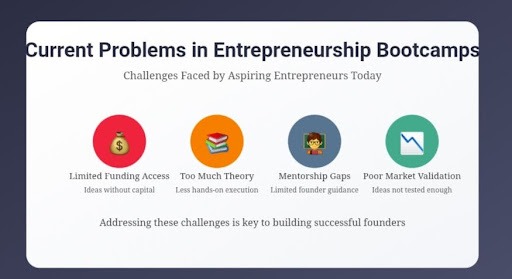
In 2026, student entrepreneurs face a combination of traditional business hurdles and new challenges emerging from the rapid integration of AI and shifting economic landscapes.
The AI and Technical Complexity –
- The “AI Hype” Gap – students struggle to differentiate between simply using AI tools and building a truly defensible AI – driven company. Investors are increasingly sceptical of ‘thin’ wrappers around existing AI models.
- Data Scarcity & Quality – Accessing, cleaning, and labeling high – quality data is a major bottleneck for students-led AI startups.
- Rapid Skill Obsolescence – the “half-life” of technical skills is shrinking; students must continuously learn and unlearn as AI tools evolve.
Financial & Structural Barriers –
- Access to Capital – This remains the single biggest hurdle. Most traditional banks require collateral or a credit history that students lack.
- Debt Burdens – Many students are already managing significant student loan debt, making the financial risk of starting a business feel insurmountable.
- The “Gap” in Funding – There is a critical shortage of funding for the “early-stage” gap- moving from a prototype to a revenue – generating business.
Academic & Personal Strain –
- Time Management – Balancing a full-time academic workload with a venture is a primary deterrent.
- Mental Health & Burnout– The pressure to succeed leads to significant psychological stress, including anxiety, depression, and “entrepreneurial stress – related obesity.
- Intellectual Property (IP) Conflicts – Undergraduates often face confusion regarding who owns the inventions they create while using university resources.
Social & Professional Limitations –
- Lack of Mentorship – Many students report a lack of access to experienced mentors who can guide them through practical business logic beyond theoretical classroom learning.
- Age Stereotypes – Investors and customers may perceive younger entrepreneurs as “lazy” or “irresponsible” requiring students to work twice as hard to prove professional conduct.
- Societal & Cultural Pressure – In many regions, there is still heavy cultural pressure to pursue stable, traditional career paths rather than high-risk ventures.
4. Why are entrepreneurship bootcamps important for students-
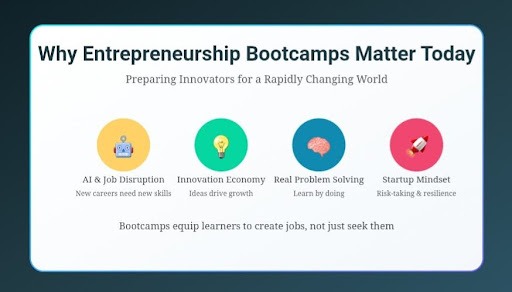
In 2026, entrepreneurship bootcamps are vital for college students as they bridge the gap between theoretical academic learning and high-speed execution required in the modern startup ecosystem.
Rapid Transformation of Theory into Action –
- Active Problem Solving – students don’t just learn business principles, they immediately apply them by building prototypes and stress-testing business concepts.
- Muscle Memory – Constant pitching and iteration help students develop the “muscle memory” needed to make quick, informed decisions under pressure.
Development of “Future-Proof” 21st Century –
- AI and Tech Fluency – Many 2026 bootcamps integrate AI- driven personalized learning and tools, ensuring students can leverage emerging technologies to optimise operations and scale.
- Soft Skill Mastery – Programs focus heavily on leadership, resilience and public speaking, which are often cited by employers as critical but missing in traditional graduates.
Low – Risk Psychological Safety –
- Fail Forward – Bootcamps provide a safe environment to fail, learn, and reflect, helping students overcome the fear of failure common in traditional education.
- Confidence Building – Through successful project completion and pitching to “Shark Tank” style panels, students gain a significant boost of professional self-esteem.
Access to High-Level Ecosystems –
- Direct Mentorship – Participants receive one-on-one guidance from seasoned founders, angel investors, and CEO’s.
- Investor Exposure – Some programs, like Columbia’s Start Me Up Bootcamp, even make students eligible for significant funding or grants.
- Global Networking – Cross-disciplinary and international programs allow students to form partnerships with peers worldwide, which is increasingly critical for cross-border e-commerce and global expansion.
5. What is the future of student entrepreneurship?
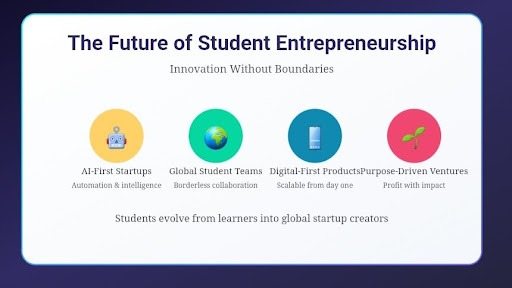
In 2026, the future of student entrepreneurship is characterised by a shift from theoretical ideation to high-speed, technology-enabled execution. Key trends shaping this landscape include-
AI – Native “AI – preneurs” –
- Active Creation – Students are transitioning from being passive users of AI to active creators. In 2026, they use AI not just for vibe work like drafting plans, but as the “spine” of their operations to build smarter apps and automate services.
- Hybrid Workforce Role – A new class of “AI generalists” is emerging among students. They focus on the orchestration of AI agents to handle specialised mid-level tasks, allowing them to remain lean while competing with larger companies.
The Rise of Micro-startups and Solopreneurship –
- Low – Overhead Ventures – Students are increasingly launching “micro-startups” – niche businesses with fast launch cycles and minimal costs – leveraging no-code tools to deploy products without technical expertise.
- Creator – Founder Model – The creator economy is maturing into a commerce powerhouse in 2026. Students are building personal brands as the foundation for digital products, memberships and boutique e – commerce sites.
“Profit with Purpose” and Sustainability –
- Sustainability Imperative – Environmental and social impact is no longer optional. Student – led ventures are prioritising the circular economy through upcycling, green tech and “hyper – local” sustainable delivery models.
- Gen Z & Alpha Values – The 2026 consumer market, dominated by these generations, regards transparency and ethical practices over mere price tags.
Structural and Geographic Evolution –
- Tier 2 & 3 City Expansion – entrepreneurial activity is no longer confined to major tech hubs. Digital democratisation has turned smaller cities into innovative centres for grassroots solutions in sectors like agritech and healthtech.
- Hybrid Career Paths – A “hybrid entrepreneurship “ model is becoming standard; 31.4% of Indian students now plan to launch ventures within 5 years of graduation after gaining industry experience, rather than starting immediately.
Formalised Institutional Support –
- Campus as a Launchpad – Universities are evolving from purely academic spaces into thriving incubation hubs. In 2026, expect dedicated startup cells to offer micro-grants, legal aid clinics for IPR, and “agile learning sprints” instead of traditional lectures.
- Government Integration – Large – scale initiatives like Startups India and India AI Impact Summit 2026 provide platforms for students to scale prototypes into globally relevant businesses.
Conclusion –
Thus the future of student entrepreneurship will prove to be a great stepping stone for those students who want to get first-hand experience of the business culture, trends and reality. These entrepreneurial bootcamps will significantly act as a medium to bridge the gap between reality and the academic curriculum. The importance of the same will be ever-increasing in the coming decade, as the start-up business culture is increasing in India and seems to form a new economic base of the Indian economy. These bootcamps will connect students with subject and business experts who can help the budding generations in the right direction. Hence, student entrepreneurship bootcamps will not be beneficial for students but also for businesses and the Indian economy.
FAQ’s
1. What is an entrepreneurship bootcamp?
An entrepreneurship bootcamp is a short, intensive program designed to teach students practical business skills and help them tackle real-world challenges.
2. Who can participate in these bootcamps?
College students from any discipline can join, even if they have no prior experience in business or startups.
3. How long does a typical entrepreneurship bootcamp last?
Most programs run from a few days up to two weeks, focusing on hands-on learning rather than long theoretical courses.
4. What benefits do students gain from entrepreneurship bootcamps?
Participants develop skills like business planning, pitching, teamwork, and problem-solving, while also gaining confidence to face professional challenges.
5. What types of challenges do students face during the bootcamp?
Students often work on market analysis, product development, pitching to investors, and overcoming logistical or financial challenges.
6. Can students get mentorship during the program?
Yes, most bootcamps provide one-on-one guidance from experienced entrepreneurs and industry experts to navigate challenges effectively.
7. How do bootcamps support students who want to launch startups?
They offer tools, frameworks, and real-world exercises that prepare students to manage business risks and overcome challenges in launching ventures.
8. Are these bootcamps only in-person?
No, many bootcamps are conducted online or in a hybrid format, making them accessible to students from different locations.
9. What career opportunities can follow an entrepreneurship bootcamp?
Students may pursue roles such as startup founders, business analysts, project managers, or gain confidence to manage entrepreneurial challenges in various sectors.
10. Why are entrepreneurship bootcamps becoming popular among students?
They provide a practical learning environment where students experience real challenges and gain skills faster than through traditional classroom methods.
References –
[1] “Camp on Entrepreneurial Adventures for Youth,ediindia.ac.in.[Online]. Available:https://share.google/hAn2jdZPIXJdukorb
[2] “Gen A entrepreneurship bootcamp”,Isha Foundation.[Online].Available:https://share.google/wENau5nWfrrqV6m0B
[3] “IDE Bootcamp 2025”,MoE Innovation Cell.[Online].Available:https://share.google/3KlAsSbtXdHim5Ls4
Penned by Krushna
Edited by Pranjali, Research Analyst
For any feedback mail us at [email protected]
Streamline Your Hiring with Eve Placement’s Custom Assessments
Eve Placement helps you engage, assess, and recruit top talent through tailored hiring challenges that go beyond resumes. From technical quizzes and real-world case studies to psychometric evaluations and audio/video submissions, our platform enables smarter, data-driven hiring decisions. Advanced security features ensure authenticity and eliminate fraud, giving you reliable results. Ready to hire better? Know More.
Mail us at [email protected]