
ML Pipeline Automation: Creating Dependable and Scalable Machine Learning Systems
Introduction to Machine Learning Pipelines
Machine learning is at the core of practically all new digital solutions and is a significant factor in how businesses decide, forecast, and tailor their user experiences. An ML pipeline is essentially what is responsible for the success of a machine learning application, as it is the pipeline that handles the data-to-models journey. The increasing complexity of these workflows makes the automation tool all the more necessary if the operations are to be kept efficient, accurate, and scalable.
Understanding the Structure of an ML Pipeline
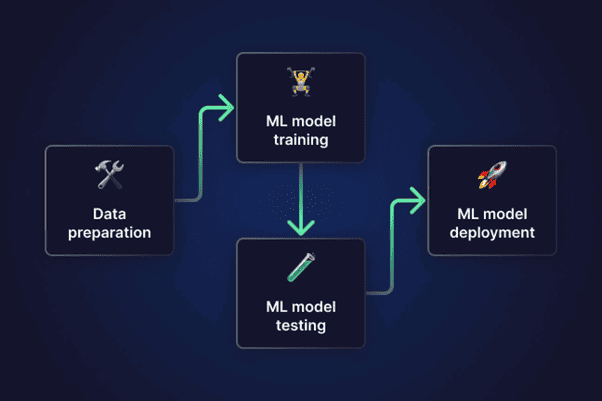
An ML pipeline is a systematic process that delineates the various sections of a machine learning project. Usually, these stages consist of gathering data, preprocessing the data, feature engineering, model training, testing, confirmation, and deployment. The process is sequential, so the next step depends on the result of the previous one; hence, the pipeline is very prone to errors. If it is done manually, a tiny error in data handling or model configuration may cause inconsistent outcomes or the crashing of the system.
Role of Automation Tools in ML Pipelines
Organisations, in order to solve these problems, are turning to an automation tool more and more that manages the ML pipeline. An automation tool performs repetitive operations without human intervention, thereby ensuring that every stage of the pipeline is going on according to the already defined and consistent process.
For instance, the automation tool might be informed about the availability of the new data so that it can start data cleaning, model re-training, performance evaluation, and, in the case that quality criteria are met, deployment of the updated version. Thereby, human involvement in routine tasks is diminished, and the total productivity is raised.
Reproducibility and Reliability Through Automation
Reproducibility is one of the major benefits that come from the automation of the ML pipeline. Machine learning experiments usually involve multiple datasets, parameters, and model versions. If there is no automation, it may be very difficult to reproduce the results obtained in the past. Automation tools keep track of every detail of pipeline executions and thus let the teams replicate the experiments and figure out the way the results were achieved. Such a high level of openness is a prerequisite for trustworthy and auditable machine learning systems.
Another significant benefit of ML pipeline automation is scalability. As companies gather more and more data, manual workflows that used to be efficient become very slow and full of errors. A fully automated ML pipeline is scalable to different cloud platforms and distributed systems, thus it can process large datasets as well as multiple models at the same time without any problem. Automation tools allow tasks to be done in parallel, thus experimentation becomes faster and deployment more seamless, and, therefore, they are the perfect choice for enterprise-level applications.
Improving Collaborations Through Pipeline Automation
Automation is also a major factor in collaboration enhancement. In general, machine learning projects involve three different roles: data scientists, software engineers, and operations teams. Automation tool manages a shared ML pipeline, which enables all stakeholders to be in the same workflow and standards. Such an agreement leads to the elimination of communication gaps, faster development cycles, and the use of continuous integration and deployment practices that are typical in MLOps.
Besides pipeline orchestration, automation has progressed with Automated Machine Learning (AutoML). AutoML is centred around automating model selection, feature optimisation, and hyperparameter tuning in the ML pipeline. Once a team integrates AutoML with an automation tool, they can produce top-performing models at half the time usually taken with trial-and-error experimentation. Besides, this method of work places machine learning within the reach of people who do not have profound technical knowledge.
However, ML pipeline automation is a risk that needs to be handled with care. Excessive reliance on automation without adequate monitoring can bring about situations where mistakes are quietly spreading. For example, biased data or incorrect assumptions can become more entrenched if pipelines are executed without validation checks. Hence, human supervision is still necessary. Automated tools should be the support of human know-how and not the substitute, thereby guaranteeing correct and ethical results.
Over the years, automating the ML pipeline has equipped organisations with the means to maintain consistency, efficiency, and resilience. Automated workflows bring down the operational costs, lessen the chances of having system failures, and increase the reliability of models. Besides, these workflows give teams the freedom to respond swiftly to changes in data and business requirements. The role of automation tools will become more and more central in handling the complexity as machine learning systems keep on developing.
Conclusion
To sum up, the coupling of a strong ML pipeline with an efficient automation tool is the cornerstone of advanced machine learning methods. Automation frees the user from complex tasks, elevates the team spirit, and facilitates the scalable rollout of smart systems. With the adoption of ML pipeline automation, companies become capable of innovating at a higher speed, operating at a better level of efficiency, and providing trustworthy machine learning solutions in the context of continuous technological changes.
References
[1] IBM, “What is a Machine Learning Pipeline,” 2025. [Online].
Available: https://www.ibm.com/think/topics/machine-learning-pipeline
[2] GeeksforGeeks, “Machine Learning Pipeline,” 2025. [Online].
Available: https://www.geeksforgeeks.org/blogs/machine-learning-pipeline/
[3] ConsoleFlare, “Best Tools for Building Machine Learning Pipelines,” 2025. [Online].
Available: https://www.consoleflare.com/blog/best-tools-for-building-machine-learning-pipeline/
[4] Microsoft Azure, “Automated Machine Learning Overview,” 2025. [Online].
Available: https://learn.microsoft.com/en-us/azure/machine-learning/concept-automated-ml
[5] DataCamp, “Top MLOps and ML Automation Tools,” 2025. [Online].
Available: https://www.datacamp.com/blog/top-mlops-tools
Machine Learning Pipeline Automation: FAQs
- What is an ML pipeline?
It is a systematic workflow that handles the journey from raw data to deployed models. - How does automation improve machine learning?
It ensures that repetitive tasks are handled consistently without manual error. - Why is reliability important in these systems?
High reliability ensures that the model outputs can be trusted for business decisions. - Does the automation tool replace data scientists?
No, it acts as a support system to enhance human expertise. - How does scalability factor into machine learning?
Automated pipelines allow systems to handle larger datasets and more complex models seamlessly. - What is the role of data preprocessing?
It cleans and prepares raw information for the machine learning training phase. - Can automation help with reproducibility?
Yes, it tracks every version and parameter to make experiments easy to replicate. - What is AutoML?
It focuses specifically on automating model selection and hyperparameter tuning. - How does a pipeline improve reliability?
By removing manual intervention, it prevents “silent errors” in data handling. - What are the common stages of a pipeline?
Data gathering, feature engineering, model training, and deployment. - Is human supervision still necessary?
Yes, humans must monitor for biased data and ethical outcomes in machine learning. - How does automation affect team collaboration?
It provides a shared workflow for scientists, engineers, and operations teams. - What is MLOps?
It is the practice of applying DevOps principles to machine learning workflows. - Can pipelines handle real-time data?
Yes, automated pipelines can be triggered by the availability of new data. - Does automation reduce operational costs?
Yes, by decreasing the time spent on manual maintenance and troubleshooting. - How do we ensure the reliability of a model after deployment?
Through continuous monitoring and automated validation checks. - What happens if a tiny error occurs in a manual pipeline?
It can lead to system crashes or inconsistent results across the board. - Why is transparency a prerequisite for machine learning?
Teams must be able to audit how results were achieved to ensure trust. - How does parallel tasking help?
It speeds up experimentation by running multiple tasks at the same time. - What is the ultimate goal of pipeline automation?
To provide trustworthy and efficient machine learning solutions at scale.
Penned by Sandhya
Edited by Pranjali, Research Analyst
For any feedback mail us at [email protected]
Streamline Your Hiring with Eve Placement’s Custom Assessments
Eve Placement helps you engage, assess, and recruit top talent through tailored hiring challenges that go beyond resumes. From technical quizzes and real-world case studies to psychometric evaluations and audio/video submissions, our platform enables smarter, data-driven hiring decisions. Advanced security features ensure authenticity and eliminate fraud, giving you reliable results. Ready to hire better? Know More.
Mail us at [email protected]