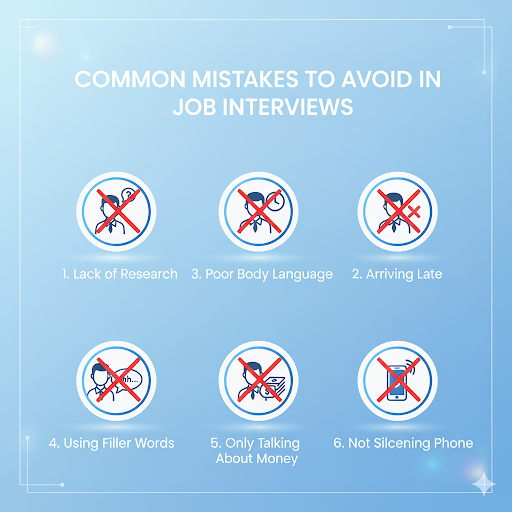
Common Mistakes to Avoid in Job Interviews
Topics: interview prep, job search
Honestly, we try to fool ourselves, but in the end, it is true that getting a job is a total nightmare. The usual thing is that you send out a hundred or more resumes, and then, after a long waiting time, a phone call comes to you saying that you are invited to an interview.
The catch? The interview is like the ultimate challenge, and failing is the easiest thing in the world.because of the answers to the questions we prepared; rather, we fail due to simple mistakes that could have been easily avoided. Companies don’t only look for the smartest candidate; they are also looking for the one who best fits their company culture. So, don’t get rejected because of just one silly mistake.
3 Big Mistakes You Are Making Before the Interview
You Didn’t Do Your Homework (Not Even a Little Bit):
This is the number one killer. Research is a must when it comes to the company. And I mean a lot more than just glancing through their “About Us” page 10 minutes before the call. You should be able to explain what the company is doing, who their competitors are, and if there is any news related to the company in recent days. Even better? Additionally, get to know the person who is going to interview you on LinkedIn. By knowing their history, you will have more subjects to talk about with them on a personal level.
You Didn’t Prepare Your “Brag Box”:
If the case is “Tell me about when you solved a problem,” you should definitely not freeze. You must have 3-5 strong stories of your past (internships, college projects, part-time jobs) that can be converted to any question in your “brag box”. These stories should be organized by the STAR method (Situation, Task, Action, Result). It is not about scripting and memorizing; it is about having your best stories at hand.
Your Resume is a “One-Size-Fits-All” Mess:
What you do is pretty much send the same resume for each company, i.e., a generic application that is done lazily, and is the reason why recruiters can snap it at once and pinpoint immediacy. A resume should be tailored to match a job description. First, analyze the skills required, and then make sure that the same words are present in your resume. It tells that you are not just randomly sending different applications, but you are the one who really wants to work with them.
3 Ways to Fail During the Interview
If an applicant asks, “So, What Does Your Company Do?”:
This, actually, is the most fatal question. It pulls the “game over” card immediately. This question reflects the research level of zero, and thus, it is against saving time. The one who is really excited about the new product launch or their market expansion should be the one telling them why.
Only Vague, Empty Answers Are Given:
In case of questioning on the experience, the sentence “Yeah, I am a hard worker” is not what they want to hear. What they want is evidence. Numbers should be used.Rather than saying “I assisted in marketing,” you should write “I managed a social media campaign which led to a 20% growth of our Instagram following in the period of three months.” Only results from a job search are what matter, and those have to be impressive.
Bad Non-verbal Communication (Especially If on Video):
Your energy is half the work in a video interview. Therefore, if you are sitting down in a dark room, looking away from the camera, or seeming bored, then you have already lost the interview. Good posture, eye contact with the camera (not with your face on the screen), and a smile are what you need to practice. You have got to ‘send out’ the zeal and the eagerness through the video.
3 “Small” Mistakes that are Actually Huge
Not Having Questions for Them:
They will always ask at the end of an interview, “Do you have any questions?” This question should never be left unanswered by ‘No.’ It gives the impression that you are not interested. This is the only time you can show them your intelligence. You can ask clever questions like “How will the success of this job be measured in the first 90 days?” or “What is your biggest challenge at the moment?”
Badmouthing Your Old Boss or Job:
Recruiters looking for red flags will definitely spot this one. Don’t tell that story even if your last internship was the worst and your boss was the devil. That kind of behavior only leads to negative reviews of you and shows that you are a difficult person to work with. In case you see it absolutely necessary to impose your view, then kindly do it professionally. It is quite right to utter, “I was seeking a position that would provide more growth potential,” or “I was looking to find a culture that suited me better.”
“Thank-You Email Not Sent:
This is such a simple thing, yet several people are forgetting it. It is an absolutely necessary thing to do a short and professional thank-you email to each of the interviewers within 24 hours after the interview. Besides thanking them for the time given, you can also briefly state the topic you talked about and indicate how excited you are about the position. It is a nice thing to do, it is professional, and you stay in their memory.”
Conclusion
Job hunting is tough, but not impossible. Interview prep is largely not only about providing the “right” answers; it is also about avoiding simple, inadvertent mistakes.A job is not always given to a person who is the most qualified. Actually, the person who is most ready, most professional, and most likable is the one who will be given the job in the majority of cases. It is really unfair if your dream job is gone from you just because you made a little mistake.
FAQs
1. Why is interview prep important in a job search?
Interview prep is critical because even qualified candidates can fail due to avoidable mistakes. Strong interview prep helps job search candidates communicate clearly, show confidence, and demonstrate cultural fit.
2. What are the most common interview prep mistakes candidates make?
Common interview prep mistakes include poor company research, unstructured answers, generic resumes, and lack of preparation for behavioral questions during the job search process.
3. How does not researching a company affect interview performance?
Failing to research shows low interest and weak interview prep. In a competitive job search, employers expect candidates to understand the company’s work, values, and recent developments.
4. What is a “brag box” and why is it useful in interview prep?
A brag box is a collection of prepared success stories. It strengthens interview prep by helping job search candidates answer behavioral questions confidently using real examples and measurable results.
5. Why should resumes be tailored during a job search?
A tailored resume improves job search success by matching job descriptions and keywords. Recruiters quickly spot generic resumes, which signals poor interview prep and low motivation.
6. How do vague answers hurt interview prep efforts?
Vague answers weaken interview prep because they fail to show impact. In a job search, recruiters prefer clear examples, data, and outcomes that demonstrate real contributions.
7. How important is body language during interviews?
Body language plays a major role in interview prep, especially in video interviews. Poor posture, lack of eye contact, and low energy can negatively impact job search outcomes.
8. Why should candidates ask questions at the end of interviews?
Asking questions shows curiosity and strong interview prep. During a job search, thoughtful questions help candidates stand out and demonstrate genuine interest in the role.
9. Is it bad to speak negatively about past employers in interviews?
Yes, negative talk reflects poorly on interview prep and professionalism. Employers may see this as a red flag during the job search process.
10. Why is sending a thank-you email important after an interview?
A thank-you email reinforces good interview prep and professionalism. In a competitive job search, this simple step helps candidates stay memorable and express continued interest.
References
[1] A. Doyle, “Top 10 job interview mistakes to avoid,” The Balance, Sep 21, 2023. [online].
Available: https://www.thebalancemoney.com/top-interview-mistakes-to-avoid-2061120
[2] R. Hellmann, “The 10 interview blunders you probably don’t realize you’re making,” Harvard Business Review, Jul 29, 2014. [online].
Available: https://hbr.org/2014/07/the-10-job-interview-blunders-you-dont-know-youre-making
[3] “How to use the STAR interview response technique,” The Muse. [online].
Available: https://www.themuse.com/advice/star-interview-method
[4] A. Ikhtear, “10 questions you should ask during a job interview,” Forbes, Oct 27, 2023. [online].
Available: https://www.forbes.com/sites/forbescoachescouncil/2023/10/27/10-questions-you-should-ask-in-a-job-interview/
Penned by Yug
Edited by Jinal Kapadia, Research Analyst
For any feedback mail us at [email protected]
Streamline Your Hiring with Eve Placement’s Custom Assessments
Eve Placement helps you engage, assess, and recruit top talent through tailored hiring challenges that go beyond resumes. From technical quizzes and real-world case studies to psychometric evaluations and audio/video submissions, our platform enables smarter, data-driven hiring decisions. Advanced security features ensure authenticity and eliminate fraud, giving you reliable results. Ready to hire better? Know More.
Mail us at [email protected]