
Why soft skills matter more than you think!!
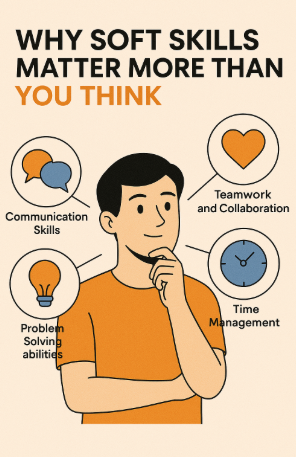
Soft Skills for Career Success are often overlooked in college—but they play a crucial role once you step into the real working world.
In college, most of us are told to focus on marks, degrees and technical skills. But when you step into the real working world, the importance of soft skills increases. It includes how you talk to people, manage situations, handle problems, and time management and you stay calm when things don’t go in your favor. Fun fact is many people don’t realize how much these skills matter till it gets too late for them.
What exactly are soft skills?
Soft skills are personal attributes, interpersonal skills, and personality traits that influence how people interact and work with others, and how they adapt to situations. It doesn’t show up on any report card or resume; instead, it shows how you act at work. A few Examples of Soft Skills are:
- Communication Skills
- Teamwork and Collaboration
- Problem Solving abilities
- Time Management
- Emotional Intelligence
Even big reports like the World Economic Forum’s Future of Jobs (2023) mention that these skills are now equally important as technical skills.
Why Are Soft Skills for Career Success Valued by Employers?
Honestly, no company wants an employee who lacks communication skills no matter how much intelligence he has in technical skills. Sometimes you might get hired for your technical knowledge but you can’t grow without soft skills because growth depends on how you communicate with people and deal with situations.
In a survey by LinkedIn, 92% of employers said soft skills are equally important as hard skills.
A great example of this scenario is Teamwork: – “If a person in a group lacks communication skills, the whole group has to suffer”.
BIG PROBLEM-COLLEGE DOESN’T TEACH THIS WELL
The truth is most of the colleges and universities are still focused towards exams and theories. Students might know how to write a report, but can they explain it confidently in a meeting? That’s where many students tend to struggle. Research from the Journal of Education and Work found that graduates often feel underprepared in areas like communication and teamwork when they join their first job. It can affect student confidence even if they are good in academics.
How Students Can Build Soft Skills for Career Success?
There are a few ideas that work to develop soft skills: –
1. Do Internships – Learn with a real-time working environment and experiences.
2. Join Clubs or Groups – It develops communication skills and time management, or leadership skills can also be developed by organizing events.
3. Practice Public Speaking – It builds confidence, and even short presentations can help boost confidence.
4. Talk to Seniors or Mentors – Talking to them they may guide you and share experiences of themselves.
These activities push you out of your comfort zone – and that’s where real learning happens.
Conclusion: Prioritizing Soft Skills for Career Success
Soft skills are not just nice to have; they are essential for success. Whether you are aiming to lead a team, manage a project, or just fit into a company’s work Culture, these skills make a difference. If our education system starts focusing on both academics and soft skills, the shift from classroom to career will become smoother for everyone.
Penned by Zaid Pathan
Edited by Ragi Gilani, Research Analyst
For any feedback mail us at [email protected]
Streamline Your Hiring with Eve Placement’s Custom Assessments
Eve Placement helps you engage, assess, and recruit top talent through tailored hiring challenges that go beyond resumes. From technical quizzes and real-world case studies to psychometric evaluations and audio/video submissions, our platform enables smarter, data-driven hiring decisions. Advanced security features ensure authenticity and eliminate fraud, giving you reliable results. Ready to hire better? Know More.
Mail us at [email protected]