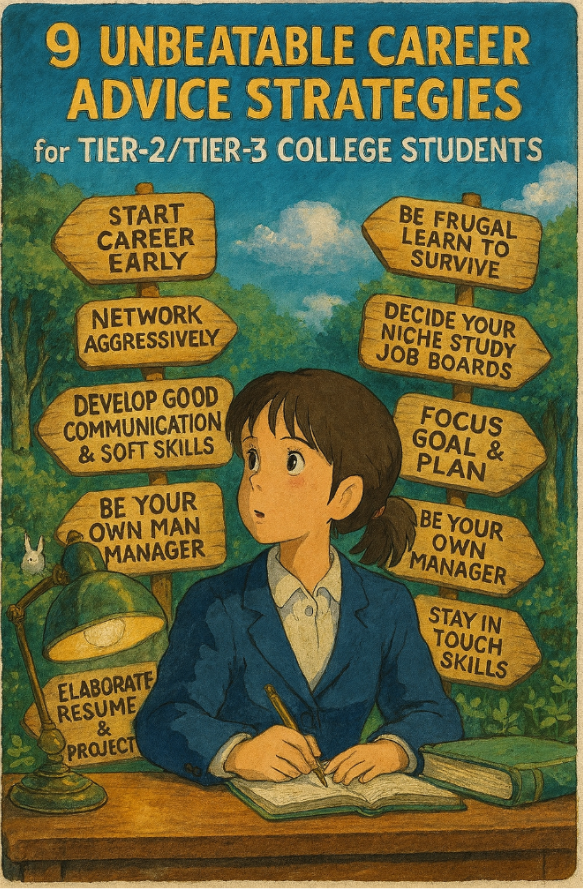
9 Unbeatable Career Advice Strategies for Tier-2/Tier-3 College Students
For millions of young individuals from India, their journey in higher education begins in Tier-2 and Tier-3 colleges, which are a crucial part of India’s university ecosystem. They offer first-generation learners, who would often encounter multiple barriers to access, a path to higher education. A widely held feeling amongst the students from these colleges, compared to students from premier universities in metropolitan cities is disadvantageous. Students know that students strengthen through alumni networks, recruiter access, industry exposure, and selection work on the university end. Students, therefore, often view their college as responsible for their exposure. Although a student’s tier does not define their abilities, it does define their resources. Even with limited resources, students with the right mindset to know their worth will seize opportunities, work towards building their employability, and seek meaningful work.
Yet the world is changing. Today’s recruiters care more about skills, initiative, problem-solving and project experience, rather than the university of brand name. Companies increasingly bring in new talent through non-campus initiatives such as internships, hackathons, creatively through freelancers, LinkedIn outreach, self-initiated skill assessments, etc. In fact, this opens a large door for ambitious young Indians, in which their career stories are not defined by the tier of their university, but by their own intentions and preparation. The following strategies blend mindset, skillset, and observable actions that lead to actual improvements in employability.
Strategy 1: Build Skills that Match Industry Needs
In today’s job market, skills are more valuable than credentials. Employers will put significantly more stock in demonstrated ability than in the name of a college. This is the single most important advice I give to students, regardless of the college level.
Identify In-Demand Skills
Review job postings for potential employers. If you are going to be in a technical role, it might include cloud computing, so look for Amazon Web Services (AWS)/Azure, data structures, and frameworks (e.g. React, Django). If you are in a non-technical role, the most common items are advanced data analysis (Tableau/Power BI), digital marketing, or analytic supply chain.
Leverage MOOCs and Certifications
This is a great time, in 2023, to take a course from companies like Coursera, edX, Udemy, or NPTEL, a great free resource from the IITs/IISc). Taking a special course or certification and learning some global certification signals to a recruiter your demonstrable interest in your career progression. Regardless of what your college had in the curriculum.
Build a Tangible Portfolio
A certification alone is not enough. You must build projects that showcase your skills. A Computer Science student should have a GitHub portfolio with live applications. A Management student should create case study analyses, marketing campaigns, or financial models. A strong, public portfolio serves as undeniable evidence of your capabilities.
Strategy 2: Create a Strong Portfolio that Speaks for You
More powerful than a mark sheet is a portfolio. Recruiters prefer evidence of application over a list of theoretical knowledge. A portfolio can take multiple forms: academic projects, personal experiments, internships, freelance work, research papers, blogs, or samples of design work. Engineers might consider GitHub repositories, mobile apps, or AI models. Students of commerce can show financial models, case studies, or market research reports, and creatives might use samples of graphic design work, videos, short films, or work samples.
Students in Tier-2 and Tier-3 colleges should consider projects to distinguish themselves from peers and attention-getting work, especially if they believe their college brand will not hold the same weight as others in securing attention and job placement recommendations.
Strategy 3: Use LinkedIn as Your Personal Branding Platform
Students from small towns often think little of LinkedIn. However, it has become a way to gain internships or contacts for internships through referrals and connections. Students should develop their profile, make learning updates, demonstrate skills through project work, and connect with people in the field. The habit of posting updates about struggles, lessons learned, or progress will help establish an online presence that recruiters certainly appreciate. There are many students from low-resource families who obtained early career jobs simply because a hiring manager discovered their work through LinkedIn. Personal branding cannot be optional anymore. It has become an integral part of today’s career choices.
Strategy 4: Gain Practical Experience Through Internships and Freelancing
Experience is the currency of the job market, and internships are the real differentiators for students in Tier-2 and Tier-3 colleges. Even a small internship provides exposure to teamwork, deadlines, communication, and problem-solving. Students should not wait for recruiters to come to campus—steps towards internship opportunities can be taken using online portals, alumni connections, college clubs, or companies that are nearby.
The Power of the PPO
A pre-placement offer (PPO) is the easiest way to receive a full-time job offer after your internship. Focus on your efforts to turn your summer or winter internship into a PPO. It is an interview that has been extended; your goal is to demonstrate to the company that you will be committed, skilled, and genuinely a great fit for the job.
Explore Remote Internships
The pandemic has normalized employees working remotely, which students in Tier-2/Tier-3 cities have benefitted from quite substantially. Companies are posting remote internships using different platforms across India, and even globally. It removes the geographical barrier to internships and allows you to gain great experience without leaving your campus to work for a company located in a metro city.
High-Quality vs. High-Stipend
Experience in a Business with High-Quality Experience vs. Paid Internship with Low-Learning: From the onset of a summer or winter internship, your focus should be on the amount of learning from that experience, and the importance of the company brand name, and recognition, all while overlooking stipend amounts. Getting a ‘high-learning’ internship experience at a well-known successful startup that is non-paid will add significantly more to your resume than an internship experience at a low-impact local company (non-national referral), no matter how much the pay was at the local company.
Freelancing is another powerful option- content writing, design, digital marketing, coding, tutoring, and video editing are skills that are needed in the current marketplace. Freelancing is a good way for students to earn money while also gaining their initial professional experience, as a function of confidence.
Strategy 5: Take the Initiative with Off-Campus Placements
Since not all universities have top companies knocking on their doors, students should seek off-campus placements. In addition to applying at job boards, students should also utilise: company websites, career portals, networking events, hackathons, placement-drive announcements, and job posts on LinkedIn. Your network is your net worth, specifically when your school’s tier+ does not provide you with automatic opportunities. Building connections is a very important aspect of career advice.
Master LinkedIn
LinkedIn is the professional portal. First, make your profile reflect your professional brand. Use a professional picture. Then, before you start applying for jobs on LinkedIn, engage. Follow people and companies you want to work for in your industry. Look for your school’s alumni who have great jobs (or are in the desired industry) and send them a personalised connection request.
Informational Interviews
Reach out to professionals, whether they are alumni of your university or not, for a brief 15-minute chat virtually. This is when you reach out and mention that you are “getting career advice” on their career path, instead of “asking for a job.” Framing your outreach in this way will build authentic rapport and trust. Ask thoughtful questions about skillsets required, industry touch points, trends, etc….
Attend Industry Events
Even if you cannot travel to a large metro city, look for virtual events, webinars, and meet-ups that are relevant to your field. These are types of events that give you exposure with the opportunity to engage this audience and recruiters, and hiring managers!
Strategy 6: Improve Communication and Soft Skills
Soft skills can often be the deciding factor in selection or rejection for a position. Students must learn how to convey their ideas clearly and confidently, speak eloquently, write professionally, and understand proper workplace etiquette.
While being fluent in English helps, clarity is much more important than accent or perfection. Students can improve their communication skills by reading out loud, watching interviews, joining a club, debating in person or online, or taking free online courses. Communication is a fundamental skill because it helps all levels of people get a job, no matter what tier of college they go to.
The interview is where the playing field is truly level. Prepare thoughtful answers to behavioural questions (ex, “Tell me about a time when you encountered a challenge?”) or a similar situation. Be excited about the opportunity, make eye contact, and be confident. Be willing to start in a smaller city or a smaller company. The first job is about gaining experience and skills; the next job is when, depending on the name of your college, it disappears altogether. The first few years will affect your future career, no matter how long it takes. Your first offer letter will not determine your career trajectory.
Strategy 7: Build a Network that Supports Growth
Networking means developing tangible relationships with classmates, professors, alumni, professionals, and mentors, rather than being connected to individuals with big names. Students can engage with online communities, webinars, alumni messaging on LinkedIn, and volunteering for events. A strong network presents opportunities. Door referrals by alumni can open doors when job placements will not. Networking becomes a major part of practical career advice if you are in a Tier-2 or Tier-3 college. Your professors may be lanyards in a Tier-3 college, but they possess professional experience and a network. Ignoring them as not just lecturers, but educators and professional youth gatekeepers towards things meaningful to your career.
Research Projects
Volunteering to assist your professors is a demand and responsibility towards your research or publication projects. You are not just proving initiative; you should demonstrate your understanding of advanced problem-solving, while also, and importantly, showcasing that you can use that experience to provide evidence of record in your resume.
Reference Letters
One of the most important things to secure is a strong Letter of Recommendation (LOR) from a respected HOD or professor. This letter is often demanded by post-graduate college applications or a direct job application. If you form a strong relationship by being proactive and showing a command of academic curiosity, they can help you make your case with a letter.
Strategy 8: Focus on Competitive Exams if they Align with Your Goals
Many students from smaller colleges build stable careers through government exams, banking exams, SSC, UPSC, teaching eligibility tests, or state service exams.
If students have the interest and discipline required for competitive exams, they can choose this path early and design a structured routine. It is important to understand exam patterns, coaching options, and required study hours. Competitive exams reward persistence, not college tier.
Strategy 9: Stay Adaptable and Mentally Strong
The journey from a Tier-2 or Tier-3 college to a successful career is not linear. There will be rejections, delays, and confusion. Many students take longer than others to find their first job. The key is mental resilience and adaptability.
Students should set realistic expectations, stay consistent with skill-building, and be open to alternative paths like internships, fellowships, apprenticeships, startups, teaching, research, or freelancing.
A career is a long-term journey. What matters is not where you start but how you progress.
Conclusion
Guidance for students attending a Tier-2 or Tier-3 college ought to be real-world, enabling, and implementable. The constraints of college facilities or placement processes are real–but they do not determine a student’s destiny. With the right combination of skills, projects, internships, networking, communication, off-campus initiatives, and flexibility, students can compose viable career strategies in other sectors of work. Today, India’s youth generate more opportunities than any prior generation has experienced. With clarity, consistency, and confidence, they will be fine. The future succeeds or fails according to the skilled and the flexible, and so this guidance is a blueprint for their careers. Even if you favour the starting point of a specific college tier, it does not define the destination. With sufficient effort and by employing the guidance in this article, every student can become the author of a career story that accurately reflects their ambition rather than their college’s brand.
References
[1] “India Skills Report,” Wheebox. [Online].
Available: https://wheebox.com
[2] “Employment Outlook in India,” Ministry of Labour and Employment. [Online].
Available: https://labour.gov.in
[3] “Recruitment Trends in Indian Colleges,” National Skill Development Corporation. [Online].
Available: https://nsdcindia.org
[4] M. Kulkarni and A. Sharma, “Bridging the Skill Gap: A Study on Employability in Indian Higher Education,” Journal of Technical Education and Training, vol. 12, no. 1, pp. 45–56, 2023.
[5] “Role of Online Certifications in Enhancing Employability of Engineering Graduates,” All India Council for Technical Education (AICTE) Report, New Delhi, India, 2022.
[6] R. V. Prakash, “The Impact of GATE Score on PSU Recruitments in India,” Indian Journal of Engineering Education, vol. 15, no. 3, pp. 112–120, 2021.
[7] S. K. Mitra, “The Gig Economy and its Potential for Indian College Students,” Economic and Political Weekly, vol. 58, no. 18, pp. 34–40, 2023.
FAQs :-
1. What is Career Guidance for Tier-2 and Tier-3 College Students and why is it important?
Career Guidance for Tier-2 and Tier-3 College Students is important because it helps students understand how to build skills, improve employability, and overcome resource limitations. Career Guidance for Tier-2 and Tier-3 College Students ensures that learners from smaller institutions do not feel disadvantaged and can still compete with students from top-tier universities.
2. How can Career Guidance for Tier-2 and Tier-3 College Students help in improving job opportunities?
Career Guidance for Tier-2 and Tier-3 College Students helps improve job opportunities by guiding students toward skill development, internships, projects, and off-campus placement strategies. With proper Career Guidance for Tier-2 and Tier-3 College Students, learners can showcase their abilities through portfolios and secure roles based on merit.
3. What skills should students focus on under Career Guidance for Tier-2 and Tier-3 College Students?
Under Career Guidance for Tier-2 and Tier-3 College Students, learners should focus on in-demand skills such as data analysis, cloud computing, digital marketing, communication skills, and coding frameworks. Career Guidance for Tier-2 and Tier-3 College Students encourages students to match their skillset with industry requirements.
4. How does a strong portfolio support Career Guidance for Tier-2 and Tier-3 College Students?
A strong portfolio plays a major role in Career Guidance for Tier-2 and Tier-3 College Students because it gives visible proof of skills. Career Guidance for Tier-2 and Tier-3 College Students highlights that recruiters value projects, GitHub code, case studies, and creative samples more than theoretical marks.
5. Why is LinkedIn crucial in Career Guidance for Tier-2 and Tier-3 College Students?
LinkedIn is crucial in Career Guidance for Tier-2 and Tier-3 College Students since it helps build professional visibility. Career Guidance for Tier-2 and Tier-3 College Students emphasises using LinkedIn for networking, showcasing achievements, and finding off-campus internships and job opportunities.
6. How do internships contribute to Career Guidance for Tier-2 and Tier-3 College Students?
Internships are essential in Career Guidance for Tier-2 and Tier-3 College Students because they provide real-world exposure and practical experience. Career Guidance for Tier-2 and Tier-3 College Students teaches students to prioritise learning-rich internships and use them to secure PPO opportunities.
7. How does networking support Career Guidance for Tier-2 and Tier-3 College Students?
Networking strengthens Career Guidance for Tier-2 and Tier-3 College Students by helping learners build relationships with alumni, professors, industry mentors, and recruiters. Career Guidance for Tier-2 and Tier-3 College Students shows that strong networks can provide referrals, internships, collaborations, and job leads.
8. What role does communication play in Career Guidance for Tier-2 and Tier-3 College Students?
Communication skills are a major part of Career Guidance for Tier-2 and Tier-3 College Students because interviews, teamwork, and workplace success depend on clarity. Career Guidance for Tier-2 and Tier-3 College Students recommends regular practice through reading, speaking, and participating in clubs to build confidence.
9. Can competitive exams be part of Career Guidance for Tier-2 and Tier-3 College Students?
Competitive exams are indeed part of Career Guidance for Tier-2 and Tier-3 College Students since they offer structured career paths in government, banking, and public sector roles. Career Guidance for Tier-2 and Tier-3 College Students encourages students to pursue exams if their strengths align with disciplined study.
10. How can Career Guidance for Tier-2 and Tier-3 College Students help students stay motivated?
Career Guidance for Tier-2 and Tier-3 College Students helps students stay motivated by reminding them that success depends on skills, consistency, and adaptability—not college tier. Career Guidance for Tier-2 and Tier-3 College Students builds a growth mindset so that learners remain resilient despite challenges.
Penned by Pranjali
Edited by Meghna Chaturvedi, Research Analyst
For any feedback mail us at [email protected]
Streamline Your Hiring with Eve Placement’s Custom Assessments
Eve Placement helps you engage, assess, and recruit top talent through tailored hiring challenges that go beyond resumes. From technical quizzes and real-world case studies to psychometric evaluations and audio/video submissions, our platform enables smarter, data-driven hiring decisions. Advanced security features ensure authenticity and eliminate fraud, giving you reliable results. Ready to hire better? Know More.
Mail us at [email protected]