How Personal Websites Help Students Show their Projects in the Realest Way
Introduction
Over the last couple of years, students have started putting their work online instead of just talking about it in a résumé. A student website basically becomes one place where everything—projects, internships, certificates and even mistakes and learning journeys—can be shown properly. It feels way more honest than a single sheet of paper because anyone who sees it can actually check whether the student has done what they claim.
Why Digital Proof Matters More than Words
When people apply for jobs or internships, everyone writes similar lines like “I know Java,” “I am good at design,” or “I have leadership skills.” Recruiters don’t know who is telling the truth. But when there is digital proof on a portfolio website — such as a working project demo, GitHub code, or a video walkthrough — there is no confusion. A student website removes the guessing part and shows what the student has actually built, not just what they hope to do someday.
Recruiters Prefer Checking the Website First
During screening, companies don’t have time to analyse every résumé in detail. So instead of imagining what a student might be capable of, they simply click the project links on the website. This speeds up decisions a lot. For example, someone applying for a UI/UX role can add Figma prototypes or case studies. A software person can add repos and live demos. Since everything is already there as digital proof, the recruiter gets a clear picture without repeatedly asking for documents or samples.
More than Projects — It Becomes a Personal Identity
Some students write short blogs about how a project idea came, why they failed in the first attempt, or what bugs took hours to fix. These honest details show growth over time. Slowly, a student website becomes not just a portfolio but a mirror of how the student thinks and works. Recruiters often say that genuine reflections and improvements tell them more than one perfect “polished” project. That’s the power of having digital proof that shows the whole journey, not only the final result.
Creating a Portfolio has Become Easier than People Think
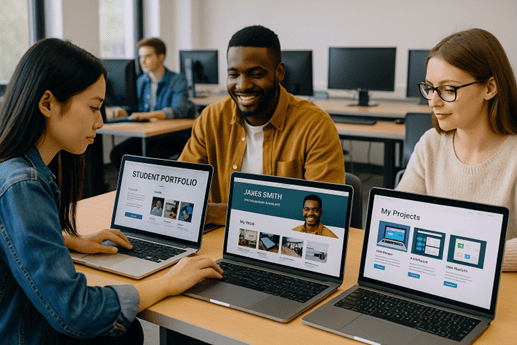
Most students assume building a website requires hardcore programming, but that is not true anymore. Tools like Notion, Google Sites, Wix and Canva help even non-coders build a good portfolio in a few hours. Students who know coding can customize using HTML, CSS, JS or React. The platform doesn’t matter as much as the content. A simple student website with real digital proof of projects is 10 times stronger than a fancy website with nothing meaningful inside.
Conclusion
Personal websites are slowly becoming the new standard for applications. Whether someone wants a job, internship or admission for higher studies, having a student website that shows digital proof of work makes the student stand out immediately. It shows effort, learning, improvement and originality — things that a CV alone can never show.
References
[1] A. Lu, “Why Every Student Needs a Portfolio Website,” Medium, 2024. [Online].
Available: https://medium.com/@annalu_portfolio/why-every-student-needs-a-portfolio-website-2024
[2] GitHub Education, “Building an Online Student Portfolio,” GitHub Student Guide, 2025. [Online].
Available: https://education.github.com/experiences/building-a-student-portfolio
[3] J. Walker, “Digital Identity and Employability: The Rising Value of Personal Websites,” CareerLaunch Review, 2025. [Online].
Available: https://careerlaunchreview.com/personal-websites-student-employability
[4] T. Rivera, “How Recruiters Evaluate Project Portfolios,” Hiring Insights Journal, 2025. [Online].
Available: https://hiringinsightsjournal.com/evaluating-digital-portfolios
Success Tips for Student Portfolios FAQ
- Why are personal websites better than a PDF résumé?
Unlike static PDFs, personal websites allow for interactive elements and live links that prove your skills in real-time. - What provides the best digital proof for a coder?
Linking to active GitHub repositories and hosting live project demos provides the strongest digital proof for technical roles. - Can non-technical students create personal websites?
Yes, tools like Notion and Canva allow anyone to build personal websites without writing a single line of code. - How does digital proof affect recruiter trust?
It removes doubt. When a recruiter sees a working model, they have digital proof that you can actually do the job. - Should I list my failures on personal websites?
Yes! Documenting how you solved a bug or handled a project failure shows growth and maturity. - How often should I update my personal websites?
You should update them after every major project or internship to ensure your digital proof stays current. - Are personal websites expensive to maintain?
Not necessarily. Many platforms offer free versions that are perfect for hosting student portfolios. - Can I use personal websites for university applications?
Absolutely. Admissions officers value seeing a portfolio that provides digital proof of your extracurricular work. - What is the first thing recruiters look for on personal websites?
They usually look for a “Projects” section where the most impressive digital proof is displayed clearly. - Do personal websites help with personal branding?
Yes, they act as a central hub for your professional identity and help you control your online presence. - Should I include certificates on personal websites?
Yes, certificates serve as secondary digital proof of your specialized training and dedication. - What makes personal websites stand out?
A clean layout and easy navigation to your projects make personal websites much more effective. - Is a LinkedIn profile enough, or do I need personal websites?
While LinkedIn is great for networking, personal websites give you more creative freedom to show deep-dive case studies. - How do I drive traffic to my personal websites?
Include the link in your bio and at the top of your physical résumé. - Can I include video content as digital proof?
Yes, video walkthroughs of your projects are excellent forms of digital proof that engage recruiters quickly. - Is it okay to use templates for personal websites?
Yes, using a template is fine as long as the content and the digital proof you provide are original. - Should I write blogs on my personal websites?
Blogging about your field shows thought leadership and adds more depth to your professional identity. - What is the most important section of personal websites?
The “Featured Projects” section is vital because it houses your most relevant digital proof. - How do personal websites show “soft skills”?
By explaining how you worked in a team, you provide digital proof of leadership and communication. - Will personal websites be the future of hiring?
They are already becoming the standard, as companies move toward verified digital proof.
Penned by Gursimar
Edited by Anuj Kumar, Research Analyst
For any feedback mail us at [email protected]
Streamline Your Hiring with Eve Placement’s Custom Assessments
Eve Placement helps you engage, assess, and recruit top talent through tailored hiring challenges that go beyond resumes. From technical quizzes and real-world case studies to psychometric evaluations and audio/video submissions, our platform enables smarter, data-driven hiring decisions. Advanced security features ensure authenticity and eliminate fraud, giving you reliable results. Ready to hire better? Know More.
Mail us at [email protected]