
Revolutionary Virtual Reality in Corporate Training
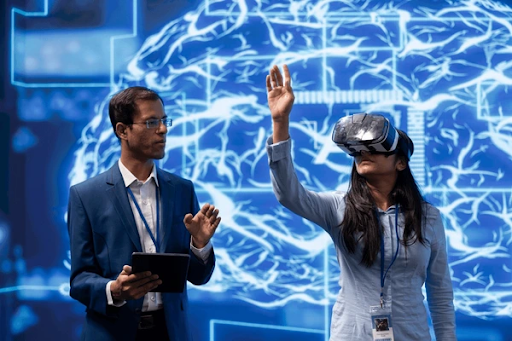
Topics: VR training, immersive learning
The Future of Corporate Training through Virtual Reality: A New Era of Learning
In today’s fast-changing corporate world, traditional training methods like classroom sessions and PowerPoint presentations have become a thing of the past. Nowadays, companies use technologies to train their workforce; one of the most innovative approaches is VR training. It is a technology that gives an immersive learning experience to employees, where they learn or seek virtual simulation of real-life situations.
What is VR Training?
The meaning of VR Training is to create a realistic environment through a virtual reality headset, where employees can practice without risk in the real world. Like, if any employee seeks the operation of machinery in a factory, then he/she can take their real-time experience only in a virtual environment.
Why Do Companies Adopt VR Training?
Nowadays, the workforce has become diverse and dynamic. Every company wants its employees to be adaptable and efficient. Immersive learning technology, like VR, becomes the perfect solution for all these challenges.
Major Benefits of VR Training
- High Engagement: When employees wear a headset and enter the virtual world, their focus and interest in training content automatically increase.
- Better Retention: Because of the “Learning by doing” approach, employees will remember concepts for a long time.
- Safe Environment: Real mistakes can be costly in high-risk industries like aviation, construction, or healthcare. In a VR environment, only those situations can be simulated that existed without any actual risk.
- Cost and Time Saving: Once the VR Training module is developed, this can be used for multiple locations and batches. Both travel and trainer costs are reduced.
- Data-Driven Feedback: VR systems track real-time performance – like decision making, timing, and accuracy. Through this data, personalized training plans can be made.
Role of Immersive Learning
The main goal of immersive learning is to involve the learner in content. When an employee will face a virtual world in real-life situations, then he/she is engaged in both emotional and mental ways.
For example, a sales executive can practice their pitch in front of a virtual client. Or, a healthcare trainee can perform a simulated surgery. Through these scenarios, employees build confidence and enhance their decision-making skills.
Instead of this, immersive learning helps in developing soft skills like communication, leadership, and empathy. Through virtual interactions, employees improve their interpersonal skills – without real-world pressure.
Experience of Real Companies
Nowadays, the world’s top companies use VR Training for their workforce development.
- Walmart trains its employees in VR for customer service and emergency response.
- Boeing uses VR for their practice of aircraft assembly to their technicians, without any wastage of actual parts.
- KFC created a VR game in which new hires learn the cooking steps in a virtual kitchen.
- Deloitte and PwC use immersive simulations for enhancing their employees’ leadership and teamwork skills.
These examples proved that VR is not just an experience; it has become a proven learning tool.
Future of VR Training
In the coming years, VR Training will become more accessible and advanced. By the integration of AI (Artificial Intelligence) and AR (Augmented Reality) learning experience becomes personalized.
Imagine an employee gets a real-time virtual coach who gives feedback according to the employee’s performance – this future is not far from now. Immersive learning is also an important part of the corporate learning strategy.
Conclusion
VR Training changes the full system of corporate training. This is not just a technology; it is an experience through which an employee learns and grows. VR Training provides flexibility to employees, and through immersive learning, companies will also make their employees smarter, confident, and future-ready.
With the changing digital era, it becomes necessary for organizations to adopt VR Training in order to sustain their competitiveness and innovation.
FAQs
1. What is VR training in corporate learning?
Employees practice real-world tasks in safe virtual simulations, building confidence and practical skills.
2. How does immersive learning improve development?
Interactive training engages employees in realistic scenarios, improving retention and decision-making.
3. Why do companies adopt VR-based programs?
Organizations reduce risk, save costs, and provide engaging, experiential learning opportunities.
4. Which skills benefit most from virtual reality sessions?
Leadership, communication, technical tasks, and problem-solving skills all improve through simulations.
5. Can VR-based programs replace traditional methods?
They complement classroom or online training by providing hands-on, realistic experiences.
6. How does VR save time and money?
Reusable modules allow multiple teams to train simultaneously, reducing travel and instructor costs.
7. Which industries use VR simulations?
Healthcare, aviation, manufacturing, retail, and corporate sectors benefit from virtual learning programs.
8. How is training effectiveness measured?
Metrics like performance, accuracy, and engagement are tracked to improve learning outcomes.
9. Can soft skills be improved in VR programs?
Yes—communication, leadership, and teamwork are strengthened through interactive simulations.
10. What’s the future of virtual reality learning?
AI integration will create adaptive, personalized experiences for employees worldwide.
References
[1] FV/PwC, “The Effectiveness of Virtual Reality Soft Skills Training in the Enterprise, ”Future Visuals, 2020. [Online]
Available: https://www.futurevisual.com/blog/pwc-study-virtual-reality-training-enterprises/
[2] Harvard Business Review, “How VR is Revolutionizing Employee Training,” Harvard Business Review, 2020. [Online].
Available: https://hbr.org/sponsored/2020/09/how-vr-training-can-help-turn-employees-into-leaders
Penned by Sanskriti Goyal
Edited by Preksha Khatod, Research Analyst
For any feedback mail us at [email protected]
Streamline Your Hiring with Eve Placement’s Custom Assessments
Eve Placement helps you engage, assess, and recruit top talent through tailored hiring challenges that go beyond resumes. From technical quizzes and real-world case studies to psychometric evaluations and audio/video submissions, our platform enables smarter, data-driven hiring decisions. Advanced security features ensure authenticity and eliminate fraud, giving you reliable results. Ready to hire better? Know More.
Mail us at [email protected]