Meta Description: Learn the basics of green finance, green bonds, sustainable investing and the skills finance aspirants need to understand sustainability-focused financial products. Primary Keyword: green finance Secondary Keyword: sustainable investing
Image Source: pexel.com
Financial decisions influence which businesses grow, which projects receive funding and how resources are used. Traditionally, many investment decisions have focused on financial returns, risk and the time needed to recover an investment. Increasingly, investors and institutions are also examining environmental and social considerations.
For finance students, understanding green finance can provide a useful introduction to an area that connects investment, banking, public policy and environmental goals. However, it is important to learn how these products work rather than assuming that every product labelled green is automatically beneficial or risk-free.
1. Understand the Meaning of Green Finance Green finance refers broadly to financial products, investments and funding arrangements that support eligible environmental objectives. These may include renewable energy, energy efficiency, clean transportation, pollution prevention and other projects that meet relevant criteria.
The exact activities considered eligible depend on the framework used by the issuer or financial institution. Investors therefore need to examine the purpose of the funding, the criteria applied and the information available about how the money is used.
2. Learn How Green Bonds Work A green bond is a debt instrument issued to raise funds for eligible green projects. Investors purchase the bond, and the issuer agrees to make payments according to the bond’s terms.
The issuer may be a government, company or other eligible organisation. The specific structure, maturity, interest payments and risk depend on the bond.
India has a Sovereign Green Bond Framework published by the Ministry of Finance. It sets out how eligible government expenditure can be selected and how proceeds from sovereign green bonds are tracked and allocated.
3. Understand Sustainable Investing Sustainable investing considers environmental, social and governance factors alongside traditional financial analysis. Different investors use different approaches. Some may avoid particular industries, while others may select companies with stronger sustainability practices or invest in projects designed to address specific environmental challenges.
Sustainable investing does not always mean choosing the investment with the strongest environmental claims. Investors still need to examine valuation, financial performance, risk, liquidity and their own investment objectives.
4. Know Why Reporting and Transparency Matter A major concern in sustainable finance is greenwashing. This happens when a company, product or project creates a misleading impression about its environmental benefits.
Clear criteria, transparent reporting and suitable review processes help investors understand what a financial product is intended to support. For green bonds, investors may examine the framework, eligible project categories, allocation reporting and any available impact reporting.
5. Explore Careers in Sustainable Finance Sustainable finance can connect with several established finance careers. Depending on their skills and qualifications, professionals may work in ESG research, investment analysis, sustainability reporting, green-bond research, risk management, banking or advisory services.
Some roles focus on analysing company disclosures and evaluating sustainability-related risks. Others may involve checking project eligibility, preparing reports, reviewing data or supporting financial transactions.
6. Develop a Practical Learning Plan Students do not need to master every sustainability framework at once. A structured learning plan can make the subject easier to approach.
Start by learning the basics of bonds, including principal, maturity, coupon payments, yield and credit risk. Next, study the difference between green finance, broader sustainable finance and ESG analysis.
Then read India’s Sovereign Green Bond Framework and identify the sections covering eligible expenditure, selection procedures and the management of proceeds. Compare these with the information published in an issuer’s own bond documents when available.
Conclusion Green finance and green bonds provide ways to connect financial resources with environmental objectives. Sustainable investing also encourages investors to consider sustainability-related information alongside financial performance, risk and long-term goals.
For finance aspirants, the best starting point is to understand basic investment concepts, learn how green bonds work and practise evaluating information from credible sources. These foundations can help students explore future opportunities in investment analysis, banking, ESG research and sustainability-related reporting.
References
[1] Government of India, Department of Economic Affairs, “India: Sovereign Green Bond Framework.” Available: https://dea.gov.in/framework-sovereign-green-bonds
[2] Government of India, Department of Economic Affairs, “Sovereign Green Bonds Impact Report 2022–23.” Available: https://www.dea.gov.in/reports-additional-reports
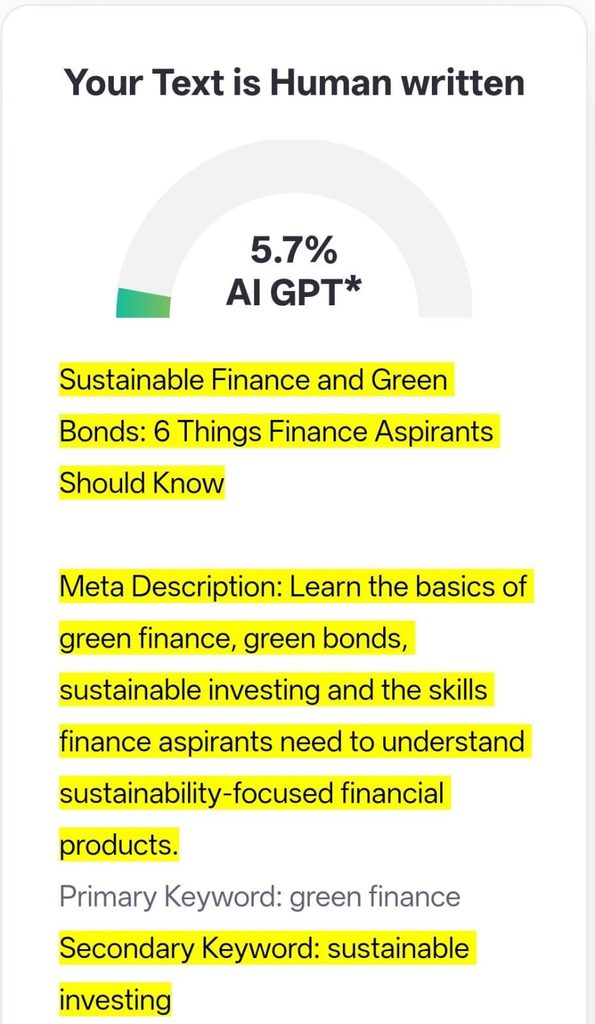
AI Detection Score:
Plagiarism Score:

Grammarly Score: